12 October
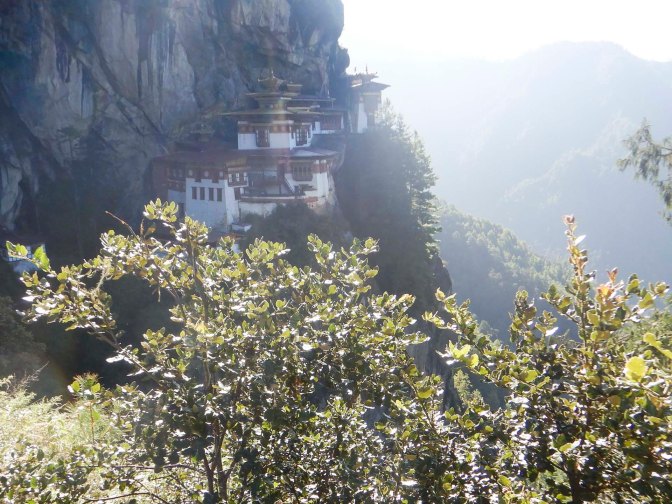
The Tiger’s Nest Monastery sited around 3,120m above sea level, about 900m higher than the town of Paro and 609m up a cliff overlooking the Paro Valley is one of the most iconic buildings in Bhutan. We couldn’t visit the country without making the visit. Besides which, the walk from the car park (about 2,600m above sea level) formed a recommended acclimatisation hike prior to setting off on our main trek.
We had an early start, taking a packed breakfast box and leaving the hotel at 05.30am, with the temperature only 3 degrees above freezing, so we’d avoid a lot of the crowds and not have to climb during the hottest part of the day.
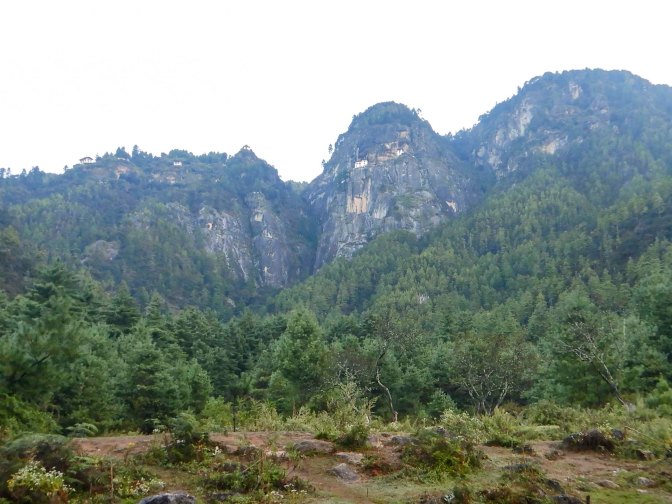
We had an initial glimpse of the monastery, perched far above us on the cliffs. It looked a long way up and in an entirely inaccessible and impossibly precarious position.
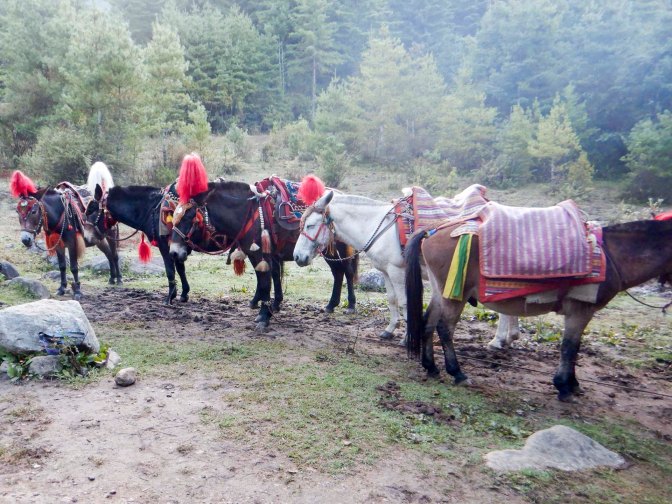
Horses were already waiting to carry tourists as far as the café at 2,940m and just over halfway from the car park to the monastery. From there everyone has to walk. However, we were all walking the whole way and set off up the hill passing through a pine forest, hearing the music of laughing thrushes as we climbed.
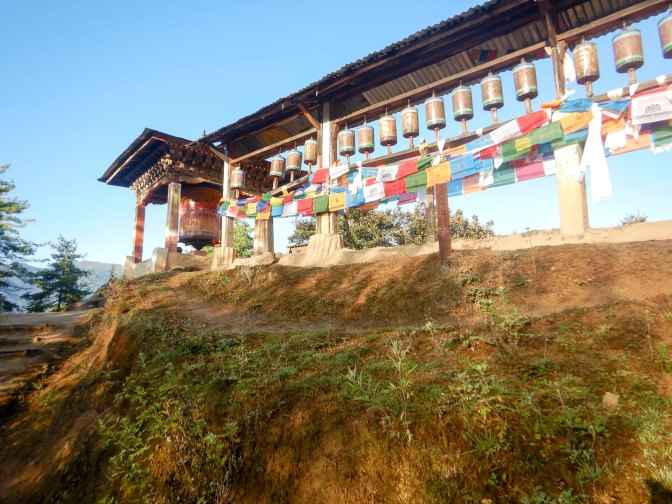
There were further glimpses of the Tiger’s Nest as we approached some colourful prayer flags fluttering in the breeze together with a line of prayer wheels.
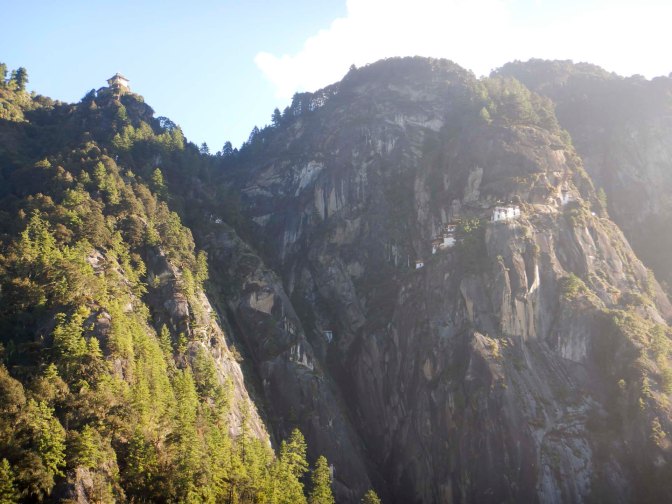
We had arrived at the café, where we sat on the balcony to enjoy refreshments and further views of the Tiger’s Nest itself, still appearing completely inaccessible.
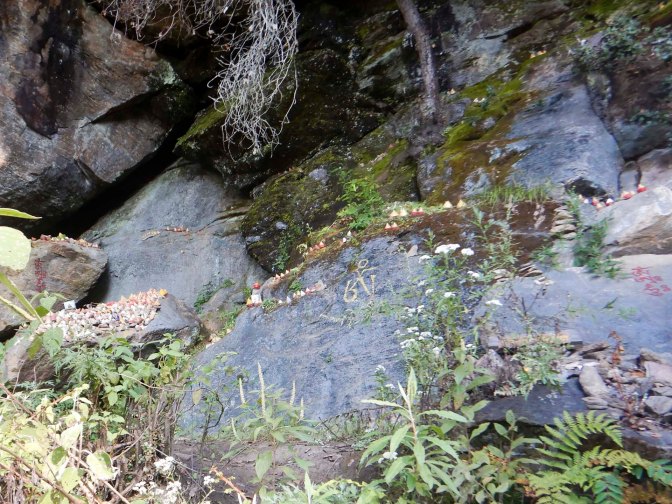
The break was over and we continued to ascend, passing ledges in the cliff filled with hundreds of miniature stupas. These are “tsha tsha” containing ash from cremation mixed with clay and water to form a paste and placed by relatives and friends in significant holy places. We were going to become used to seeing these as we travelled through Bhutan.
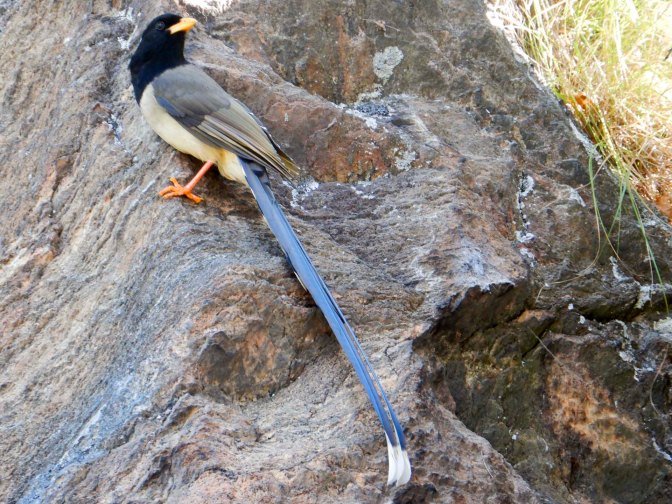
We passed some ancient hemlock and oak trees; not English oak but a Himalayan variant with a leaf different from the one with which we are familiar. Our guide pointed out some indigo plants – used as a natural dye. We also saw long-tailed magpies and were fortunate when one decided to pose on the cliff for us!
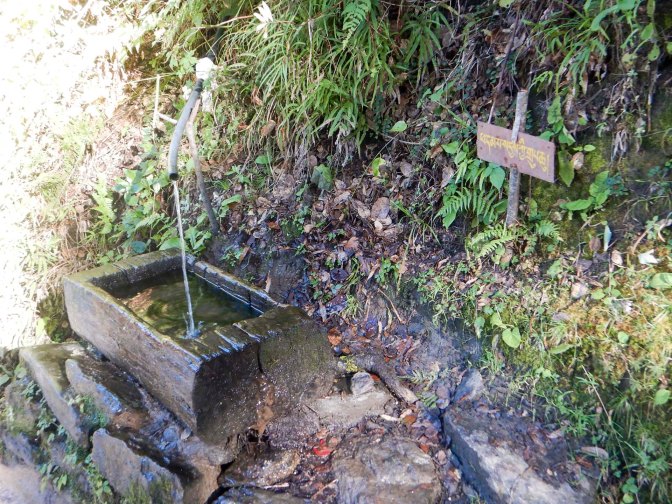
We saw various sacred sites as we ascended including the birthplace of a previous Chief Abbot of Bhutan and a holy spring.
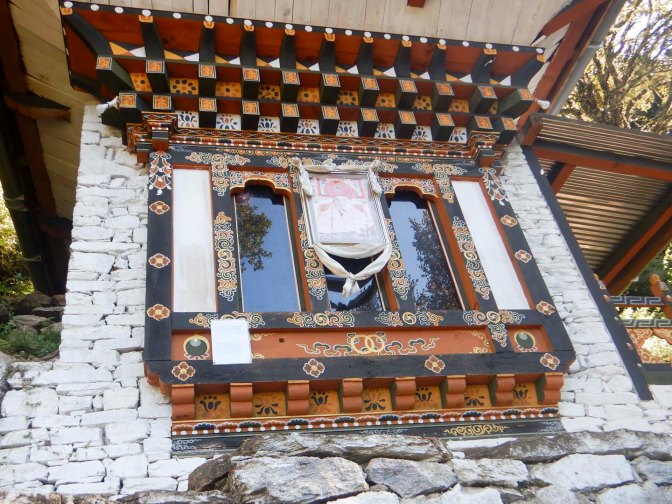
We saw further views of the Tiger’s Nest at the highpoint of the path (3,140m).
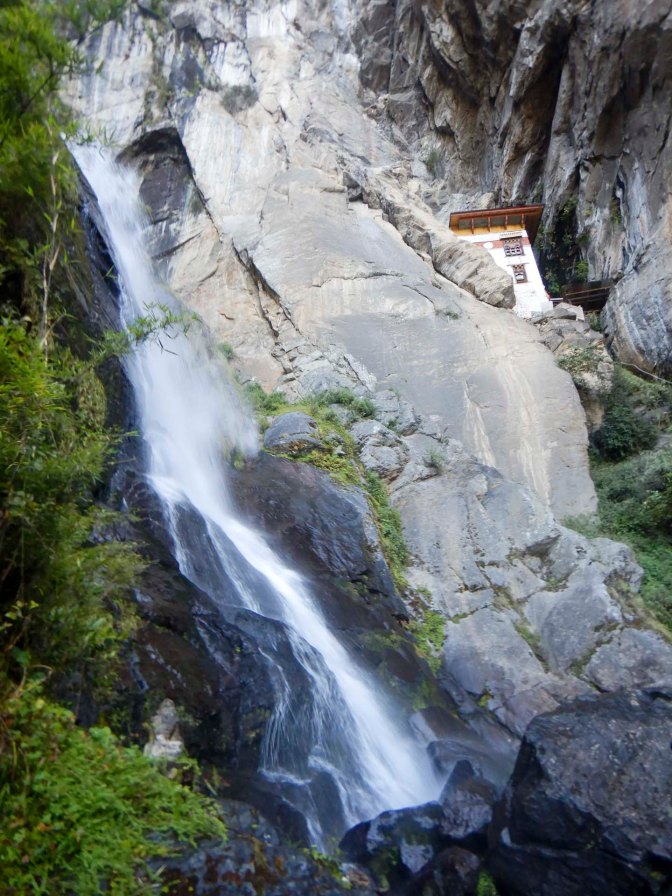
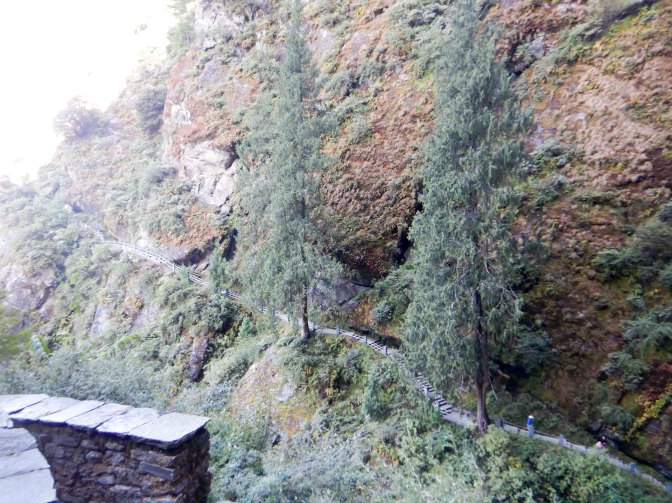
In order to reach the monastery we had to descend on the path to cross a deep ravine-like valley by a waterfall.
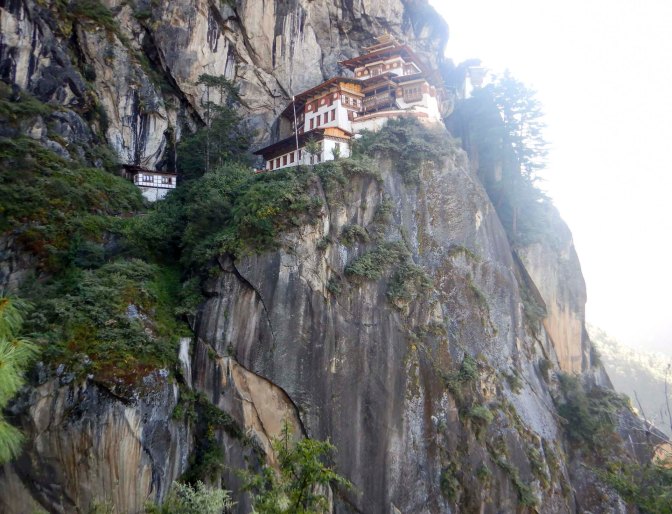
From the waterfall, there was a final ascent to reach the entrance of the monastery at around 3,120m.
No hats, cameras, phones, rucksacks or trekking poles are permitted in the monastery complex so we had to deposit everything in lockers.
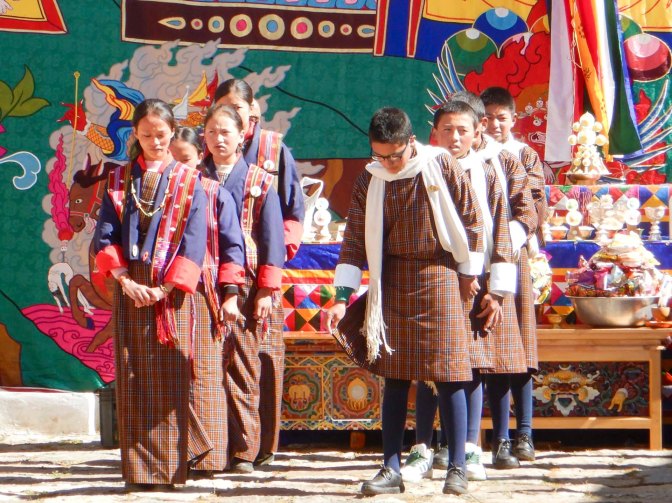
It was important that we were all wearing clothing which covered both our arms and our legs. Bhutanese people have to wear National Dress in order to enter holy places as well as for any formal occasions or meetings, for school uniform, in Government buildings and to attend festivals; hence our guide was dressed in his gho – a knee‑length robe wrapped and belted at the waist with a kera, white cuffs, and a scarf of colour denoting rank ranging from white for ordinary citizens and visitors to saffron only worn by His Majesty the King and the Je Khenpo (Chief Abbot). A large fold of the gho forms a convenient and large pocket.
We were fortunate to be told that we could enter eight of the nine temples with our guide. Of course our shoes had to be removed and left outside each temple. At the first temple, we saw an image of one of the eight manifestations of Guru Rimpoche flying to the Tiger’s Nest on the back of a tigress in order to defeat five demons who were opposing the spread of Buddhism in Bhutan. Having arrived at the Tiger’s Nest he had meditated in a nearby cave for three months.
We visited a very holy temple where we all sat down then our guide prostrated and made an offering. He explained to us that there are seven bowls of holy water all coloured by saffron placed on the altar. The bowls are positioned and filled with water each morning to represent the seven offerings which must be made to Buddha and the deities: food, drink, water for washing, flowers and incense to please the senses, a butter-lamp for light and perfume. He explained that most people have an altar in their house and it’s a morning routine in Bhutanese households to fill them all with water in this way.
In the next temple, there was a hole with three corners – in the shape of a ceremonial dagger.
Nest we went into a temple where there was a gold image of the Thai Buddha.
We visited a temple depicting the Buddha for wealth (seen with a mongoose) and then the temple with a Buddha for long life followed by the Buddha for compassion with eleven faces although this Buddha can have other manifestations. Finally we visited the temple where we saw a scene depicting the Buddha born without conception from a drop of water on a lotus leaf.
We were rapidly realising that Buddhism is a complicated and confusing religion as we tried to understand all the information we were given about Buddhas, deities, gurus, manifestations, treasure finders, reincarnations, descendants and more.
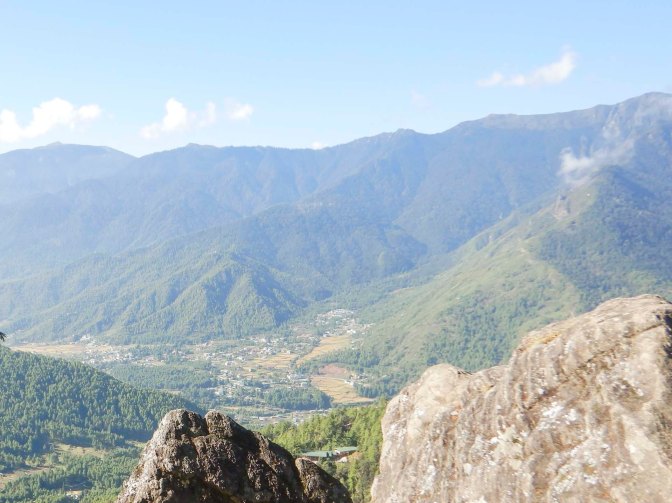
There followed the walk back down to the car park and we were able to enjoy the amazing views again as we descended. There were many more people ascending – we had definitely been well advised to start early to in order to avoid both the crowds and the hotter weather.


