26 March – 4 April 2026
Having completed warden training in March 2025 and volunteered as hostel warden for a week in July 2025, this was my second stint as warden at Ty’n Cornel, billed as the most remote hostel in Wales. I actually volunteered for a week in January but the hostel had to be closed because there wasn’t safe access in the ice and snow.
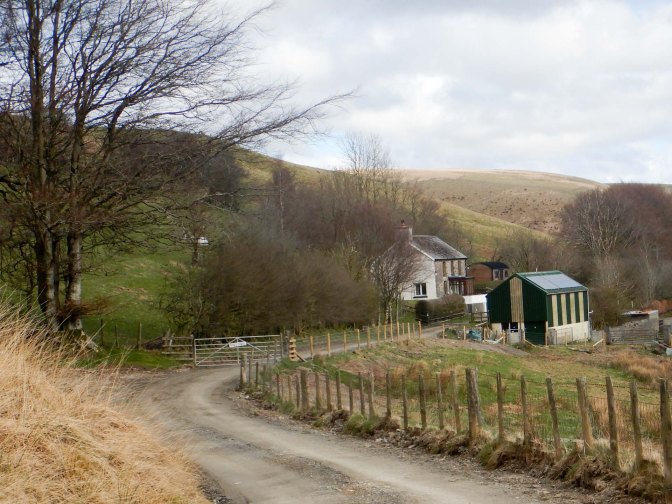
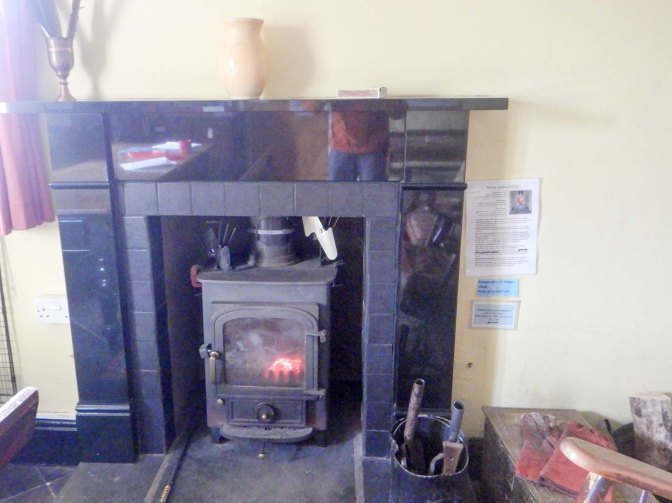
On this occasion, I didn’t have bookings every night so, in addition to my duties, I spent time exploring the area. Besides which, the hostel was cold except in the evenings when I lit the log fire. Once I was happy that everything was shipshape it was definitely better to be out and about keeping warm by being active, especially when the weather was dry.
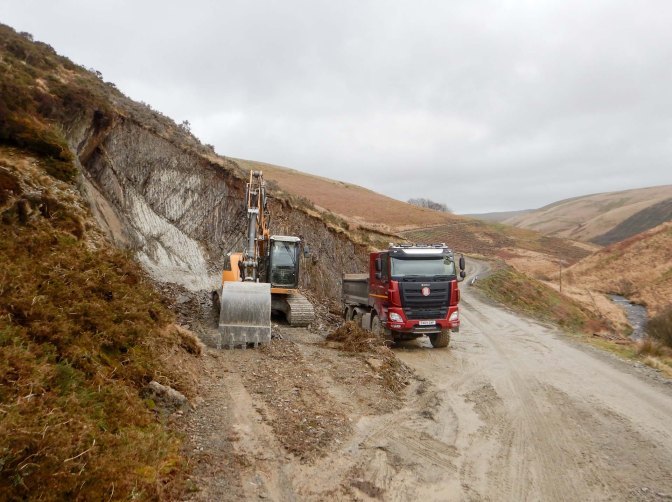
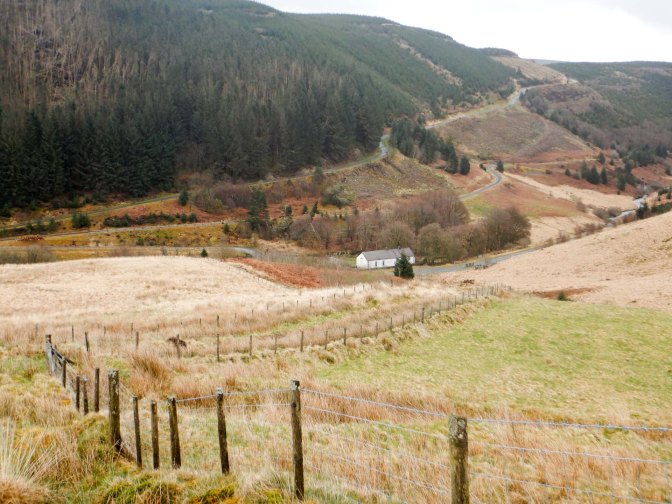
Much forestry work is ongoing at the moment with new planting as carbon offset projects. This work with vehicles passing has made the “road” to the hostel much more muddy. However, the silver lining is that many of the potholes have been filled in following damage by the forestry vehicles so actually it was less of an ordeal for me to reach the hostel in my Peugeot 107 than it had been last summer. Driving along the road took some planning to try to avoid times when the lorry was transporting and depositing stones and the digging machine was working on moving the stones into position.
At this time of year, before the bracken has grown, the paths are actually all much easier to follow and I also completed some exploration on routes without paths across the tussocky open moor.
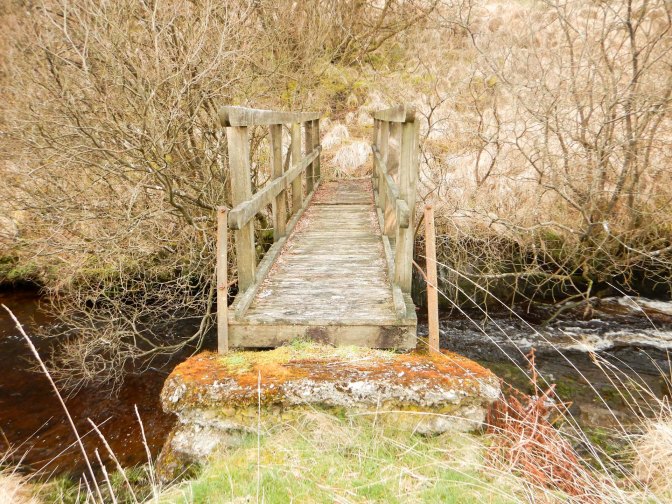
My first “all day” outing started by crossing the Doethie Fawr on a footbridge only a few hundred metres from the hostel. I followed a path which became indistinct in the woodland. There were views back over the valley. I crossed a main track and then squeezed between planted trees to emerge on moorland. I definitely strayed from the path on to animal tracks and pathless sections but still left the moorland at a bridle path sign near Bryn Ambor Farm as I had planned.
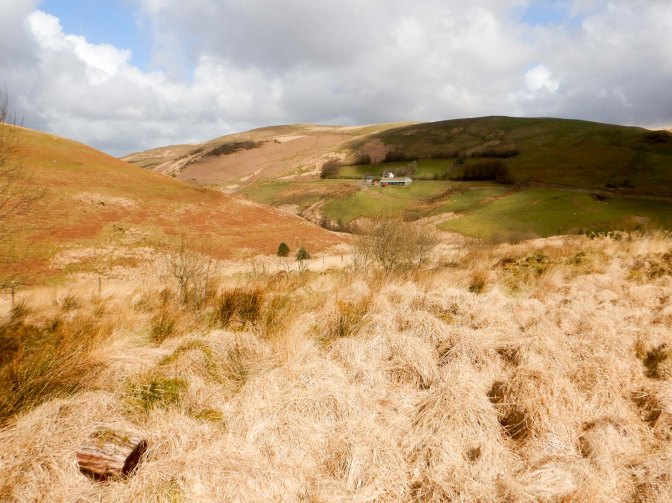
There followed a steep uphill then a stunning walk along an airy track with superb views of the nearby moor and distant mountains past cairns and a standing stone.
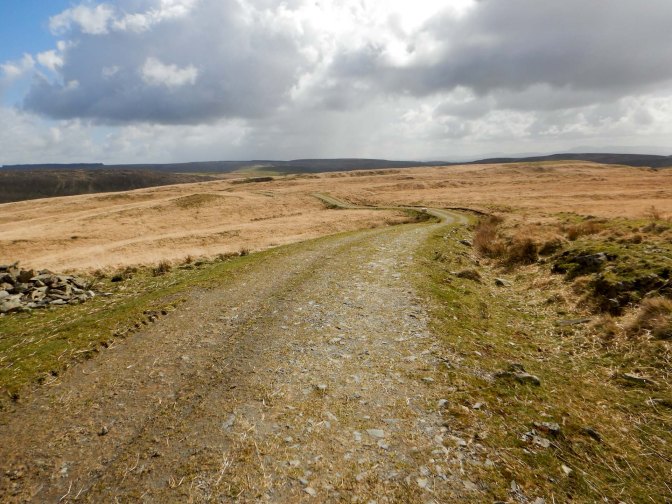
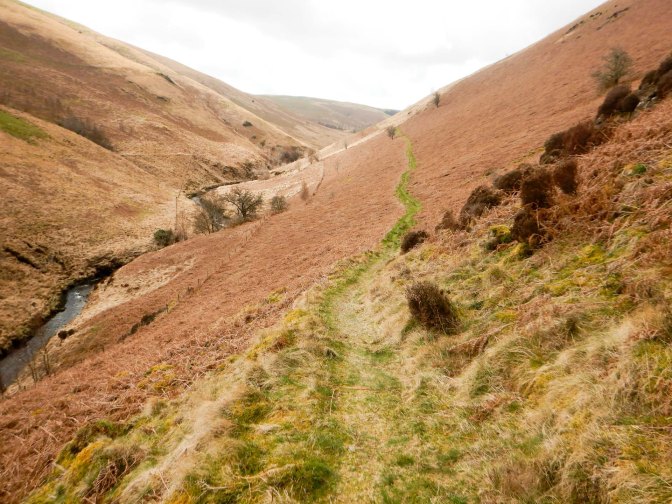
The track descends, taking a zig zag course to ease the slope and affords views of the scenic Doethie Valley to the east.
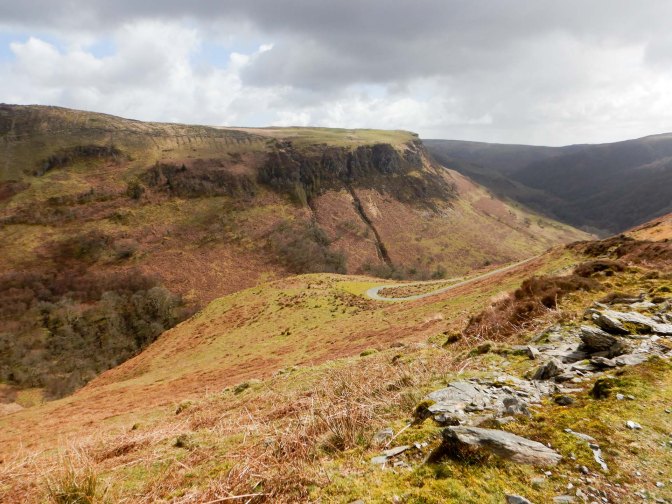
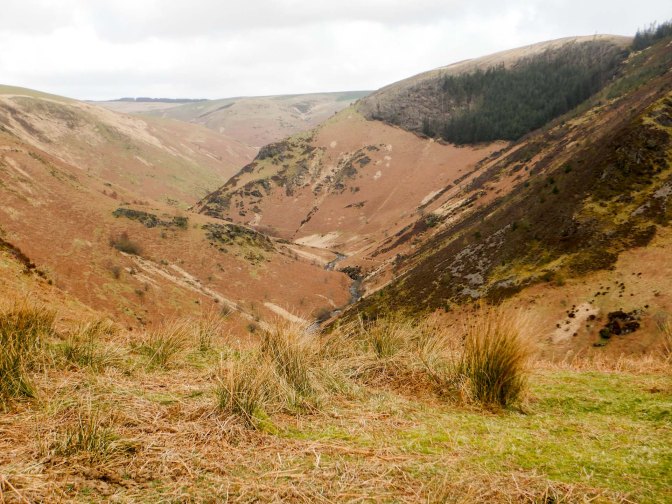
I crossed the river on a good bridge but had to walk for around 400m along a track which is signed as private on the far side of the bridge although after the section I walked it becomes part of the Cambrian Way. I just walked briskly and hoped for the best – no need to worry as I didn’t meet anyone apart from three sheep!
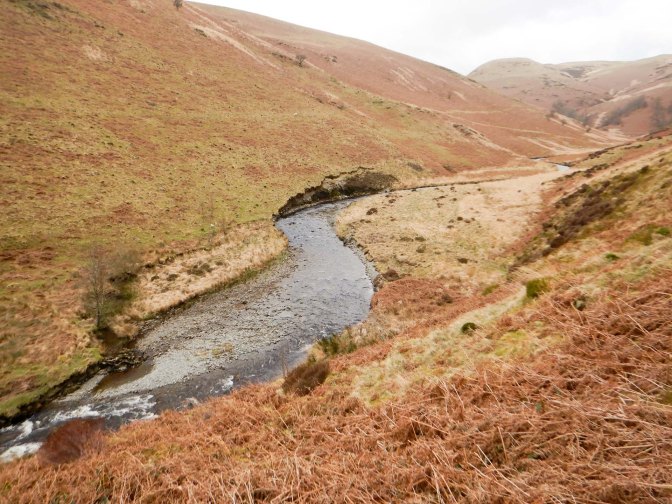
My walk continued on the balcony footpath overlooking the extremely scenic Doethie Valley with its multiple interlocking spurs, small rapids and waterfalls and some old ruined farms. There are a few fallen trees providing little obstacle to me carrying only a day rucksack and a few wet, marshy patches but overall at this time of year the path is well demarcated on the ground because the bracken hasn’t grown up yet.
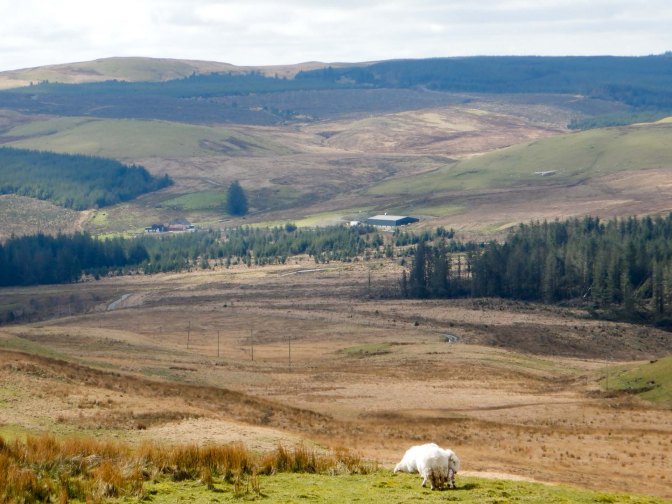
My second walk was an afternoon expedition to Llethr Llywd, the 465m summit opposite the front of the hostel. I reached it by following the road past Blaendoithie (our nearest neighbour) and ascending open moorland just after the fence ends.
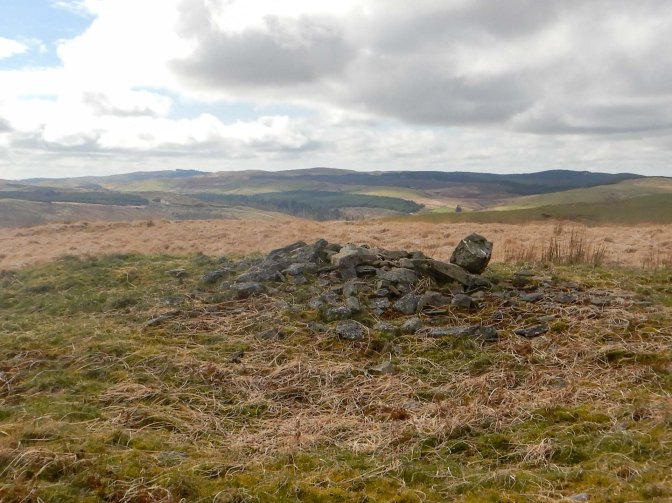
I continued on to the cairn Penrhiwllwydog. The monument comprises the remains of a round cairn, probably dating to the Bronze Age (c. 2300 – 800 BC). According to Cadw, the government agency caring for historic monuments in Wales, it retains significant archaeological potential and so is of national importance for its potential to enhance our knowledge of prehistoric burial and ritual practices.
I descended over the other side of the hill to reach the minor road between Nant-gwernog and Pysgotwr then was able to follow the road round the hill to return to where I had initially left the road and hence return to Ty’n Cornel.
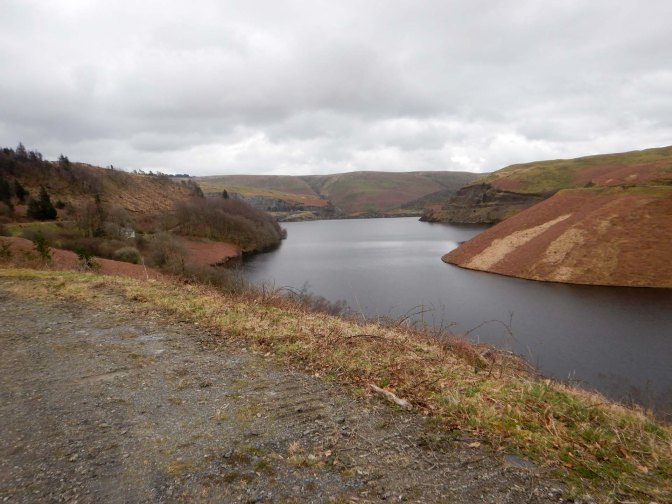
My third walk started across territory already walked by me down the Doethie Valley, before turning uphill to “new” areas of easy walking on forest tracks with views of Llyn Brianne Reservoir. The reservoir was constructed in the 1970s to provide water to Swansea. As there were no guests the previous night, I was permitted to leave at 09.00am – the hostel manager was concerned that otherwise I might not finish by 5pm when I was due back at the hostel ready for the arrival of booked guests. Actually the route was easy to navigate and I was able to maintain a relatively fast speed.
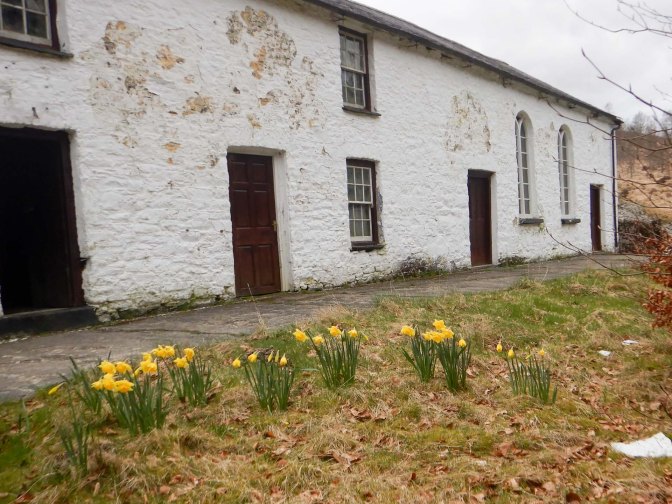
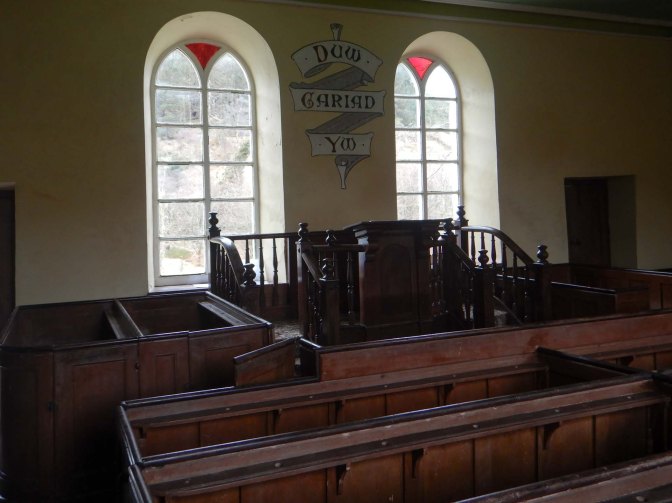
I passed the Soar y Mynydd Chapel, said to be the most remote chapel in Wales and a centre for Calvinistic Methodists, a Welsh Protestant revivalist movement. The chapel was built in 1822, immediately following the independence of the Calvinistic Methodists from other Methodists and from the Church of England. However this was a centre for worship much earlier than that with meetings held at various farms and homesteads. In April 1779, this remote church underwent a powerful revival when, during the preaching, the congregation broke out crying, shouting and praising continuing until dawn on the Monday. The following Sunday, the scenes were even more dramatic. The revival which had started here spread through much of Wales.
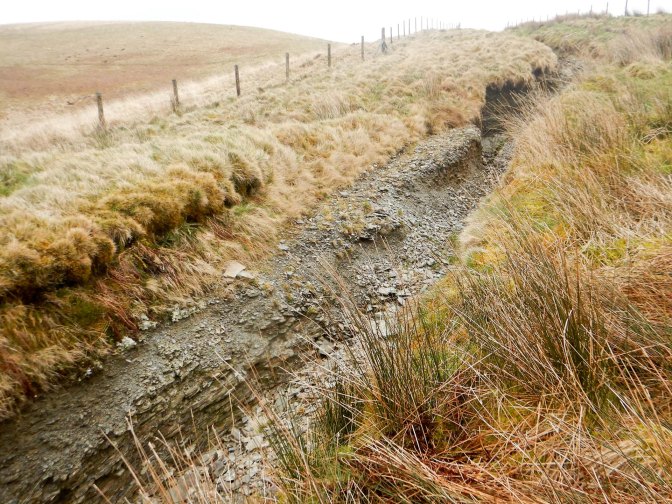
I returned to the hostel along the old drovers’ road, now completely broken down with deep gullies and closed to vehicles. I was back at the hostel a few minutes after 2.30pm – so I could have started at 10am. Actually the earlier start was appreciated, making me feel much more relaxed all day as I had less time pressure.
My fourth exploration was to follow the Cambrian Way in its northward direction crossing the remote moorland over the less boggy high ground of Esgair Wynt and Esgair Cerrig. This was the day that there was a planned power cut from 09.30am so I had started cleaning early so as to have finished while I had electricity for heating water and for the vacuum cleaner.
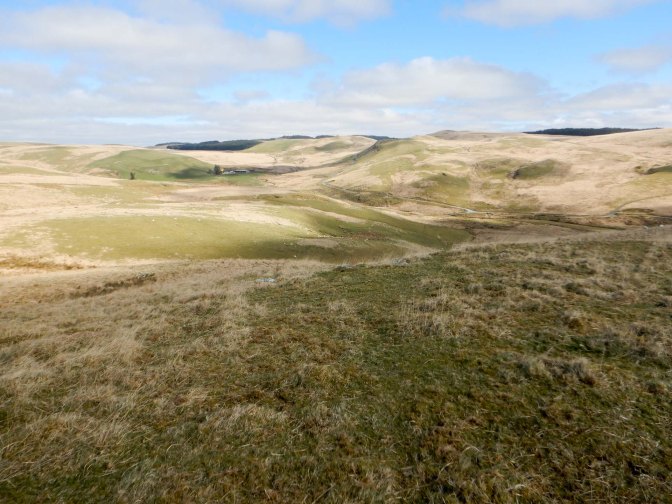
While en route I was tempted to detour to the hills to the east (Llethr Llywelyn, Cyrnau and the trig point at Esgair Hir). However the path I followed was extremely pleasant and nowhere near as boggy as its reputation so I continued and eventually saw the iconic isolated telephone kiosk at the road junction to Nantymaen.
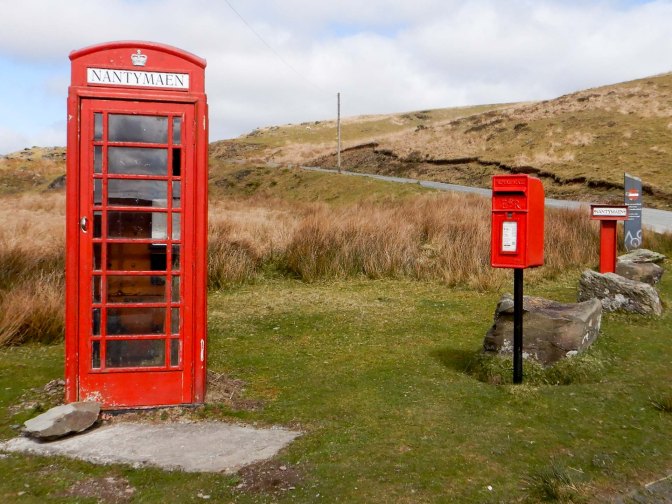
The stream crossing of Nant y Ffrwd just upstream of where it is joined by Nant y Maen was trivial and I set off along the minor road towards the Soar y Mynydd Chapel. However, I had visited the chapel the previous day and was keen to revisit the following day on Good Friday. As I walked at blistering pace along the road, I realised that a more interesting option would be to climb back on to the moor and visit the high ground to the east of where I had been earlier.
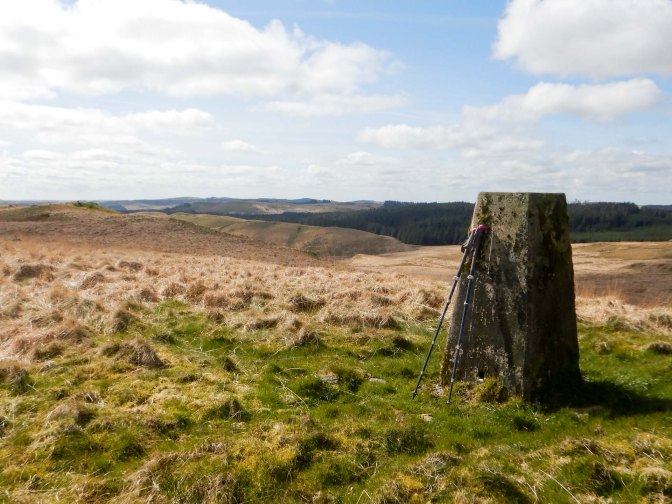
Navigation proved to be surprisingly difficult to the trig point as I tried to avoid the worse of the tussocks. However, I was at Esgair Hir, from where there were great views of remote moorland, in time to eat a late lunch.
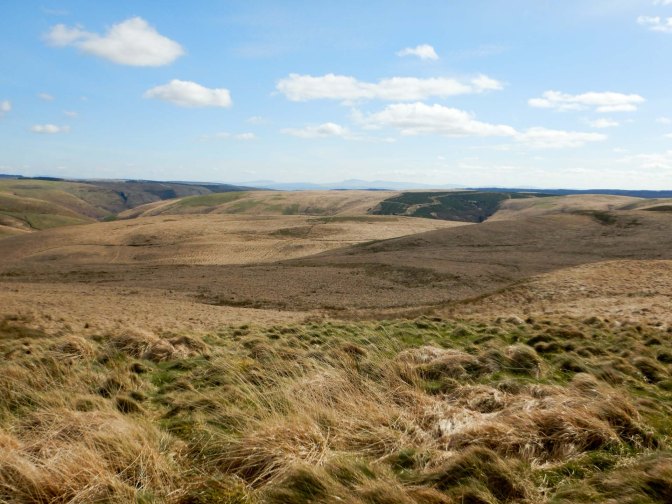
I kept to the high bits as much as possible, over further tussocky ground to reach Cyrnau.
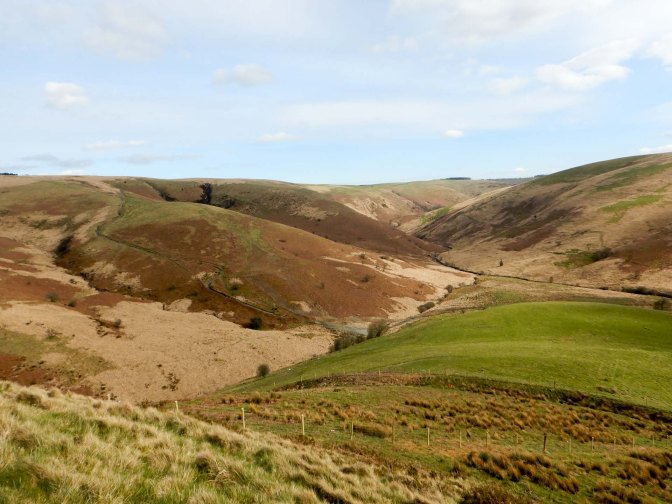
Looking at the map, I thought that I could return to Ty’n Cornel avoiding most of the “road” to the hostel, aiming to reach the drovers’ road south east of the hostel. I had previously noticed forestry workers accessing the road in that area. Indeed this was possible and meant that I had completed a circular walk. The electricity was back on again on my return. I successfully reset the fire alarm and the water heater timer.
On Good Friday after I had cleaned the hostel, I spent the morning driving to Llandewi Brefi in order to collect clean laundry, also taking the opportunity to collect the food waste caddy from the refuse box which had been serviced the previous day. I was keen to spend the “last hour” up to 3pm walking to and sitting in the Soar y Mynydd Chapel as a Good Friday vigil. In the end I left the hostel before 2pm, reaching the chapel, on foot over the stony and gullied drovers’ road, at around 14.40.
There was no-one else there so I sat in one of the box pews, contemplating the words “DUW GARIAD YW” – “God is Love” painted above the preacher’s dais. There is no cross and little other ornamentation in this simple Calvinistic chapel.
I returned on foot to the hostel, which had suddenly become very busy as the expected three guests had arrived before 4pm on motor bikes, closely followed by next week’s warden on foot. I didn’t need to worry as they had the code to enter the building, didn’t necessarily expect me until 5pm and they had made themselves at home with a well established log fire burning. They had even noticed that my car had a flat tyre and subsequently changed the wheel for me. The advantage of having an elderly car is that I have a proper spare wheel albeit steel rather than alloy.
I had certainly managed to make the most of my time as volunteer warden, meeting more guests than I had expected initially, with several late bookings, and still been able to explore a lot of the local area.

 Where's Kathryn?
Nice work if you can get it.
LikeLiked by 1 person
It’s all entirely voluntary as the hostel is run by a charity – The Elenydd Wilderness Trust – the volunteer warden has free accommodation but obviously no travelling expenses paid. The Trustees and hostel managers (also volunteers) are incredibly supportive and dedicated. The whole thing is extremely well-run with a training weekend for volunteers and very clear policies and an annually updated guide to what the wardens are expected to do to ensure the hostel is kept in good order. I volunteered after I stayed at the hostel (as a camper in the garden) during my walk on the Cambrian Way
LikeLiked by 1 person
Meant as a compliment to you. Well done.
LikeLiked by 1 person
Thank you BC!
LikeLike