4 – 22 November 2025
I never went inter railing in Europe as a student and neither did my husband even though at the time it seemed to be a rite of passage. I recall feeling slightly in awe of those fellow students who returned to University in the autumn telling tales of overnight journeys on slow trains and other nights spent sleeping outside on warm beaches of southern Europe. They invariably had stories about strict train guards (it always seemed to be in Germany) who complained about them putting their feet on the train seats. Some appeared to make detailed itineraries beforehand whilst others made plans as they went. This was before the Euro so journeys involved lots of money changing of small sums of money. Some nights were spent in hostel dormitories but in pre-internet days and without mobile phones, booking had to be done by post beforehand or by simply turning up and trusting to luck. There was of course no “Google maps” to help with wayfinding round cities…. The tickets allowed people aged under 21, although later changed to under 26, travel for a month on European trains.
Fast forward to November 2025 and age 64 with my husband age almost 66 ready over forty years late to complete this rite of passage missed in student days. How different it is! We each have the Interrail Eurail app on our smart phones with a First Class senior Interrail Global Pass valid for ten days train travel in two months attached. We have even planned our trip, booked reservations on some trains and booked hotel accommodation (using on-line platforms) for each night of our expedition apart from the night booked on a sleeper train. We’re each equipped with a lightweight 40 litre bag that converts easily to a proper backpack with full harness and hip belt and we don’t need much clothing as virtually everything is made of technical fabrics that will dry out easily after washing overnight in a hotel room. It’s all an amazing contrast, although we do retain that spirit of adventure having chosen to include time in three countries we have never previously visited – two of which use currencies that are new for us.
A further change from those days long ago is that we can start our train journey from our home town and proceed through the Channel Tunnel which wasn’t opened until after our student days. The ten days travel can include up to two days in our home country. Our journey through the tunnel was fixed as it had to be booked and there’s a limit on the number of people allowed to use Interrail tickets. Hence we had an early start on the 06:52 train from Exeter. The train from the station near us at Pinhoe was at 06:28 and only allowed fifteen minutes connection time so we decided it was more reliable to walk the 3.7 miles to St David’s Station.
We coped with the IT and loaded the first journey on to our passes. The journey to Paddington in first class meant we enjoyed free coffee, soft drinks and snacks. We were running with two train engines down until reaching the electrified line at Newbury so arrived at Paddington twenty six minutes late. However there was still lots of time before we needed to be at St Pancras for the Eurostar check-in. Not content with our long early morning walk, we opted to hike across London and were still at St Pancras with plenty of time to spare.
Eventually it was time to check in. I would have emptied my pockets for security but the Eurostar website states clearly that only certain items need to be removed from pockets and placed on the trays. There weren’t any notices to clarify this. The whole area seemed to be very insecure and I managed to walk through with my wallet from which I had removed the coins as advised on-line. My husband was told to return and place the entire contents of his pockets in a tray. Everybody appeared to be coming up “red” as they walked through but no further checks were being made. I “guarded” my husband’s possessions which had already come through the scanner as he took a few minutes more having returned to place more items in a tray. I assume the staff are carrying out this process for several trainloads per day but it still appeared that none of them were sure of the process or of their role!
Having survived security and been checked by British and then French border staff in rapid succession we were officially in the Schengen zone with passports stamped – is the departure lounge a part of France which is for ever England? Fortunately our Eurostar train departed and our Eurostar Plus status meant we enjoyed a lunch with wine or soft drinks served to our seats. We arrived in Brussels the same day and, having already had border checks, walked straight out of the station.
We’ve been to Brussels previously so just had one night in a hotel close to the station before starting our second train day, loading a journey to Frankfurt on to our passes. The landscape is very flat. We crossed the River Main. Once at Frankfurt, and certain of our connection, we loaded our journey to Nuremburg. The scenery became more undulating but still predominantly rural. This was our destination for a two night stay. The train was delayed – as we were to discover, delayed trains are par for the course in Germany. However, our hotel was near the station and close to the old town so there was time to wander round before dark. Christmas market preparations were in full swing and the Christkindlesmarkt is one of the oldest and most iconic Christmas markets in Europe.

We enjoyed some traditional German food at a restaurant close to the city wall and opera house – shoulder of pork, potato dumpling and sauerkraut plus a local red beer for me.
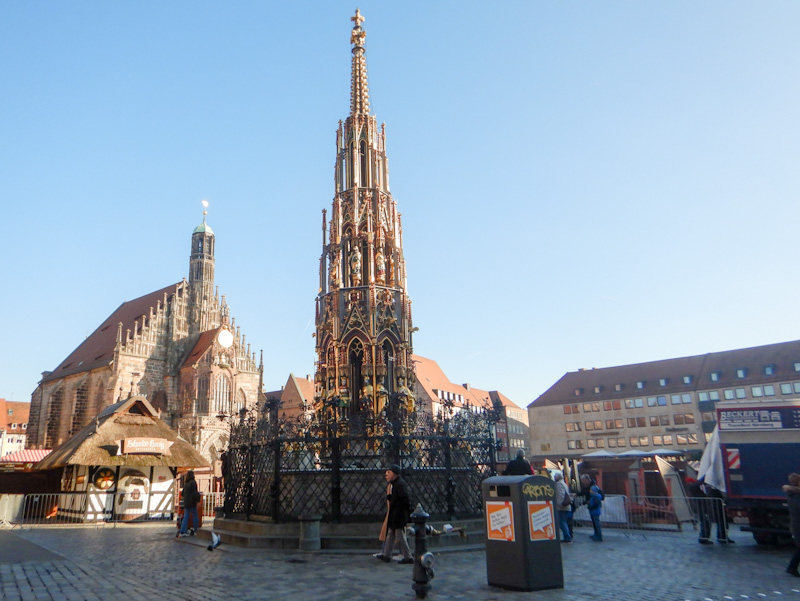
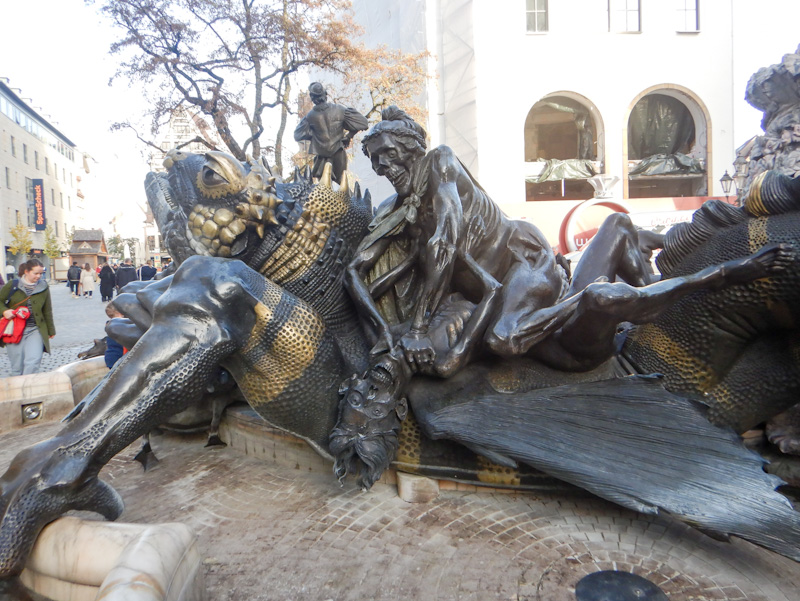
The following day we explored Nuremburg more thoroughly as it wasn’t a travel day.
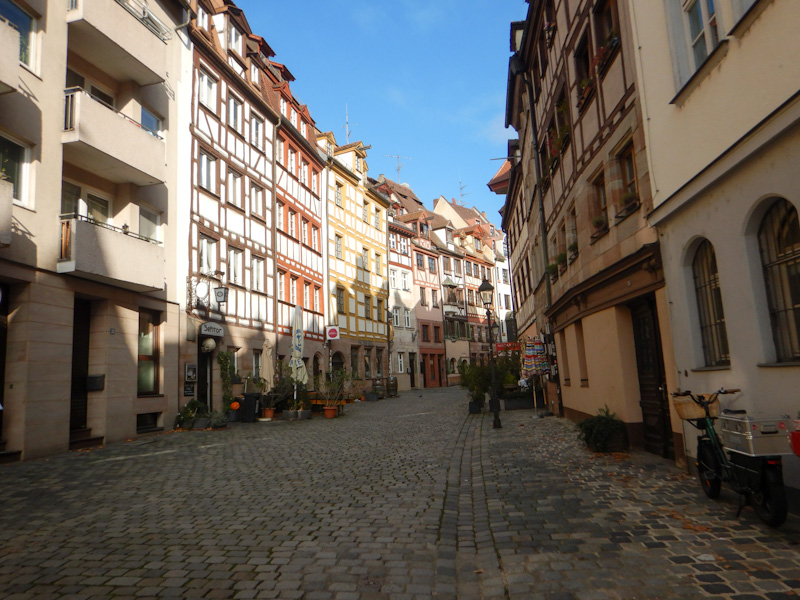

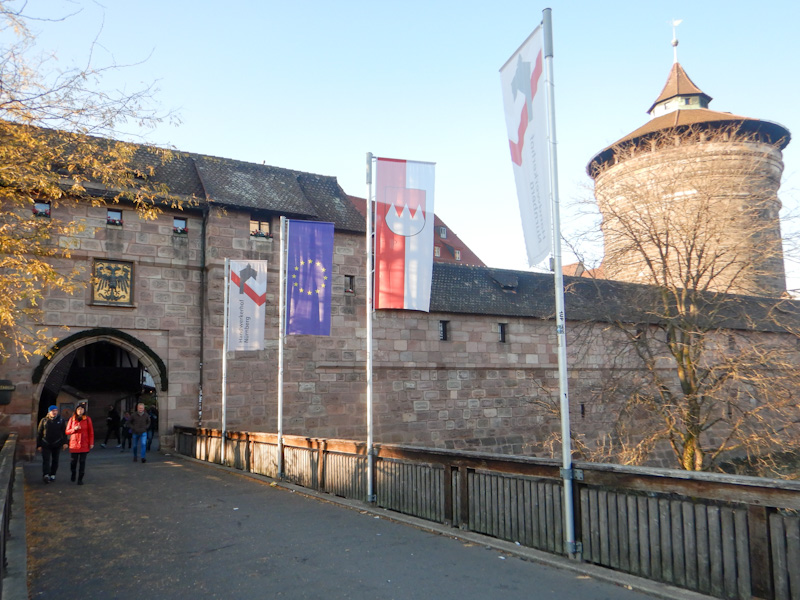
This included sculptures, bridges and the four kilometre encircling city wall in various states of repair complete with many towers.
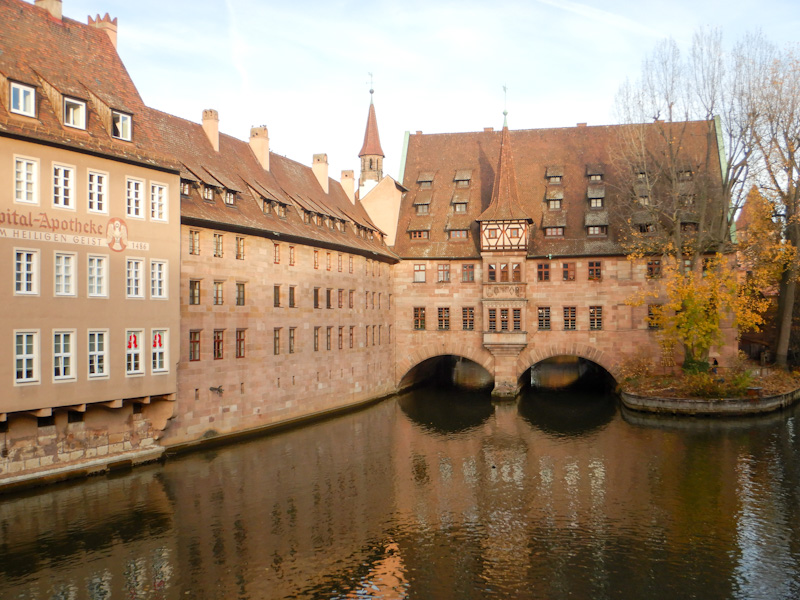
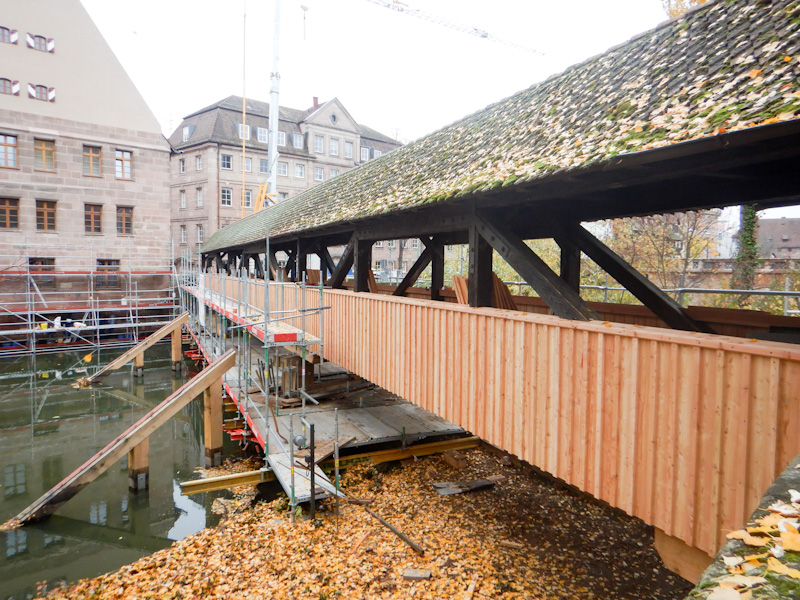
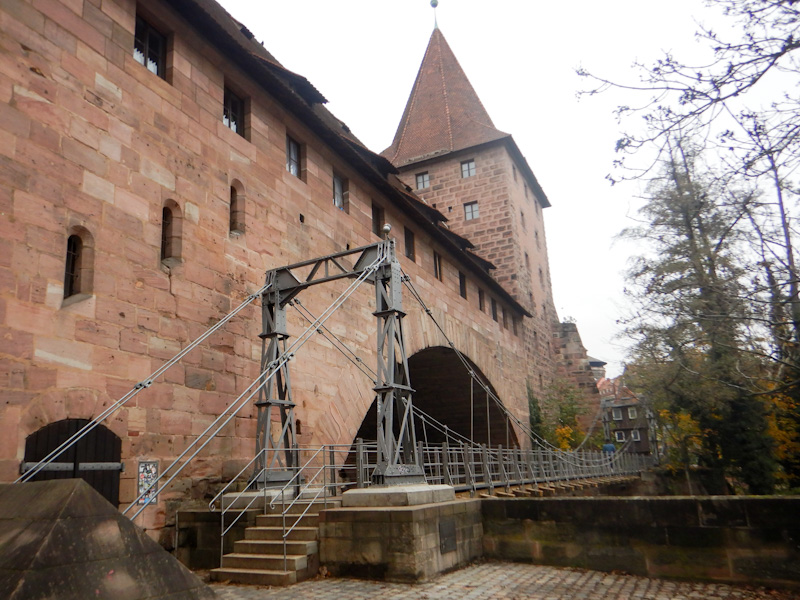
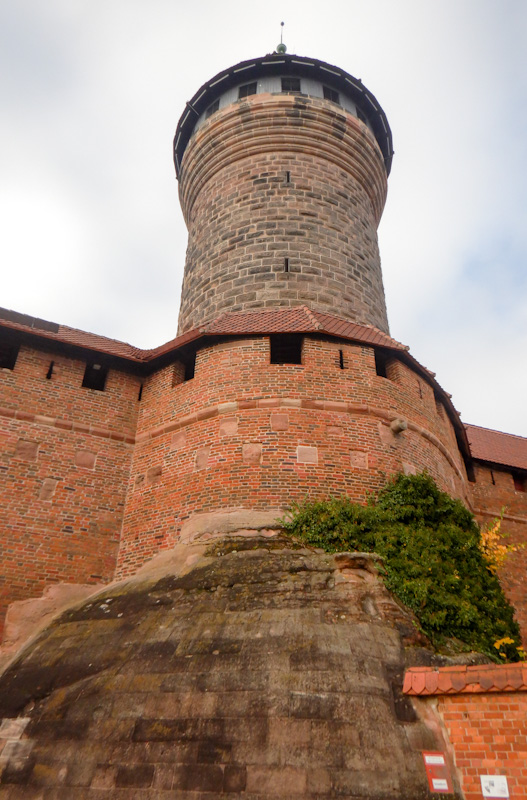
We visited the castle, reconstructed after World War 2 damage and perched on a sandstone ridge and towering high above the city.
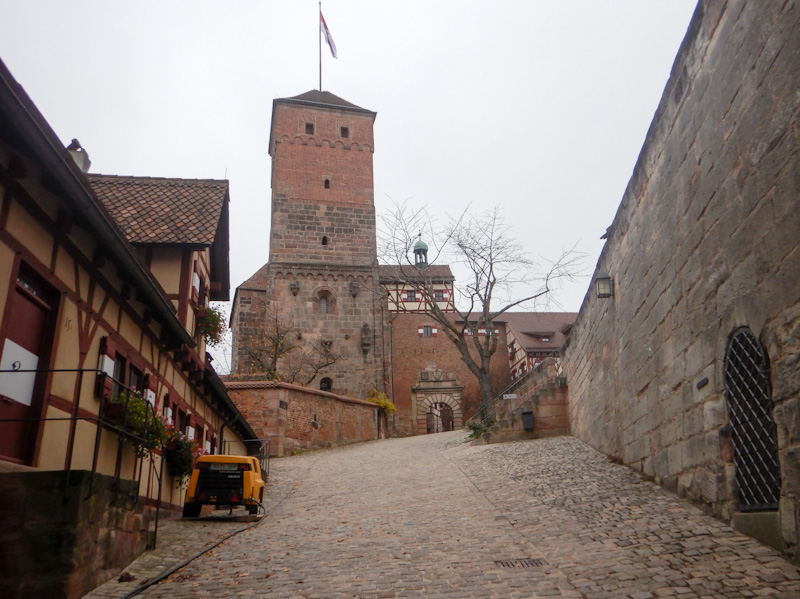
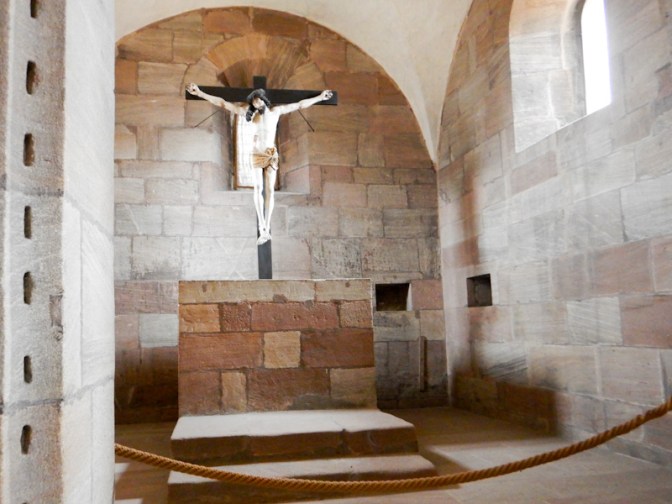
This was one of the most important imperial palaces in the Holy Roman Empire – the areas open include the Palas (residential building) with its imperial apartments, the Romanesque double chapel, and the Deep Well.
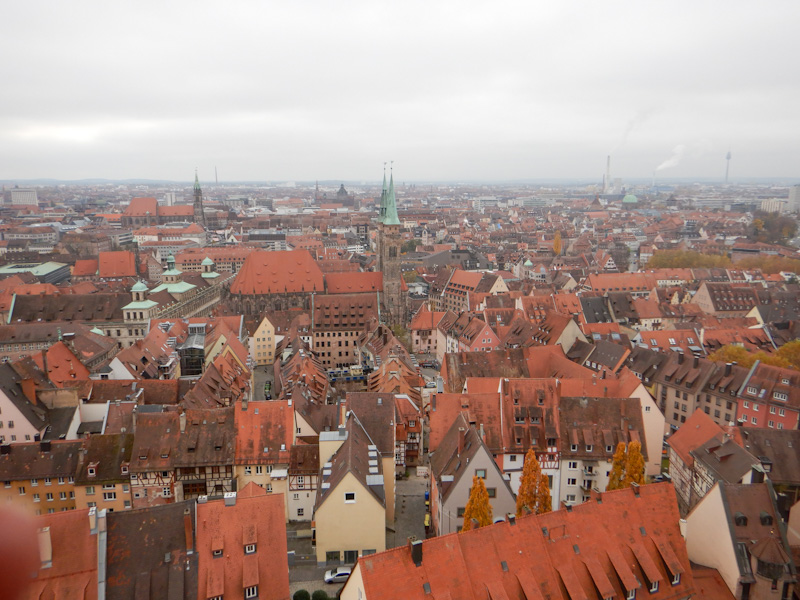
We climbed the Sinwell Tower. ascending over a hundred steep and narrow steps, to enjoy panoramic views of the city’s red-roofed Old Town.

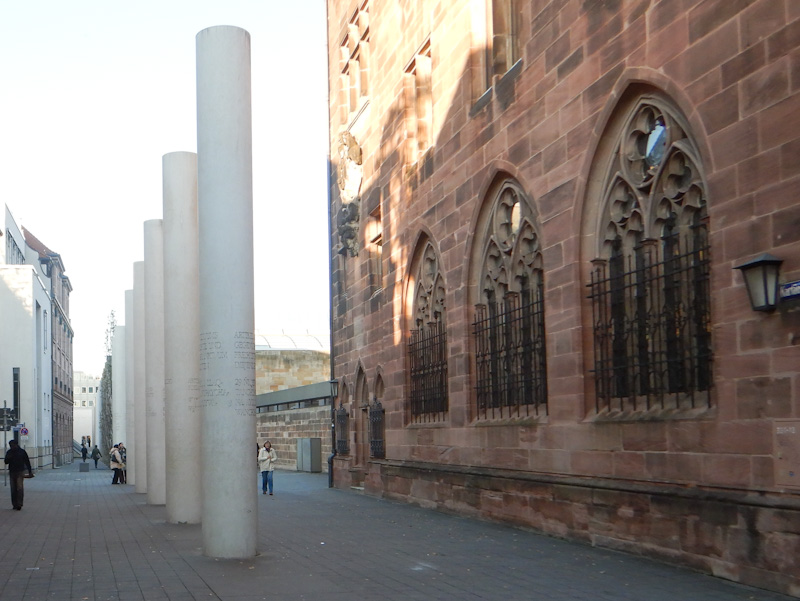
The Way of Human Rights sculpture is part of Nuremberg’s efforts to shake off its Nazi-era reputation as the “City of the Party Rallies” and reinvent itself as a “City of Peace and Human Rights”. It’s a poignant reminder of the atrocities of the past and present as well as a symbol of hope for the future. Inscribed on each of the twenty seven concrete pillars and on two ground plaques as well as the integrated cypress oak is one article of the General Declaration of Human Rights in German and another language – a different language on each inscription.
Nürnberger Rostbratwürste (small, spiced pork sausages that are so iconic they’re protected by EU law) were included as an option to try at the hotel buffet breakfast. However, we couldn’t complete our visit without sampling the traditional gingerbread at lunch in a local café and enjoying another traditional meal in the evening – venison goulash.
It was time to move on in our whistle-stop tour of, what were for us, new European destinations. Our third train day involved an initial journey to Vienna including our first sights of the Danube on this journey. I recognised a few place names from the Thurn and Taxis board game including Regensburg, Passau and Linz. There appeared to be many solar panels in fields near the train line. We were late – again. Hence we missed our planned connection, but were able to visit the first class lounge at Vienna Hauptbahnhof while we waited for the next train.
The connecting train was a less luxurious traditional compartment train. We crossed the border from Austria into Slovakia. This was a new country for both of us. The train staff changed from Austrian to Slovakian at the station nearest to the border. Our destination was the capital – Bratislava.
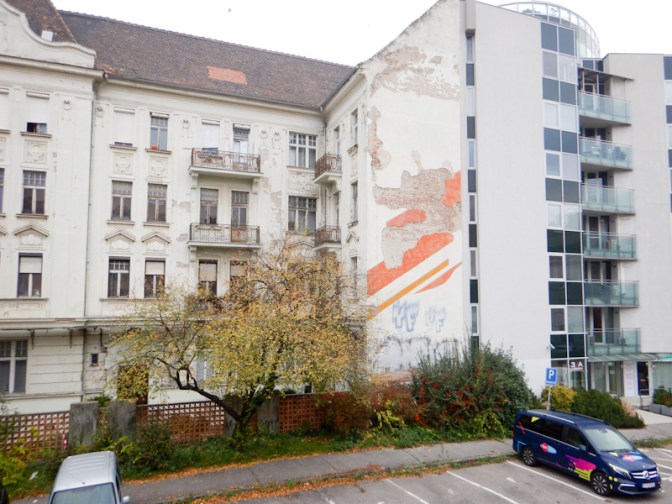
Hotel Matyšák where we were booked to stay is near the station. It has its own vineyards, winery and wine cellars so all the wine at the hotel restaurant is from its own winery.
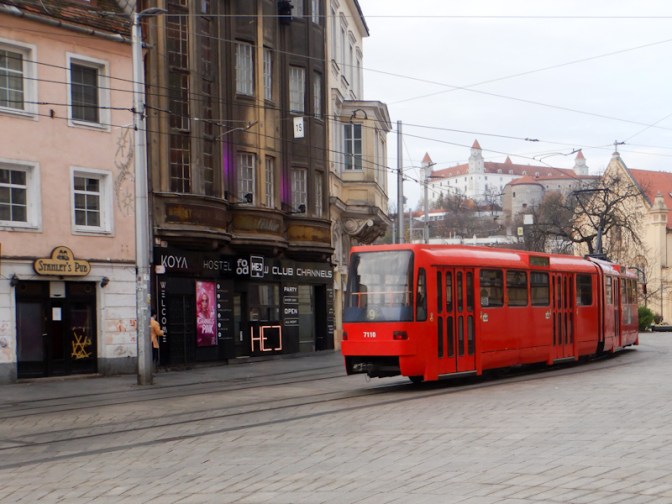
Despite being on the later train, there was still time for a brief visit to look at part of the old town before dark.
The hotel restaurant more than lived up to our expectations and we enjoyed traditional Slovakian cuisine of Živánska (3 types of meat, sausage, bacon, vegetables, potatoes) accompanied by Pinot noir. The wine was served meticulously by the waiter after a protracted display of preparation and aeration.
Despite our feast of the previous evening, we went to breakfast at 07.00am, anxious to utilise as much of the daylight time as possible (without missing breakfast!). We detoured to the station to purchase our 24-hour Bratislava card which offered numerous free and discounted admissions to the sights and some reduced restaurant prices (which we wouldn’t use as we had booked a meal at the excellent hotel restaurant again).
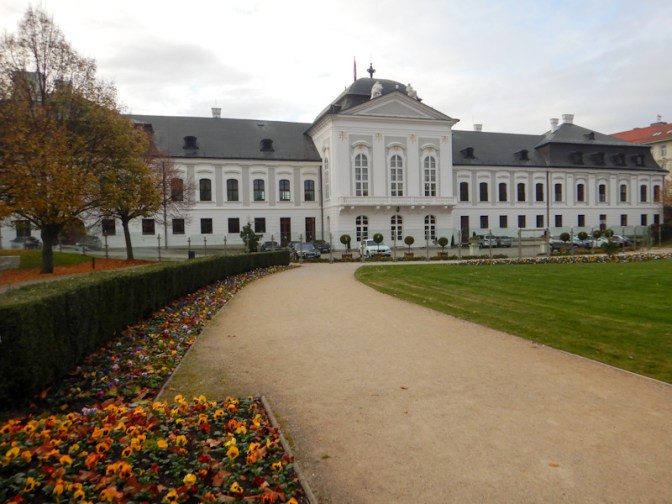
We wandered through the gardens of the presidential palace. The fountains were already turned off for winter but there were many flower beds with pansies thriving. There’s a row of trees each planted by a head of state visiting from other countries soon after the founding of Slovakia in 2003.
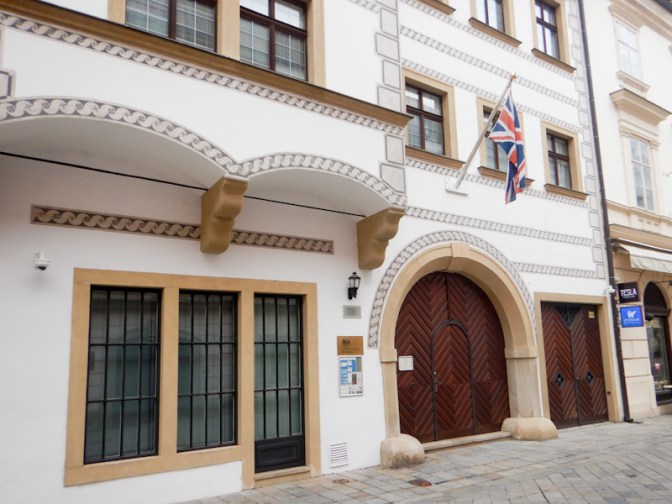
The Old Town area was still quiet so early in the day. We passed shops, historic buildings, the Christmas market under construction and various embassy buildings including the British Embassy.

St Martin’s Cathedral was already open for visitors. Between 1563 and 1830, eleven kings and seven royal wives were crowned here.
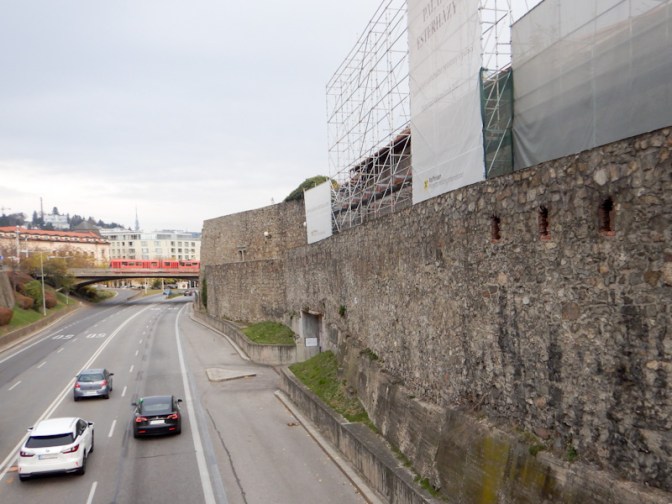
We climbed on to the City wall where there was a poster presentation commemorating the contributions of Jewish residents.
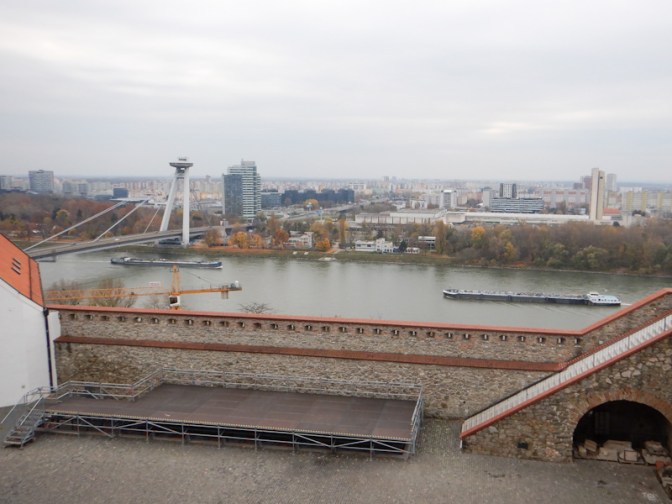
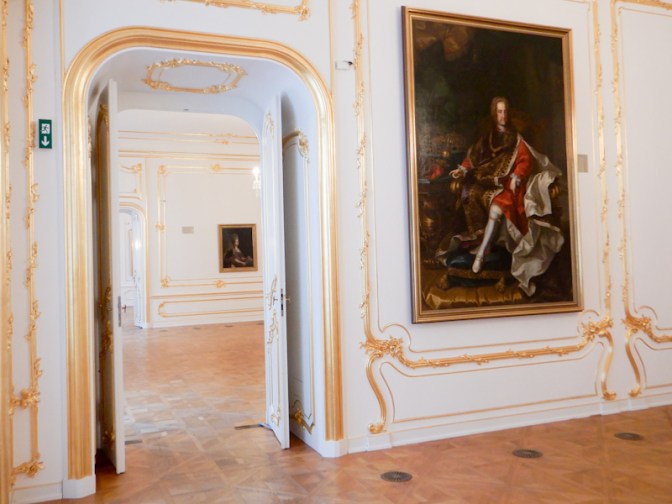
Eventually we climbed further to reach the castle where there are exhibitions outlining the history of Slovakia housed within the ornate rooms of what is essentially a palace within the stone castle walls.
The view from the Crown Tower was impressive despite the dull weather.
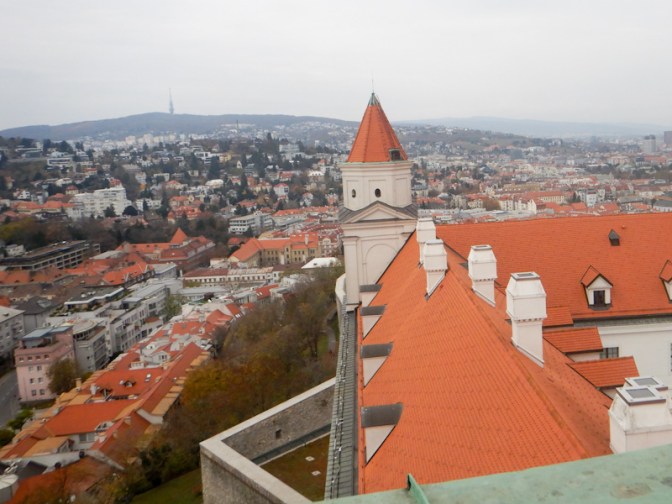
We descended past a gateway in the apparently impenetrable castle wall.
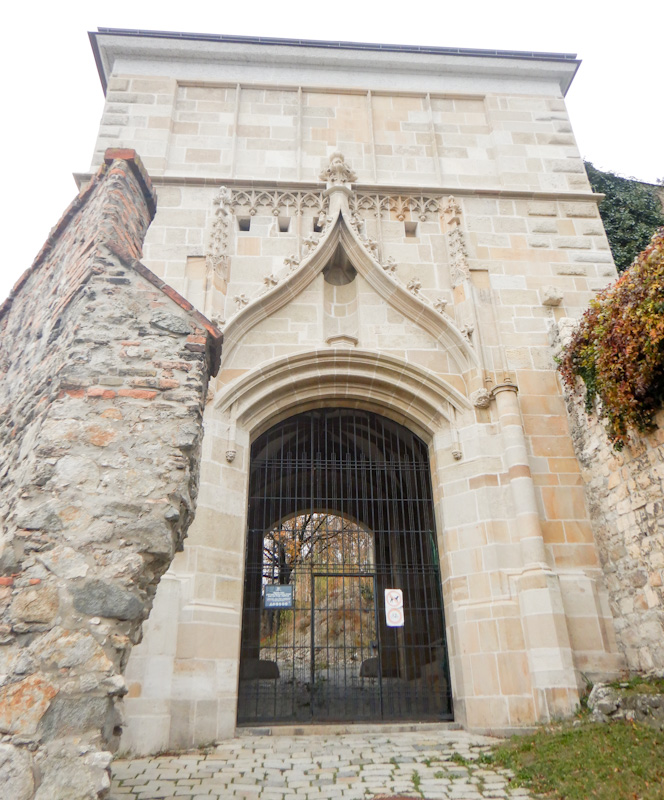
We arrived at an area with various connected museums – archaeology, Hungarian culture in Slovakia and Carpathian German culture. it was interesting to see items of ordinary people in the area dating from the nineteenth and early twentieth centuries.

Our walk along the side of the Danube was truncated by the start of persistent rain so we retreated to a traditional looking café overlooking the main market square to drink coffee and eat cake.
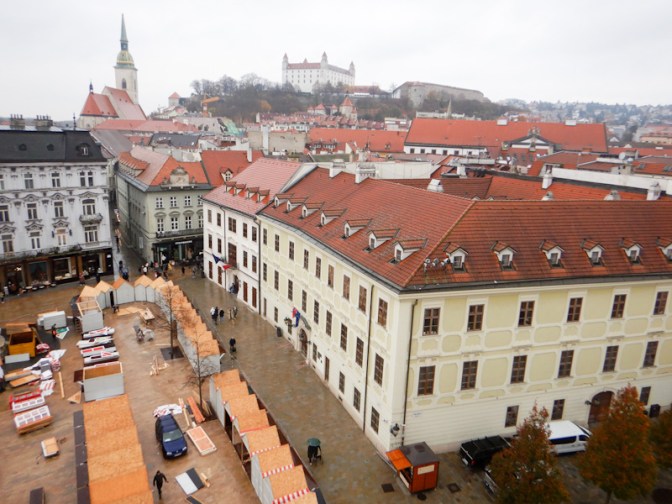
The town hall tower was our next objective and offered superb views. My husband was concerned that we had missed the advertised exhibition about the city. However, this followed the tower ascent and there was certainly no way of missing it as various attendants pointed the way through a maze of display rooms. Suffice to say, it was an extensive exhibition covering the history of the city, the history of the town hall, a fascinating special exhibition outlining the lives of nine prominent bourgeois families and one noble family and how their lives were changed by events of the nineteenth and twentieth centuries including Communism. The visit concluded with a descent into the rooms that once housed the city prison.
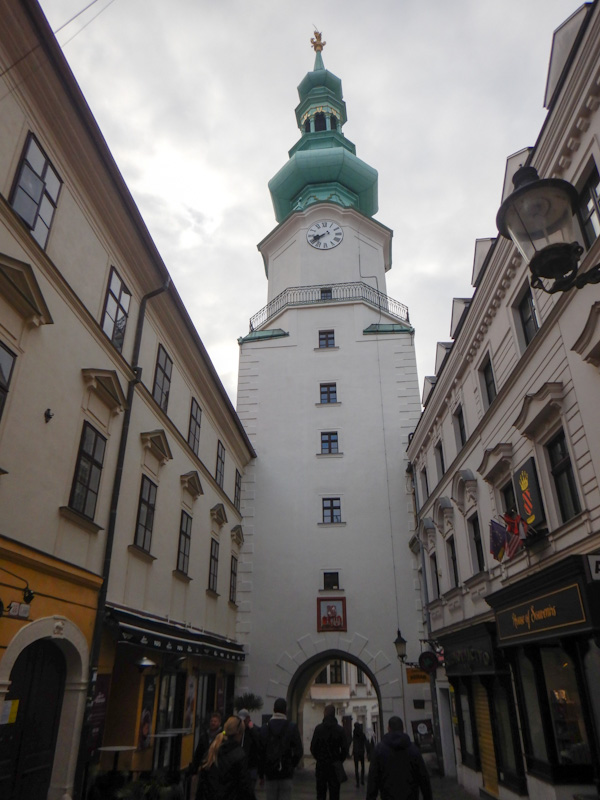
Eventually we escaped. it was still raining as made our way the short distance to the 51m high Michael Tower for a climb up to another vantage point.
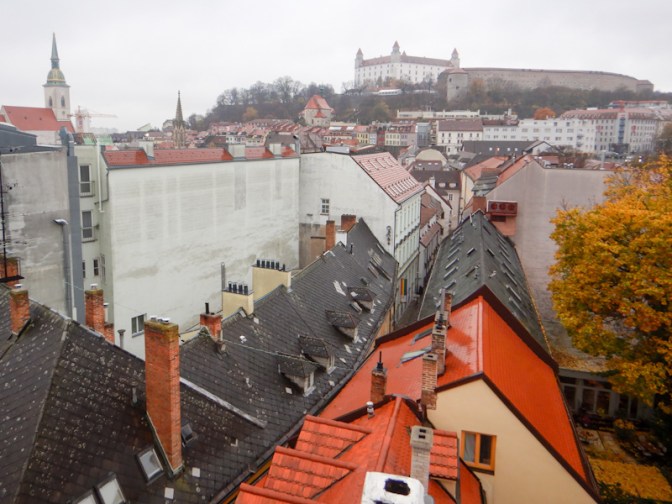
There was still time to visit the art gallery housed in the Rococo ornamental decorated rooms of the Mirbach Palace, built between 1768 and 1770 and restored in the 1960s and 1970s. Cabinets of Prints are preserved as interior wall decorations in two rooms. The gallery visit also included a special exhibition showing Vietnamese people coming to the area during communist times and their subsequent struggles after the regime changed and they remained marginalised members of society.
There was so much to see but dusk was falling and we were tired as we strolled back to our hotel in the fading light.
We enjoyed our dinner in the hotel restaurant – Sviečková na smotane (tenderloin on cream Carlsbad dumplings and cranberries) for me with local beer.
We had an early start for our fourth train day but the hotel allowed us into the breakfast room for an early coffee and provided us each with a huge breakfast box that turned out to be sufficient for our lunch as well. We were heading for Budapest on a convoluted route where the train ascends to pass through part of the Tatra mountain range.
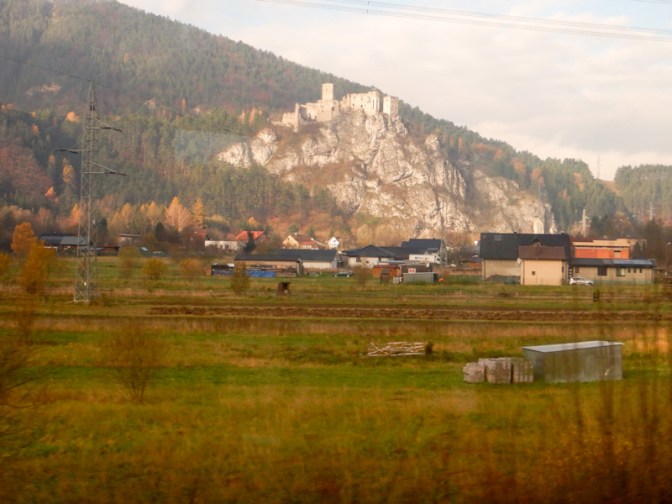
Mostly we were below the tree line but we had some glimpses of snow and passed some resort towns specialising in winter skiing and summer walking. As we journeyed further east the buildings were less renovated and there were more concrete tower blocks.

We reached Kosice where we changed trains and travelled over flatter landscape in a generally south westerly direction across the border and through part of northern Hungary to Budapest. There were multiple stops at small village stations.
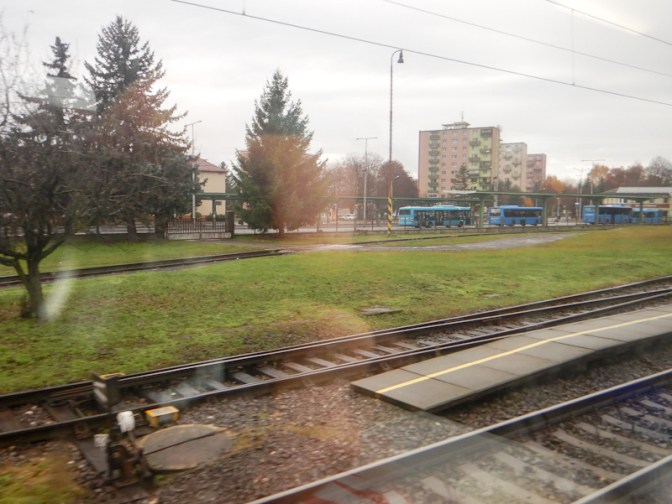
At Miskolc, there was a longer stop. More carriages were added to the front of the train. Many young people boarded the train to be waved off by their families.

Eventually we arrived at Budapest where it was already dark. Our hotel was very close to the station and we just ventured a couple of buildings along the street for pizza. Suddenly we were confronted with a new currency – Forints. We had already managed to buy these in England but the reality of spending a currency where the there are around 450 to the pound made everything seem very expensive even though it was not.

Our difficult task the next day was to visit Budapest in a day (apart from Andrássy Avenue and Heroes Square which we would visit before our train journey on the following day).

After breakfast we walked along wide streets past many grand buildings to the synagogue – the second largest synagogue in the World. It was necessary to look above ground floor level to see interesting facades.

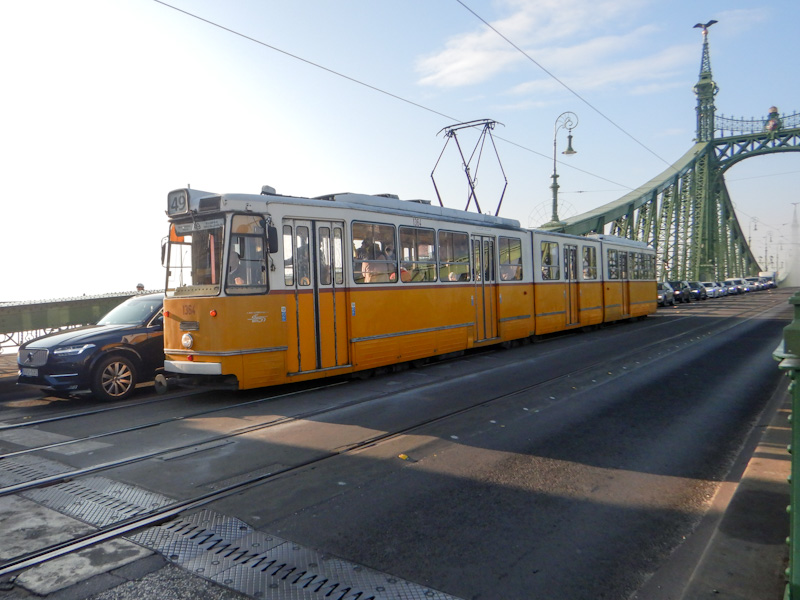
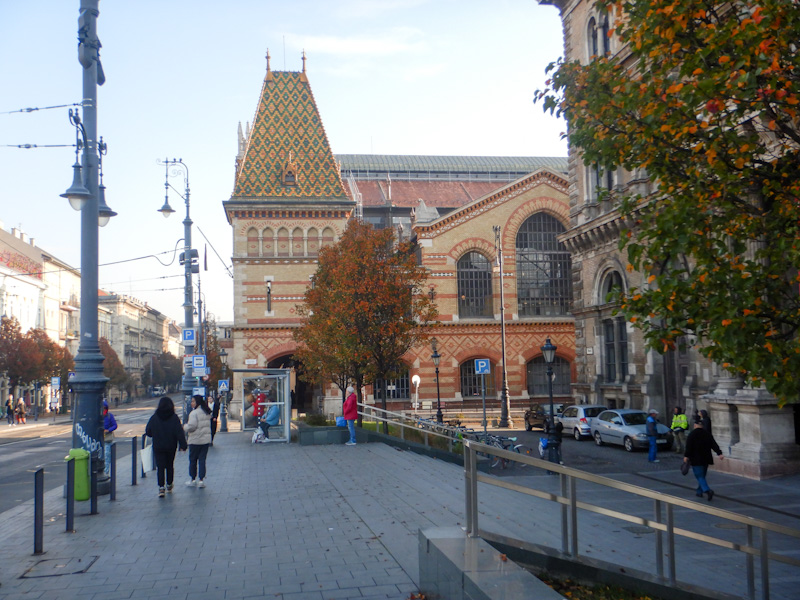
We walked on increasingly crowded streets to the Danube. The early morning mist was beginning to lift as we reached the Central Market Hall so we diverted to view the huge green iron Liberty Bridge across the Danube. Initially built as part of the Millennium World Exhibition at the end of the 19th century, the bridge features Art Nouveau design, mythological sculptures and the country’s coat of arms adorned on its side. it-s actually the shortest bridge across the Danube in central Budapest, linking Pest where we were standing to Buda where we were to visit later.

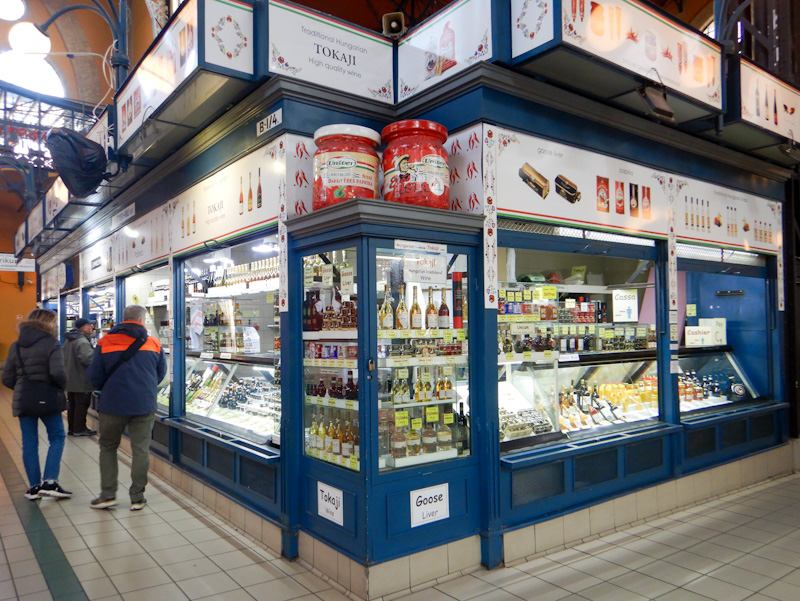
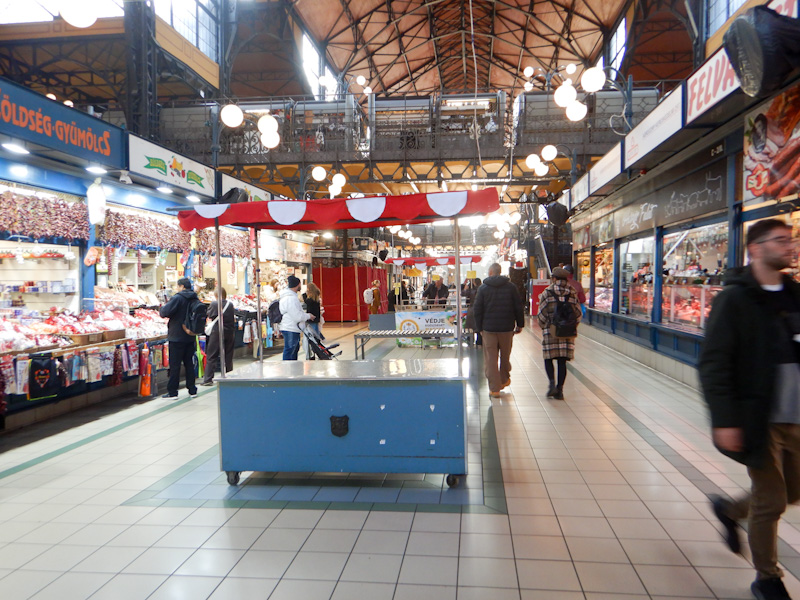
The market is enormous. We strolled round the produce stalls on the ground floor – paprika, sausages, cakes, sweets and fruit were just a few of the offerings – and briefly visited the souvenir and clothing stalls on the floor above.
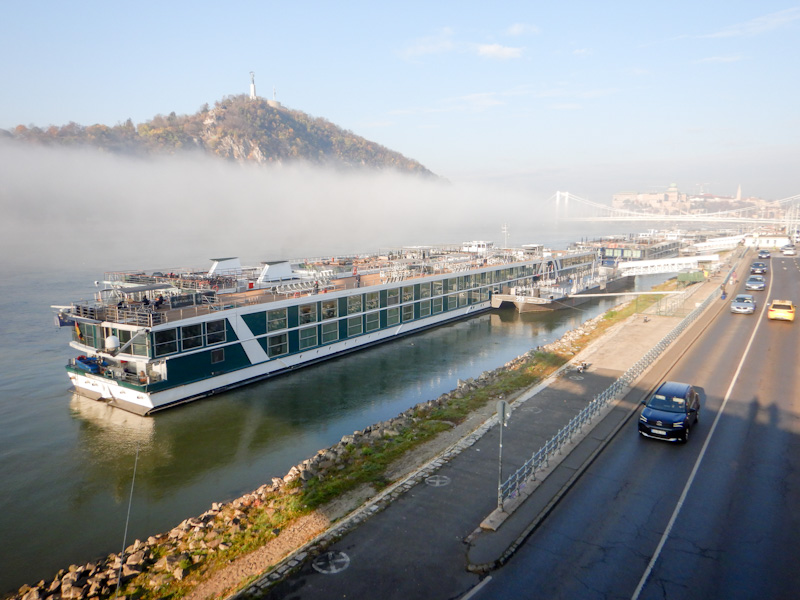
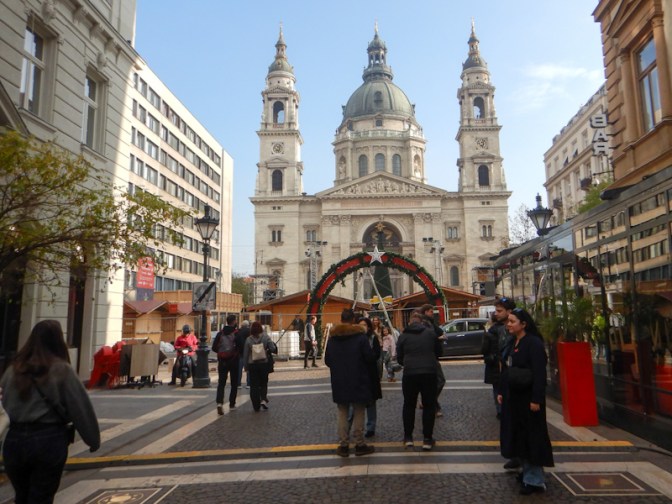
We found our way along the river bank past river cruise ships and then deviating away to St Stephen’s Basilica. It was crowded and we decided not to view the interior – it would have cost time with the necessity to buy tickets in one place and then head to the entrance.
We were tempted off for coffee and cake at an opulent although traditional café – my choice was traditional Hungarian dobostorta (a layered cake made to a special recipe) which made up for me eating decidedly non Hungarian pizza the previous evening.
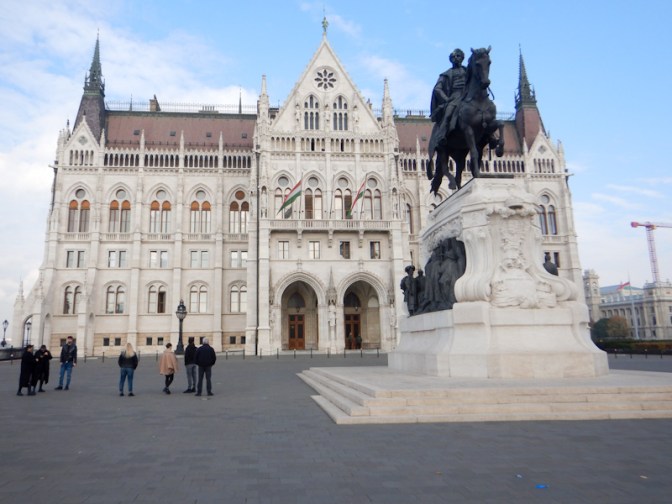
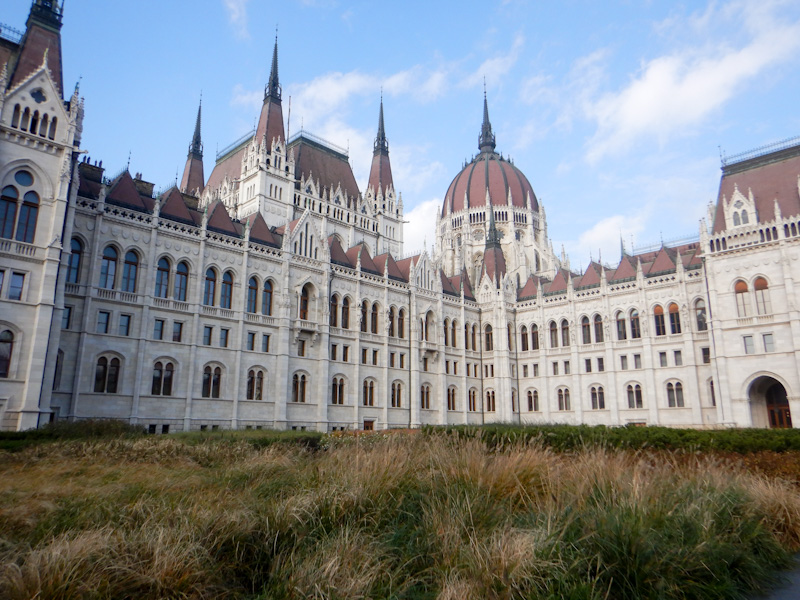
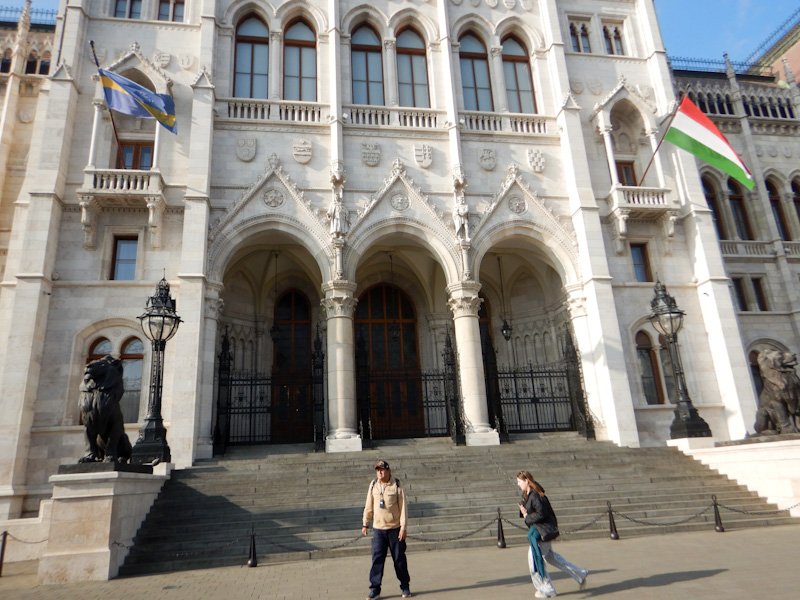
We walked to the outside of the vast parliament building – the third largest national assembly building in the World.
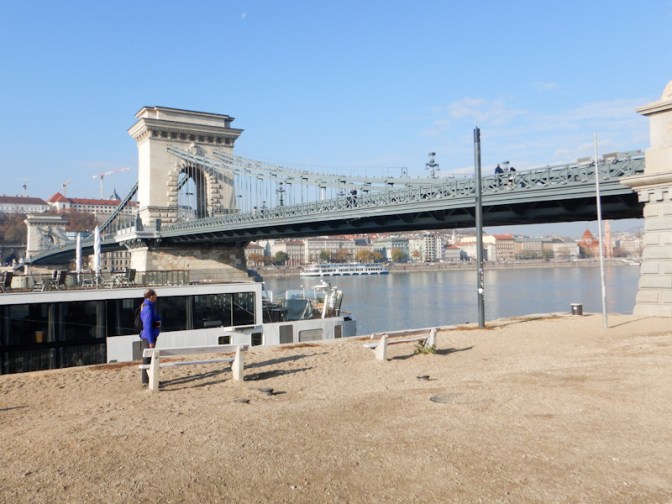
We passed the chain bridge.
We chose to cross the Danube on the Margaret Bridge, connecting Buda and Pest across the Danube and linking Margaret Island to the banks on the Buda and Pest sides of the river.
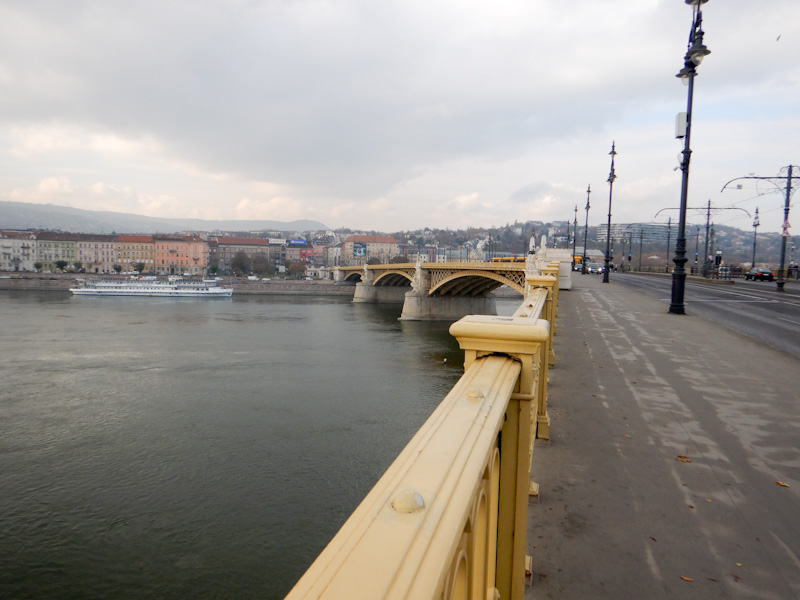
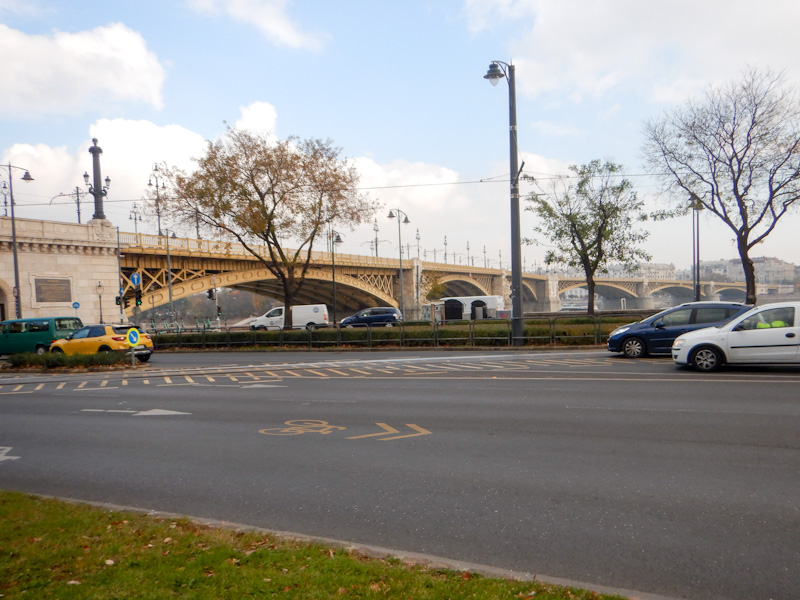
We made our way up the hill towards the Fisherman’s Bastion, stopping for lunch at a quiet café part way up the hill.
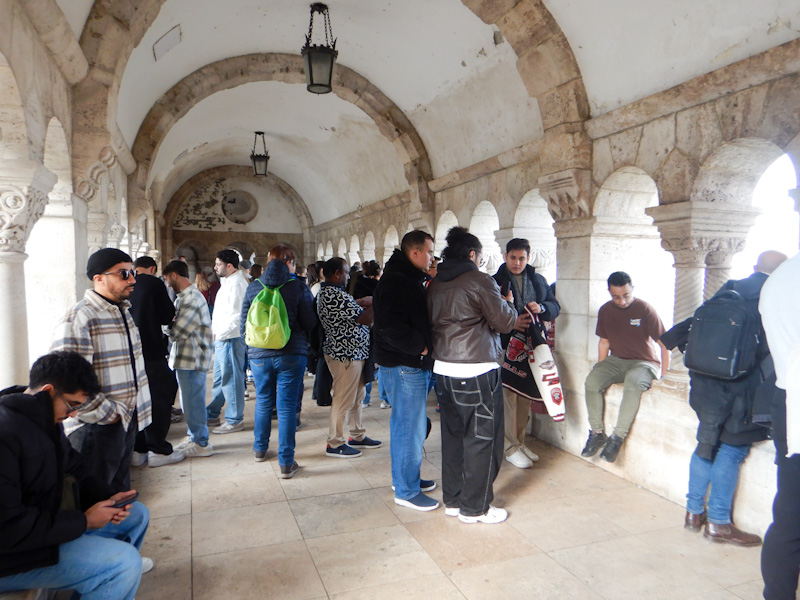
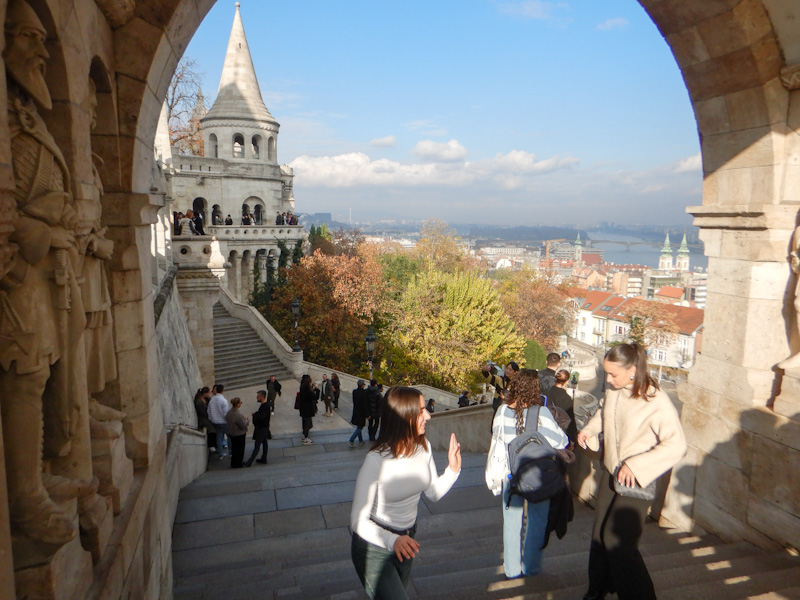

The path up the hill was almost deserted so it came as a shock to suddenly see the thousands of people at the summit, many concentrating on getting the most impressive selfie.
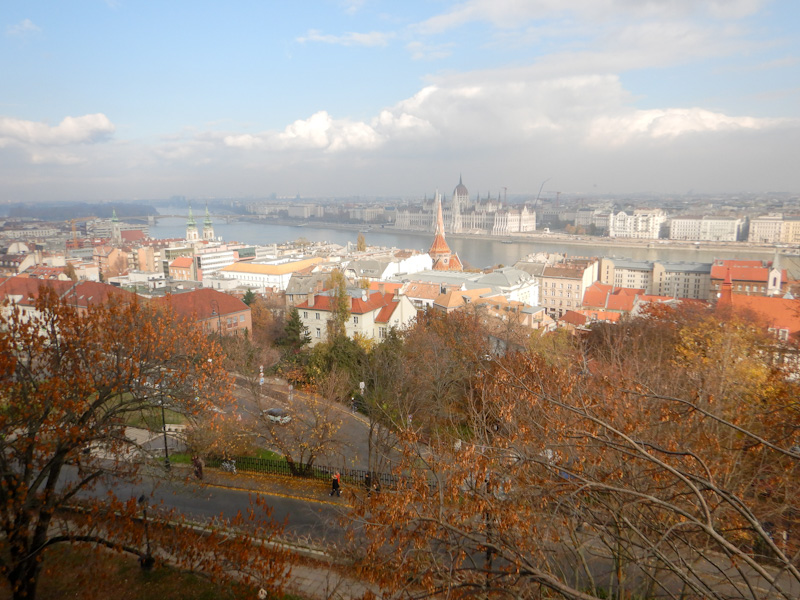
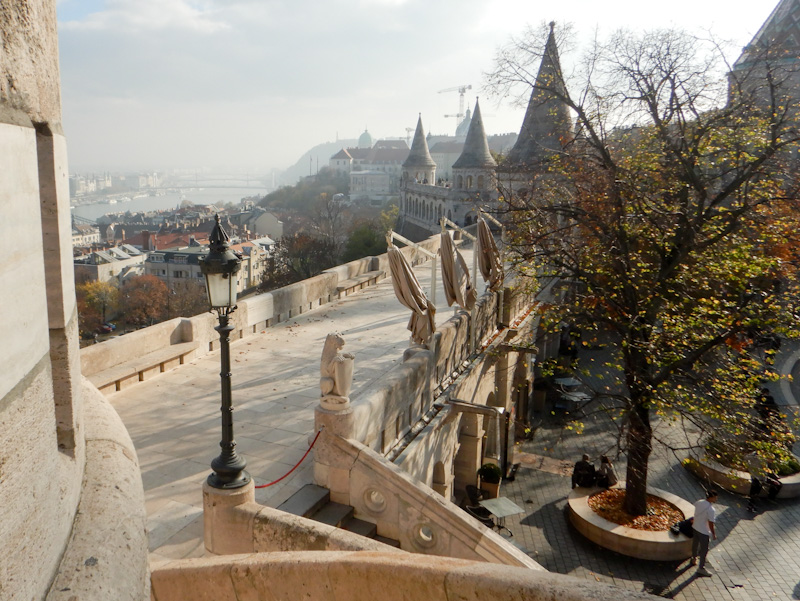
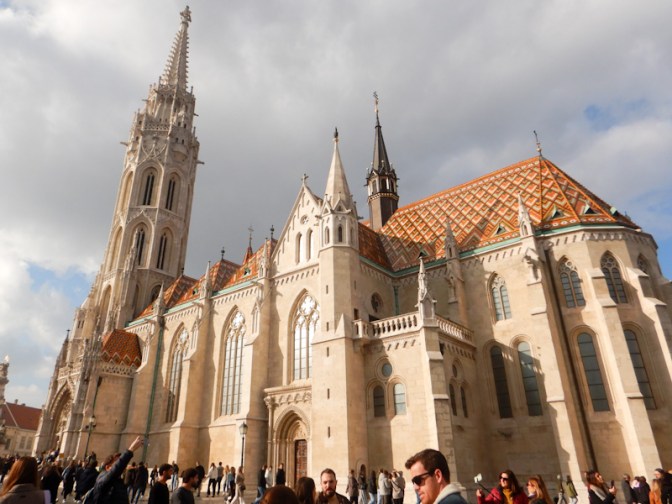
Only a few metres away was a fascinating interactive display of all the Hungarian Nobel Laureates in the sciences – including just one woman: Professor Katalin Karikó in 2023 for the ground breaking discovery of a non-inflammatory type of messenger ribonucleic acid (mRNA) which contributed to the rapid development of the first COVID-19 vaccine. There were only a couple of people near the exhibition compared to the thousands in the close vicinity – and even they weren’t looking at the display!

We wandered along the castle wall area past a closed art gallery (it was a Monday so most museums were closed). There were fabulous views including right across the city to the tethered helium balloon floating high above the City Park.
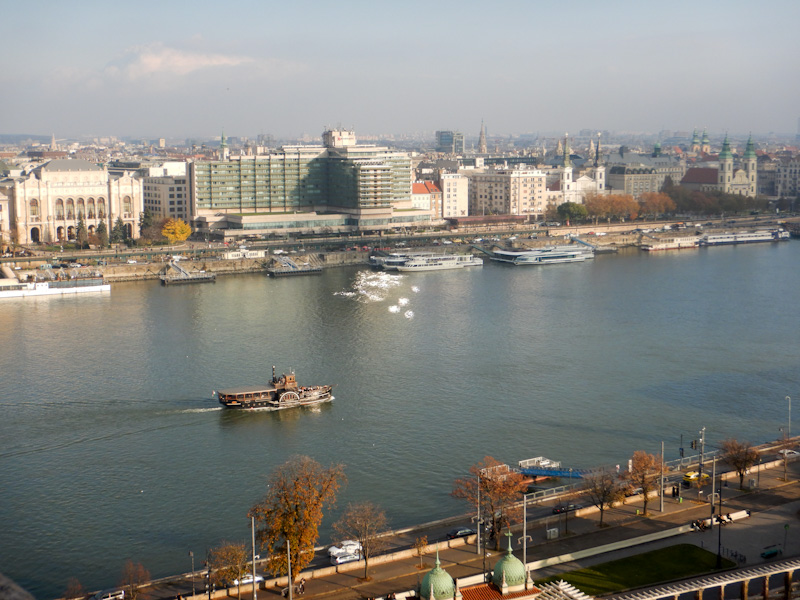
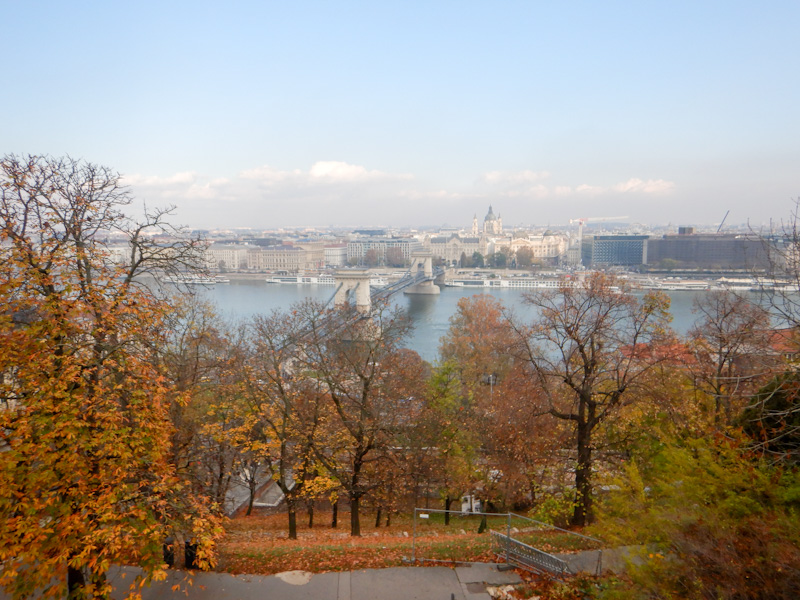
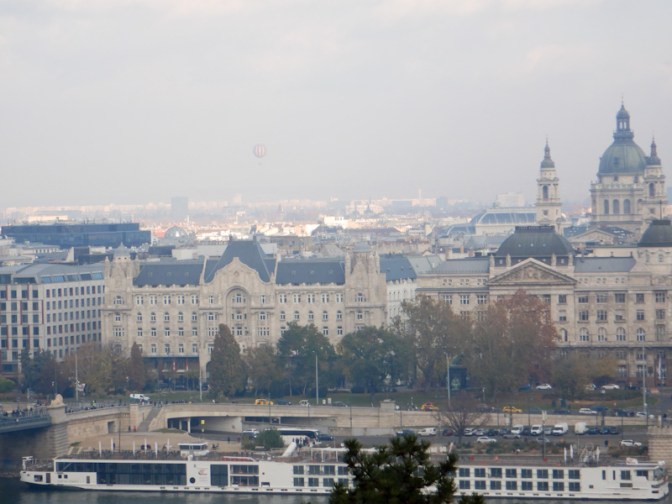
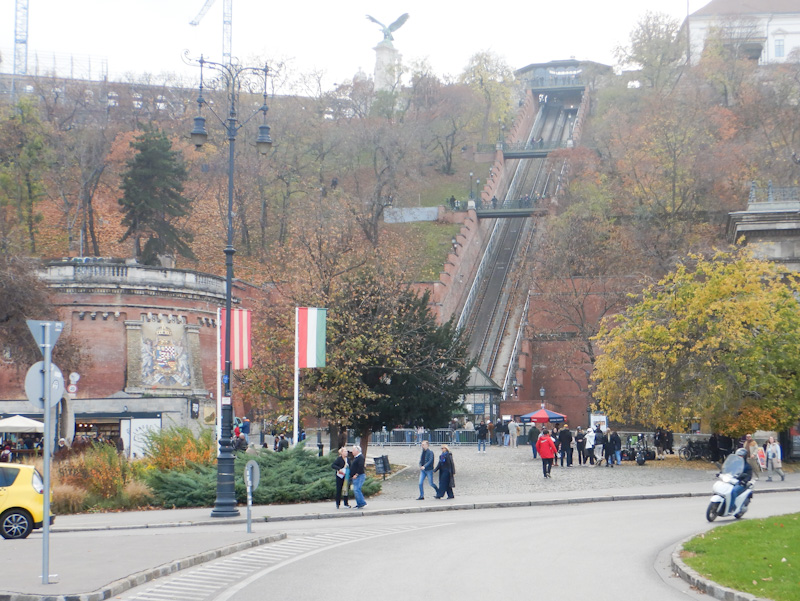
We walked down the steps rather than queueing for the funicular.
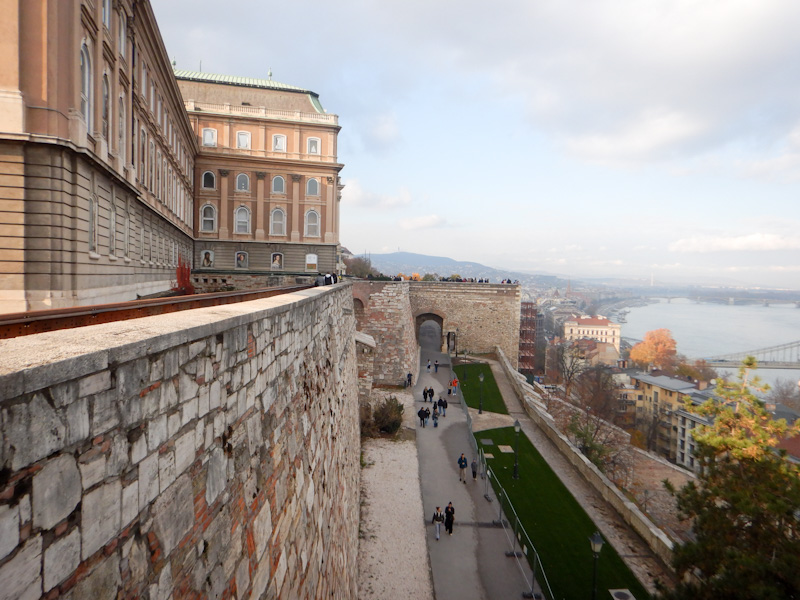
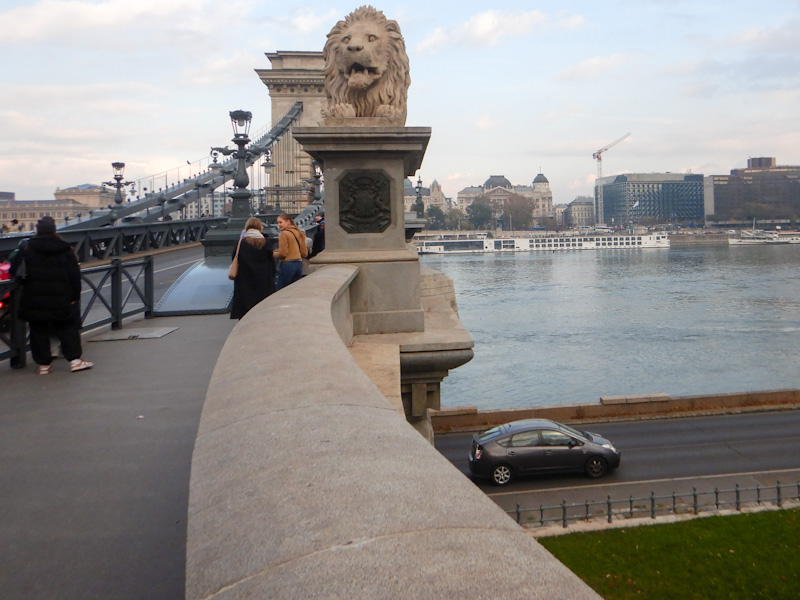
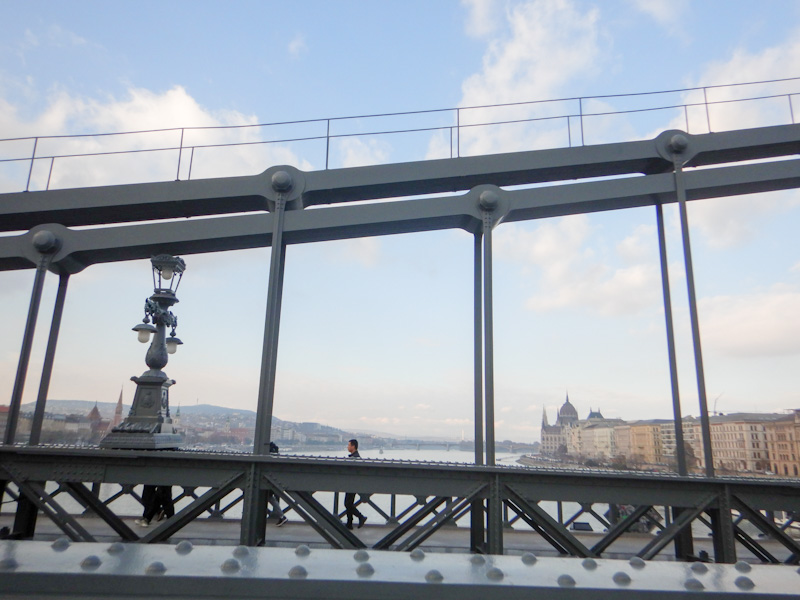
We crossed the river using the chain bridge, opened in 1849 and the first permanent bridge across the Danube in Hungary. Designed by the English engineer William Tierney Clark it’s a larger-scale version of his earlier Marlow Bridge, across the River Thames and was shipped in sections to Hungary. Local construction was supervised by the unrelated Scottish engineer, Adam Clark. It was blown up in January 1945 by the retreating Germans during the siege of Budapest but rebuilt and reopened in 1949.
We managed to book dinner in a Hungarian restaurant run by a Jewish family. The menu was packed with traditional Hungarian fare and I ate game goulash in red wine served with ewe cheese spaetzle. My desert was crepes with a Hungarian filling and all was accompanied by Hungarian wine.
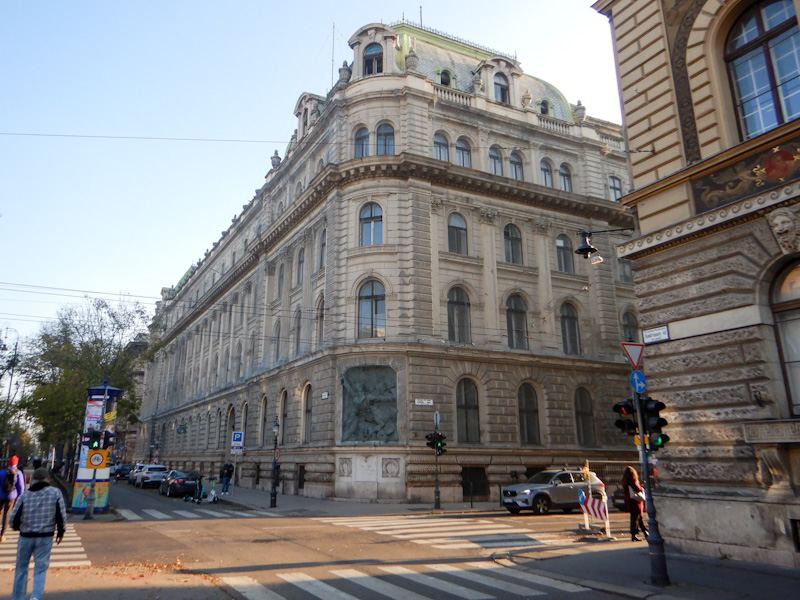
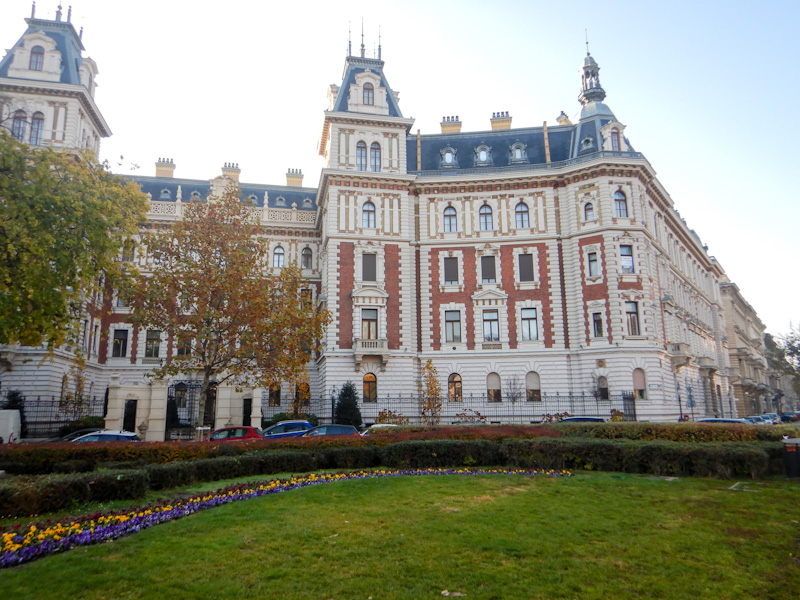
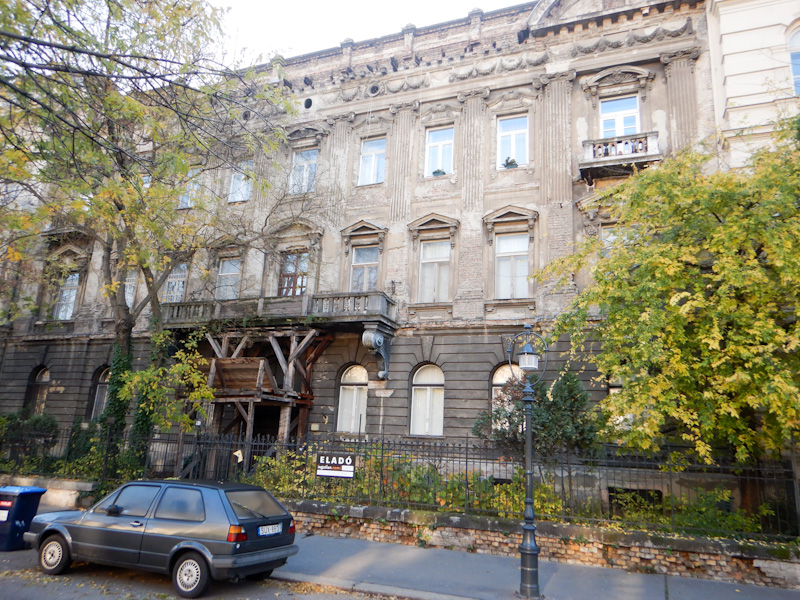
The following morning we set off on foot for Andrássy Avenue, a wide boulevard lined with spectacular Neo-renaissance mansions and townhouses in various states of repair. It’s been a World Heritage Site since 2002.
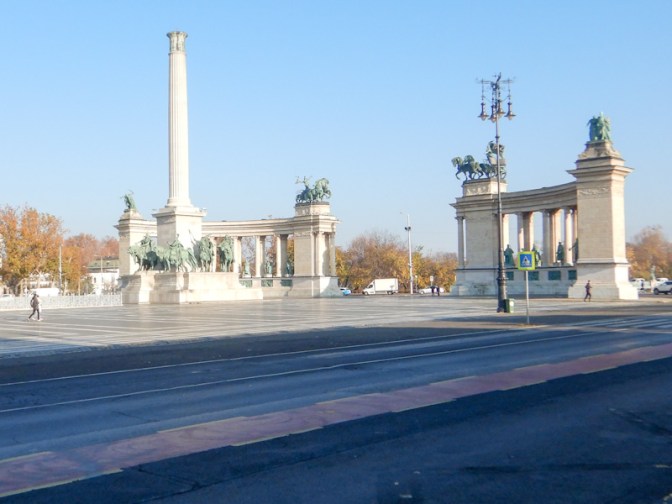
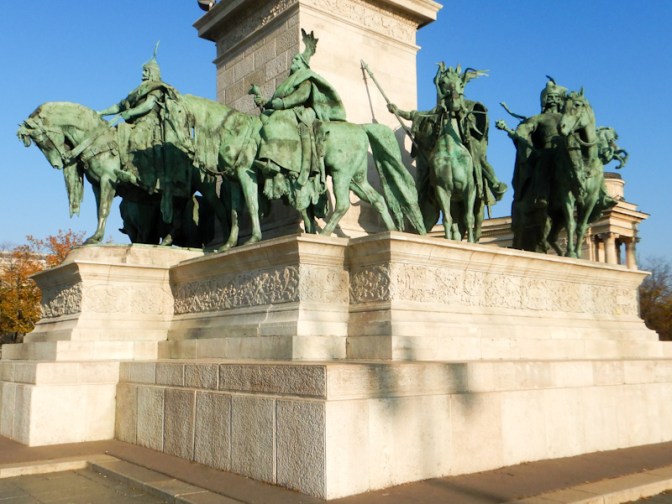
The street ends at the enormous expanse of Heroes Square, flanked by the Museum of Fine Arts and the Hall of Arts. The iconic Angel Gabriel statue on the large column has been removed for restoration. At the base of the column is a group of seven mounted figures representing the Magyar chieftains who led the Hungarian people into the Carpathian basin.
At the front of the monument is the Memorial Stone of Heroes (Hősök emlékköve), a large stone cenotaph surrounded by ornamental iron railings, providing a tribute to those who died defendinding the borders of Hungary. There aren’t any human remains interred but just an artesian well which provides water for the Széchenyi and Dagály thermal baths.
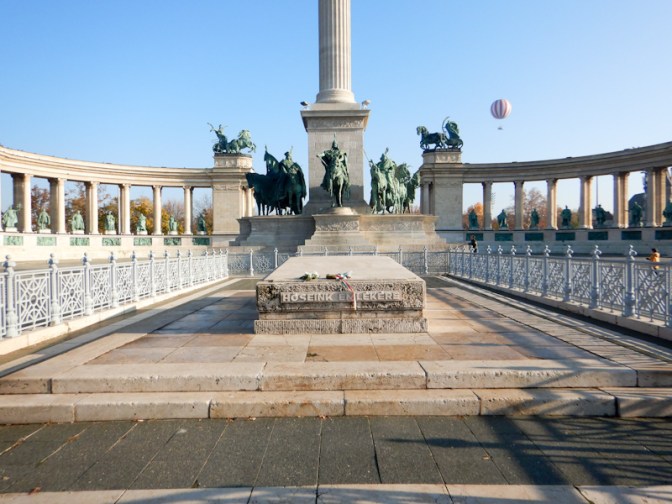
Behind the column are two matched colonnades, each with seven statues representing great figures of Hungarian history. On the left there’s also a statue representing labour and wealth and another representing war whilst on the right additional statues depict peace plus knowledge and glory.
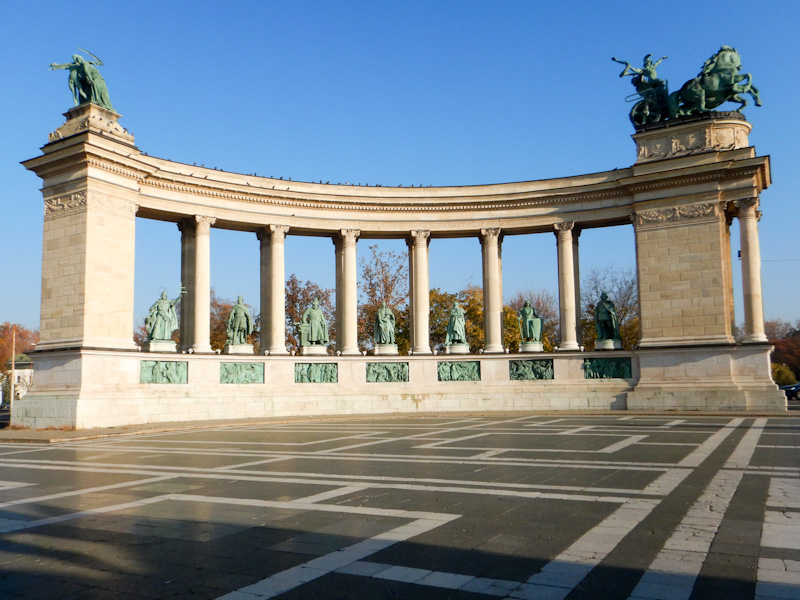
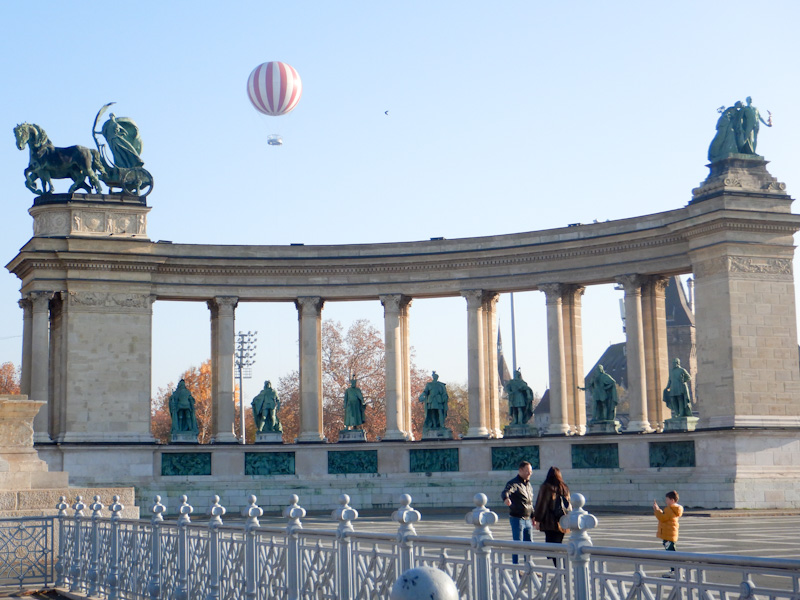
We walked on past the empty summer boating lake being made ready as a winter ice rink into the city park.

We walked past the fantastical Vajdahunyad Castle, a veritable hotchpotch of architecture.

We reached the launch pad for the helium balloon we had seen from the castle walls the previous day as well as when we were in Heroes Square earlier. Amazingly during the first two hours of opening on a Monday, an ascent is available for half the usual price if it’s open – I had missed my chance as that was yesterday!
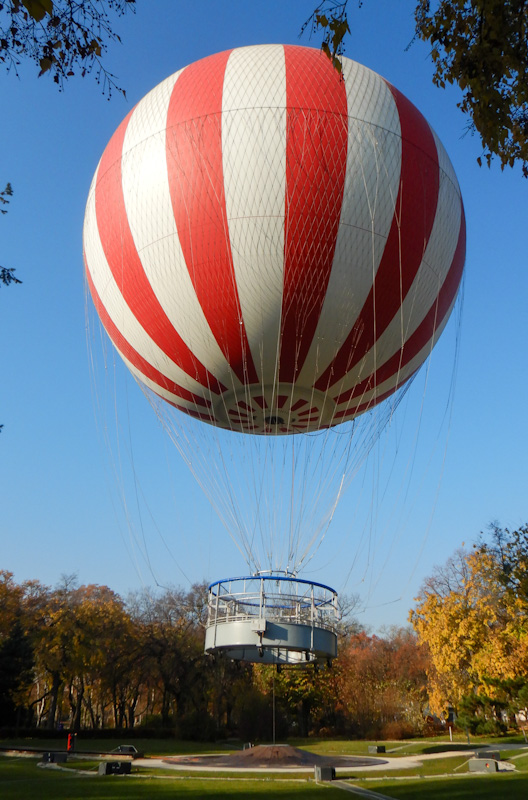
We returned to Heroes Square, which was becoming busy and then turned past the Museum of Ethnography, where we climbed up the sloping grass covered roof on the side steps to reach yet another vantage point.
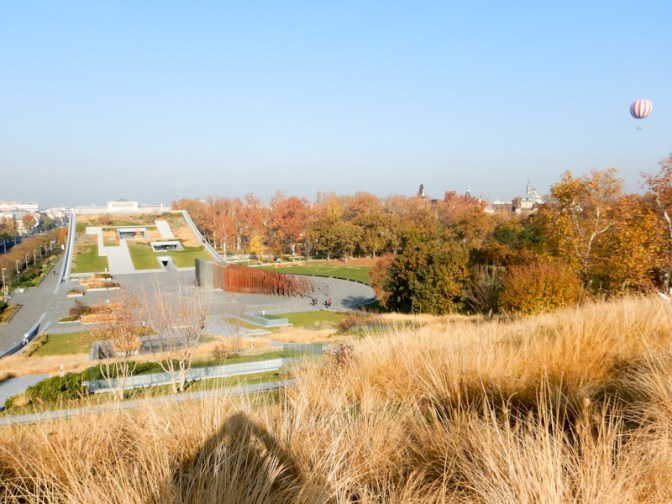
It was time to return to our hotel and checkout before boarding the luxurious high speed rail jet to Vienna – our fifth train day. We had upgraded to business class for a small supplement. The seats were luxurious and even reclined with a footrest. Sadly we waited and waited for the train to start before an announcement that it was cancelled due to a track issue and that we should transfer to a different train on another platform.
We rushed across, with the advantage of travelling light and somehow managed to find what were possibly the only remaining unreserved first class seats on the train packed now with its own load and the transferred passengers. There was already a couple in the six seater compartment and two women dumped huge cases and a coat on the floor in front of our seats and two empty but reserved seats opposite us. At the next station, an Australian couple who had reserved the two seats opposite boarded with lots of luggage. Fortunately we were all English speaking and so could explain that the other huge cases weren’t ours. We just pushed them out into the corridor as we didn’t know where the owners had gone! Things became even stranger when our tickets were checked and the couple who had already been in the compartment when we boarded were despatched to second class. Now we were just four people in a compartment for six. The ladies with the cases and coat came back looking for their cases which by then had slid down the corridor.
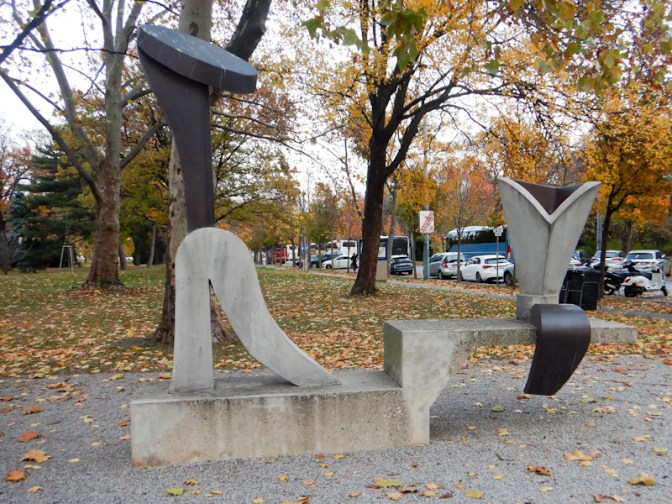
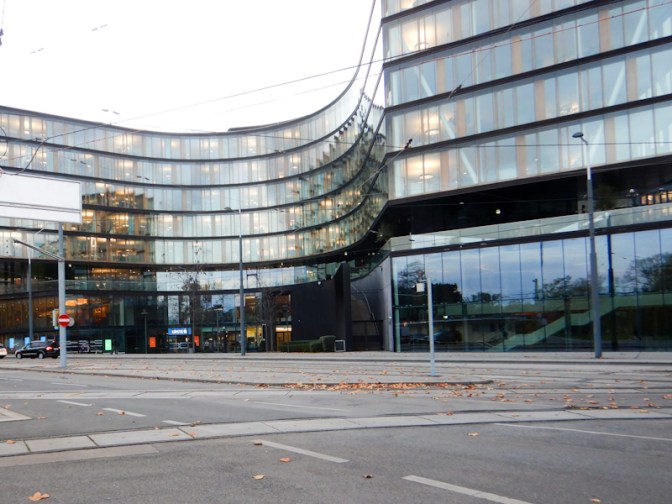
At last we arrived at Vienna. Our hotel was very close to the station. Sadly the delay meant that there was little time to commence our explorations of the city and we just looked at the nearby Swiss Garden where there are lots of sculptures, returning to our hotel past some very futuristic looking apartments and offices.
Dinner was at the conveniently close Vapiano where I managed the on-line ordering system while my husband relaxed! We thought it was a chain based in Vienna but are clearly behind the times – our daughter has visited one of the London branches. Anyway we enjoyed the fresh pasta based meal.
Next day was our sixth train day but it didn’t start until the evening. This was our opportunity to do Vienna in a day – possibly even more audacious than Budapest in a day and a morning. The hotel breakfast was one of the best and we set off having left our luggage securely at the hotel.
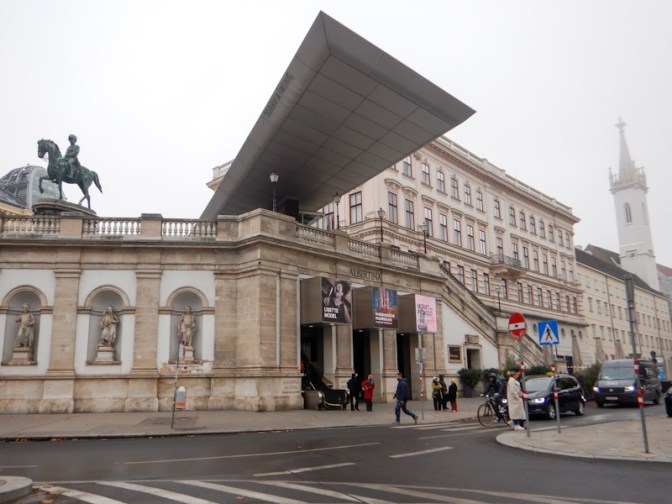
We walked around the Museum quarter near the famous Spanish Riding School.
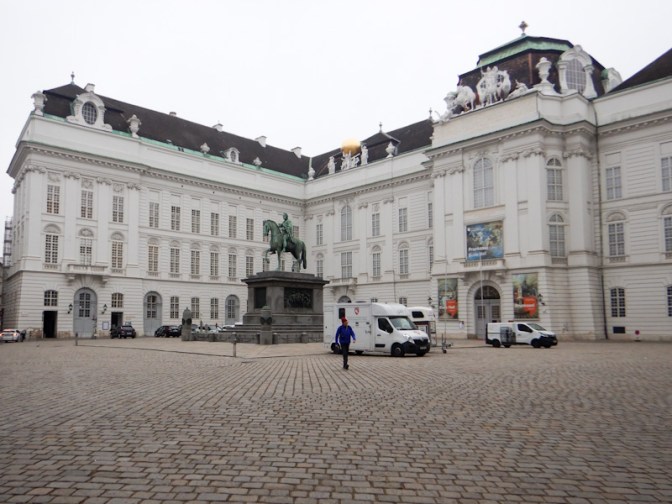
The statues and squares all seemed larger than life.

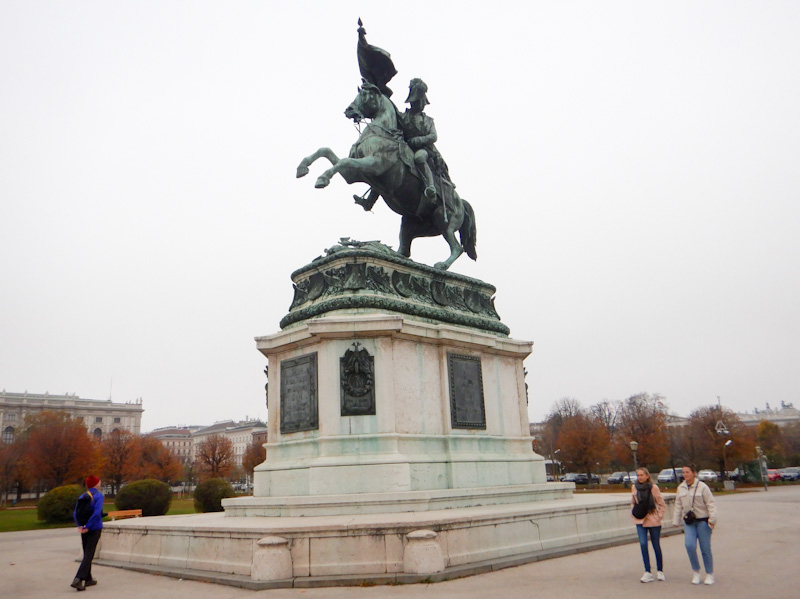
We noticed some large groups of tourists. We enjoyed the obligatory Viennese coffee and cake.

Horses and carriages were being driven along the streets to entice visitors to ride.
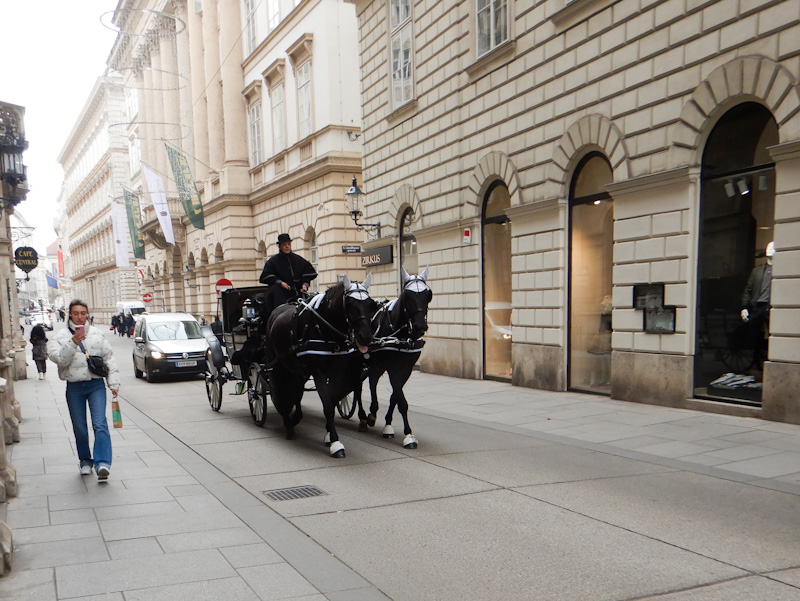
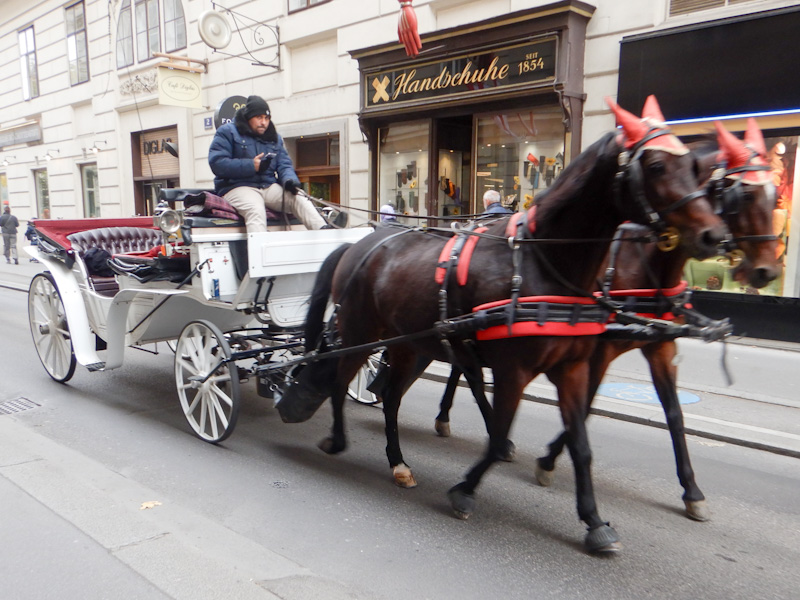
Christmas markets were being set up.
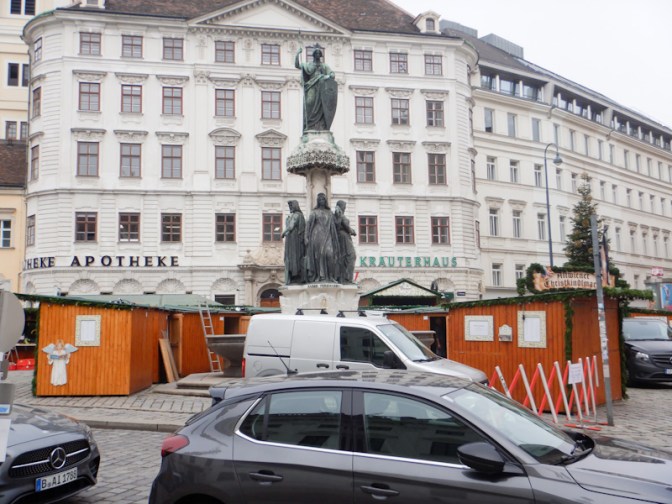
We walked through more squares past lavish, expensive shops.
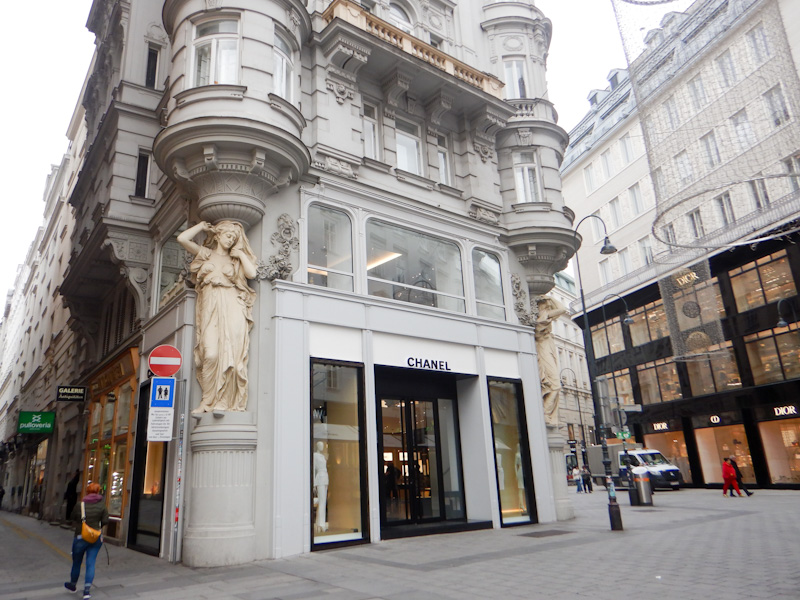
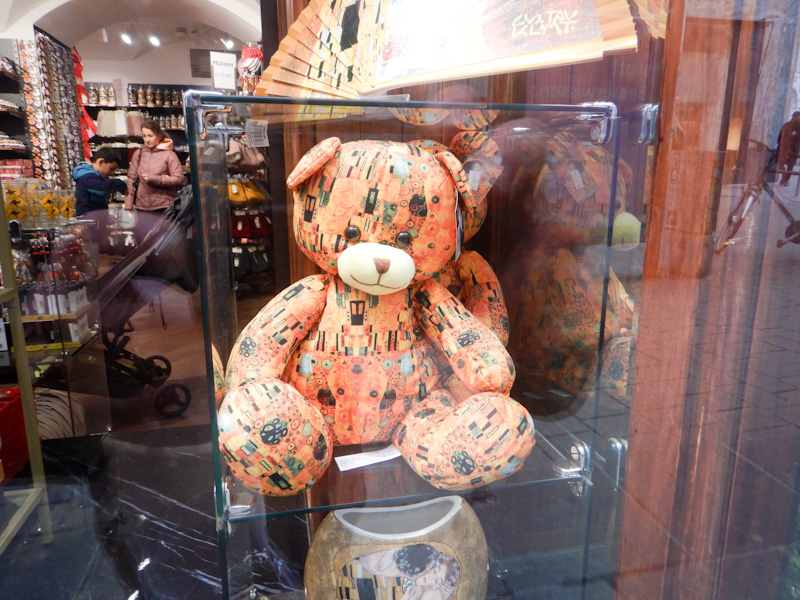
We found the Anker Clock in plenty of time to see all the figures passing by at 12 noon, accompanied by music. It was surprising how many other tourists were waiting for this to happen even fifteen minutes before it started, although oddly many left partway through the “performance”.
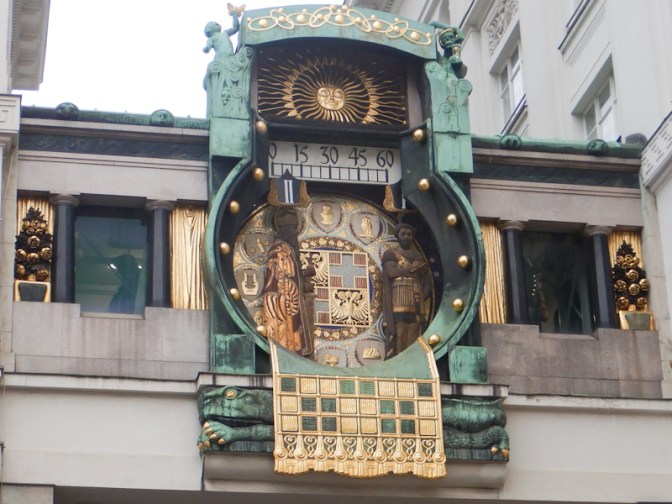
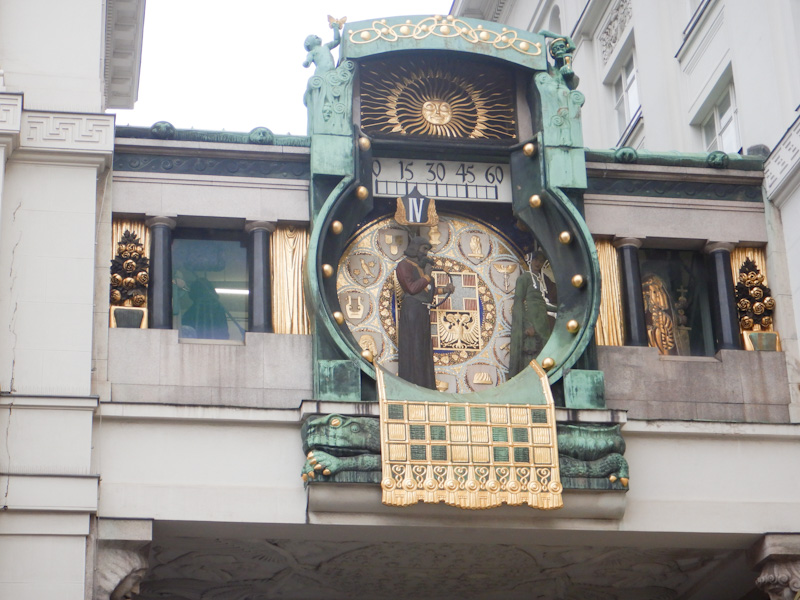

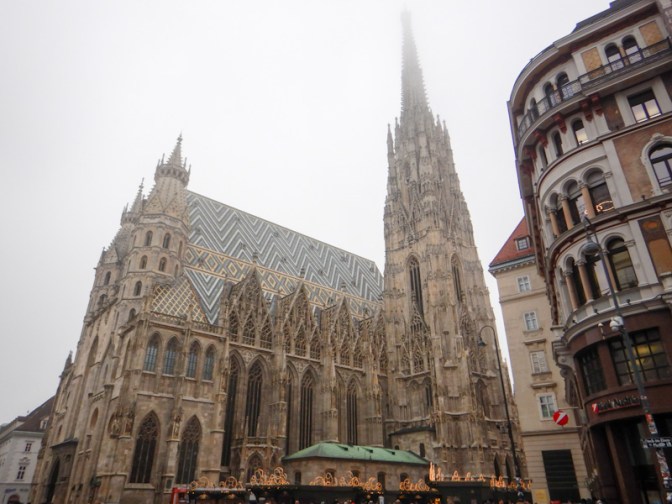
At the Cathedral, mass was in progress so we didn’t stop.
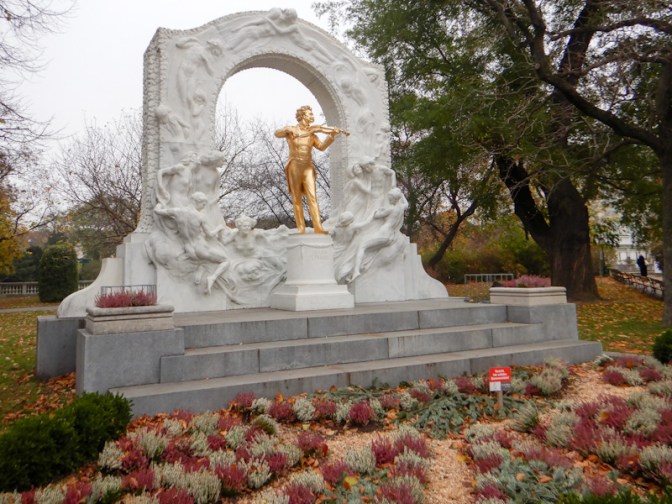
We walked to the Stadt Park to look at the statues especially the most famous Strauss statue.
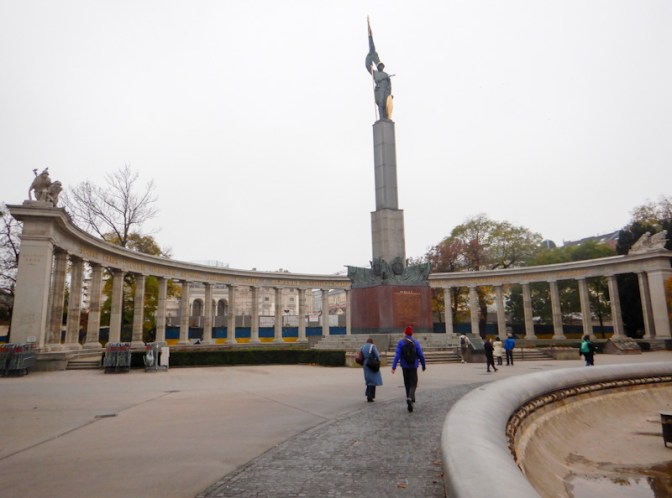
We walked past the Russian War Memorial.
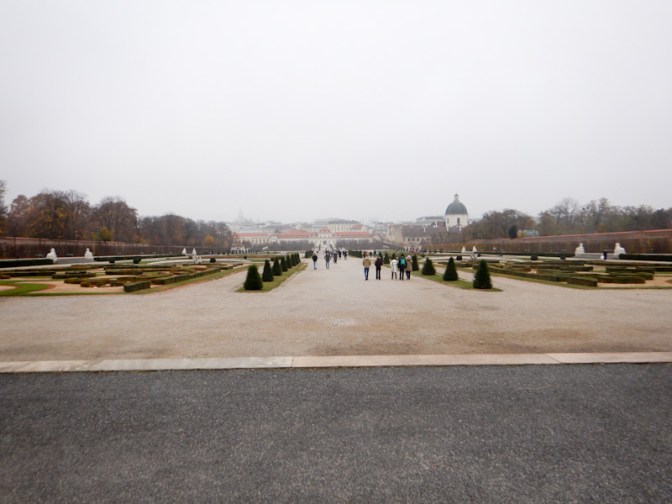
We reached the Belvedere Art Gallery. It’s in three sections but we just had time to visit the Upper Belvedere. The Baroque Gardens are reputed to be amongst the most beautiful in the World and one of Europe’s most significant historical gardens. We could see them from vantage points in the Gallery but in the cold weather weren’t keen on more wandering around.
There was a lot of art to see, all housed in the historic setting of the Baroque Palace. The works include the World’s largest collection of Gustav Klimt paintings with the most famous being “The Kiss” as well as works by Monet, Munch and others both well and lesser known. The current exhibition explores the interactions between art and society from 1200 to the 1970s showing how political and social environments, migration, international networks, and economic
conditions influence artistic production in any given period.
We opted for the convenience of eating at Vapiano again after our long and tiring day before picking up our baggage from the nearby hotel and heading for the railway station.
We had booked our own sleeping compartment on the train. The top bunk was a long way up and there was no safety barrier. However, we both survived the night and I didn’t fall out! The train changed direction and stopped at several stations overnight as well as crossing the borders from Austria to Hungary and then to Romania – a new country for us both. We didn’t have to be woken at the border into Romania as the sleeping car attendant took our reservation papers which were evidently sufficient. We had carried our own food on board for breakfast – nothing was provided except a bottle of water. There was toilet paper so carrying our own as advised in some information had turned out not to be necessary this time.
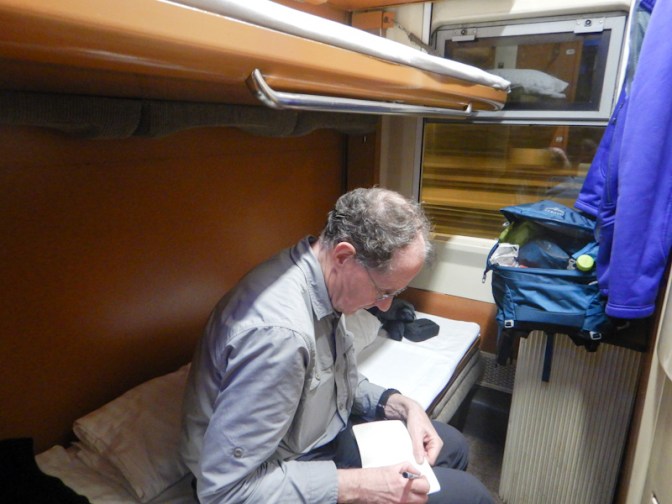
The reason for backtracking to Vienna then returning east through Budapest was because we preferred to board the sleeper in the early evening at Vienna rather than between 10 and 11pm at Budapest.

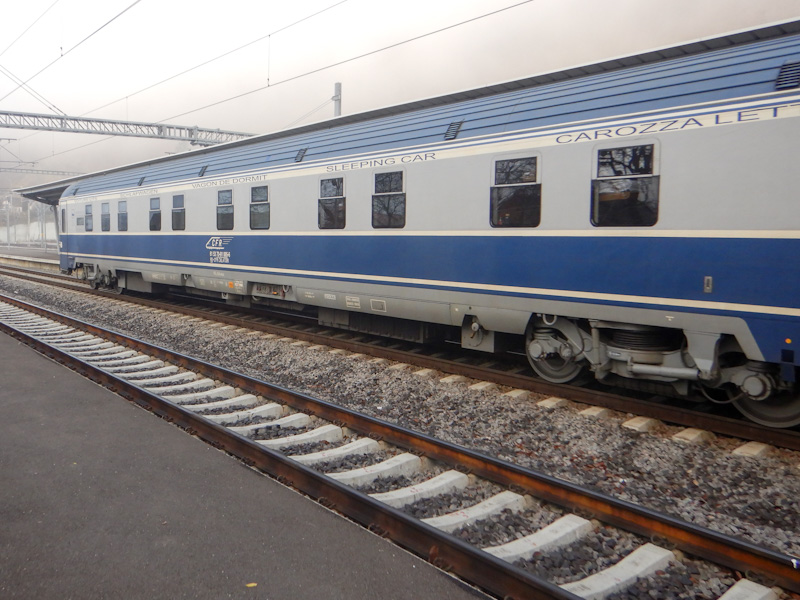
We were up and dressed in plenty of time for our arrival at Sighișoara. It seemed that the line was in the process of being improved as there were stations with new electronic boards, some of which were still covered in plastic. We couldn’t see the names on the stations and were getting worried as to how we would know when we arrived at Sighișoara. However, we had reckoned without the helpful sleeping car attendant who ensured that everybody was up and about in good time to disembark at their destination. He explained that we were late but in fact we realised afterwards that we arrived at more or less the expected time and that the train is “always” late compared to the timetable.

I received an e mail from Casa Savri, where we were booked to stay, asking about our arrival time so I sent a reply to enquire whether we could leave our bags there all day. In fact we walked from the station to the accommodation and on arrival we were told that we could even check-in and have our room straightaway! it was an enormous traditionally furnished room – the hotel building had a partially covered courtyard at the centre and there were many fascinating artefacts on display.
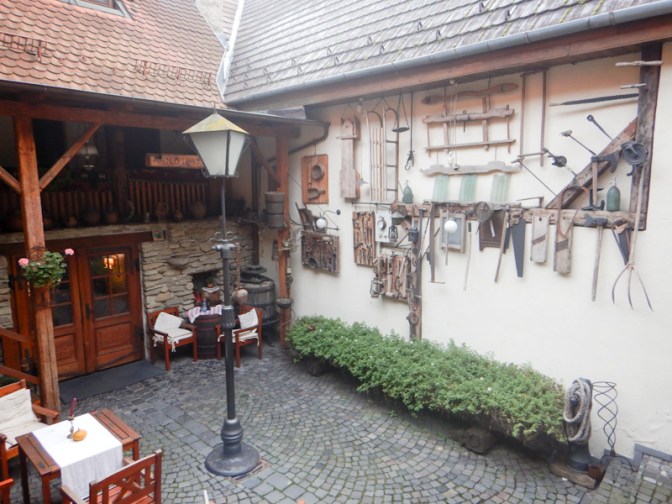
We must have slept reasonably well on the train as we were ready to go out and explore the town.

Our first stop was at a Bureau de Change to buy some Romanian Leu – it’s almost six leu to the pound and there aren’t many coins. Even 1 leu comes as a note!
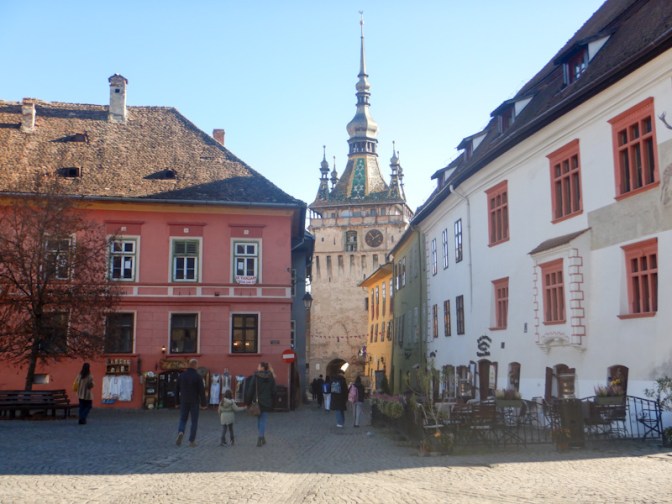
The town had evidence of habitation from the Bronze Age then Romans and Dacian settlers from the First Century AD. It became one of the seven Saxon walled citadels in Transylvania.
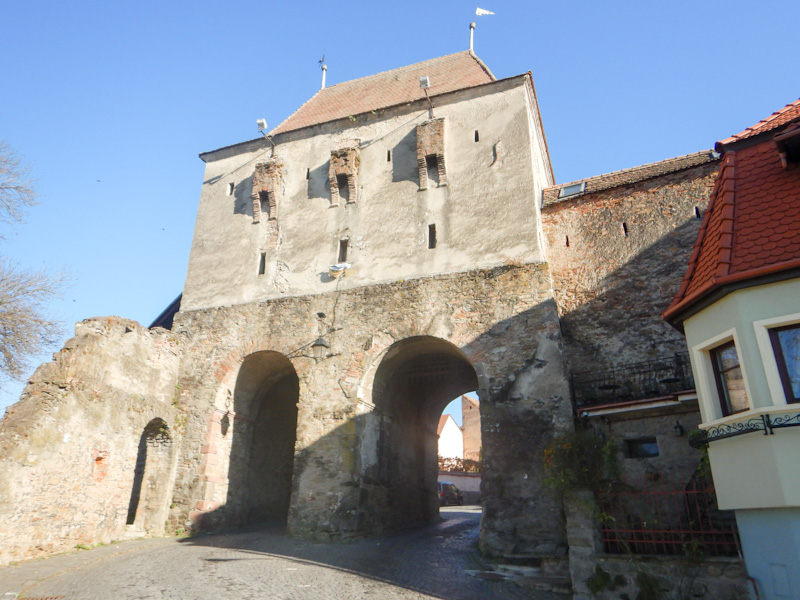
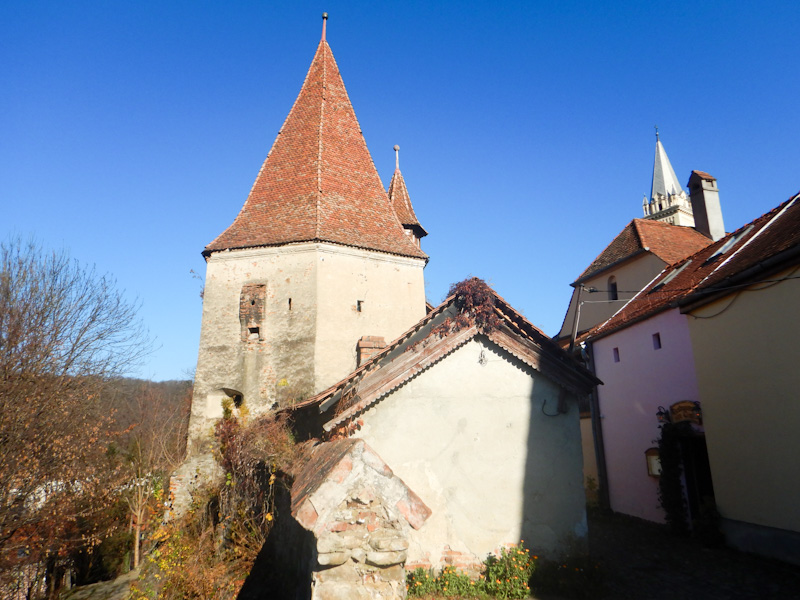
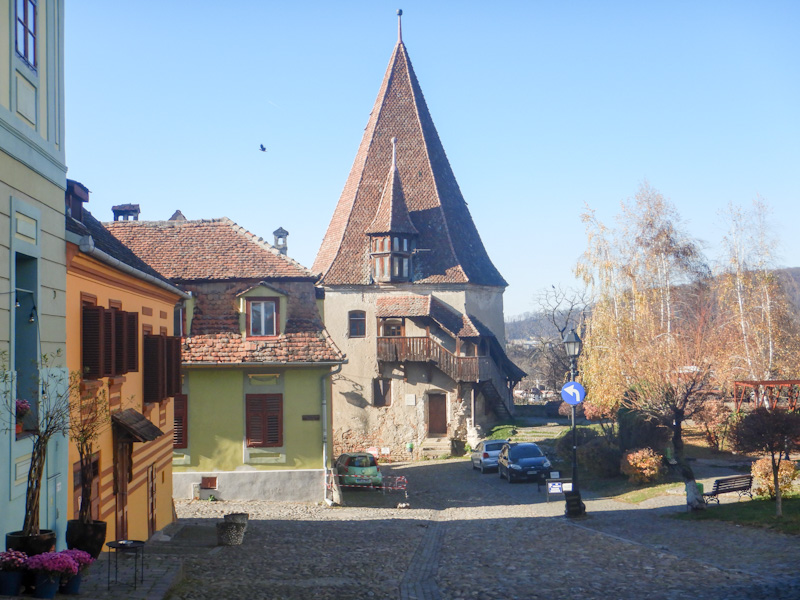
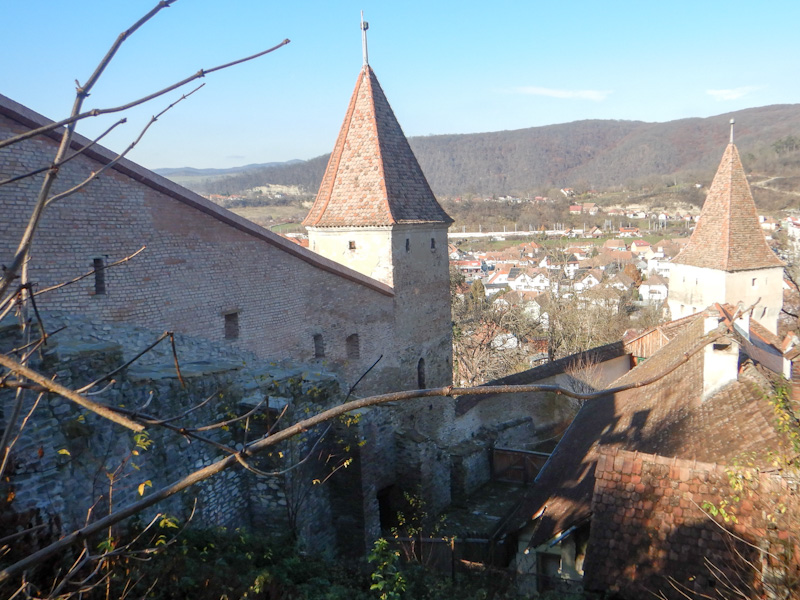
Some of the medieval town wall originally built in the twelfth century has been restored along with the towers, each built, maintained and defended by a craft guild. Nine of the fourteen towers are still standing.
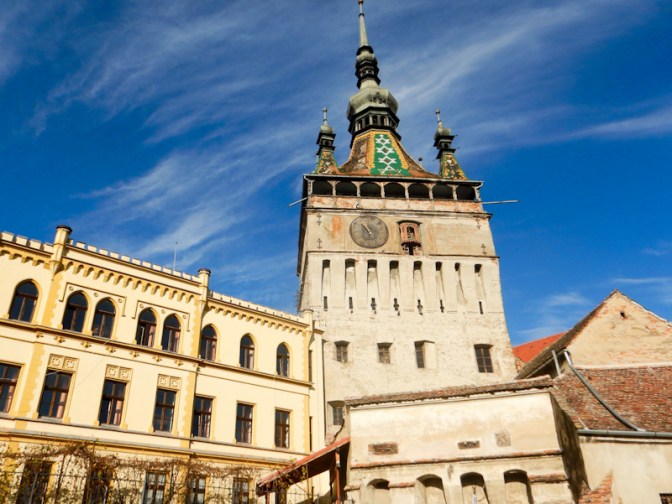
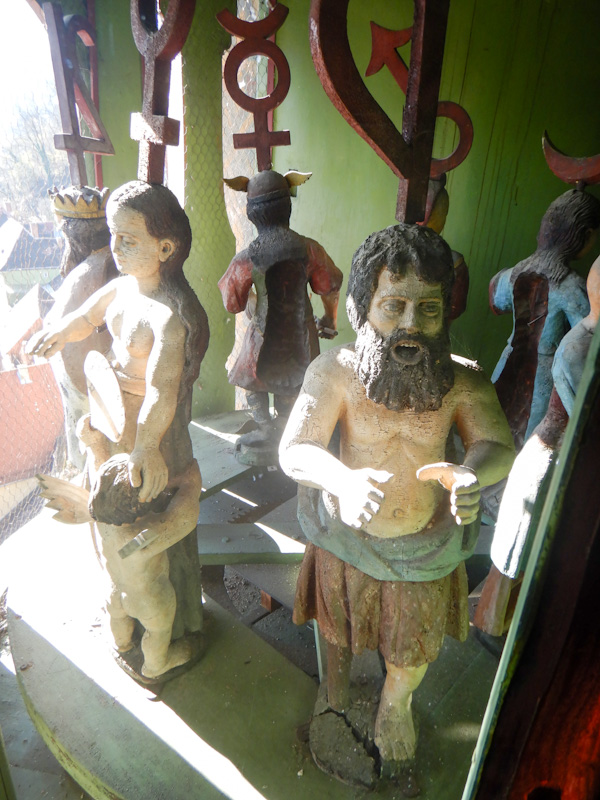
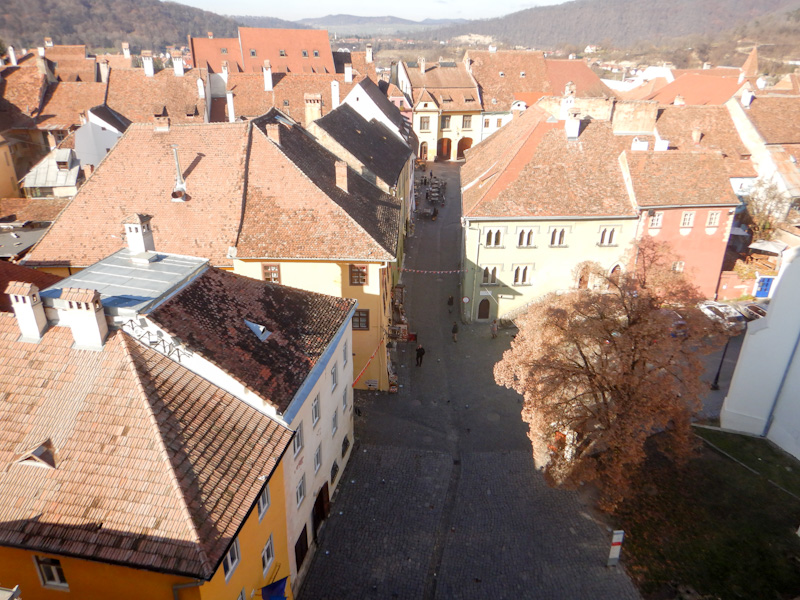
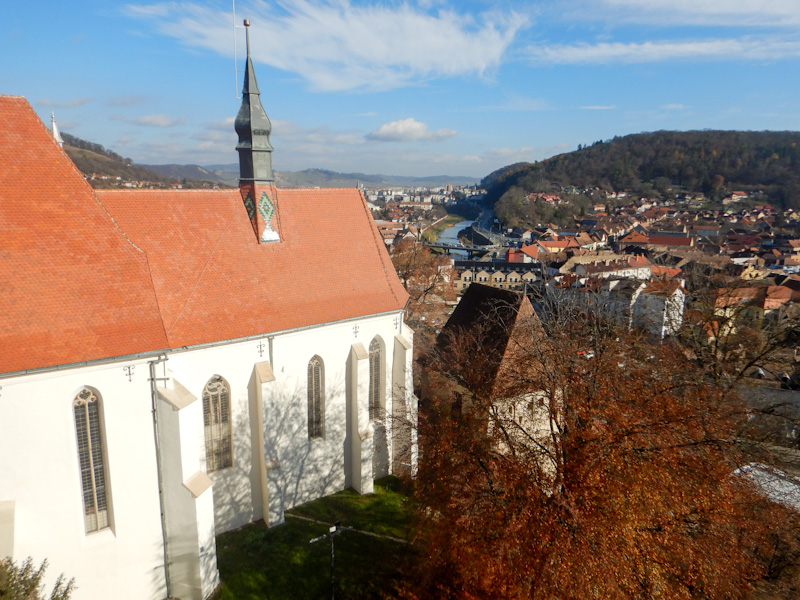
We visited the town museum and climbed the 14th century clock tower.

A number of very well behaved 4-5 year olds were at the museum on a kindergarten visit – but they didn’t climb to the top of the tower.

We spotted the weapons museum (the children were heading there) housed in the Vlad Draculae House – Vlad the Impaler, ruler of the province of Walachia was born in Sighișoara and was the inspiration for Bram Stoker’s fictional Count Dracula.

However we ascended the Students’ Stair, a covered stairway built in 1642 linking the main square with the Church and School on the Hill. it was meant to provide a covered walkway between the lower and upper sections of the citadel. 176 steps of the original 300 remain.
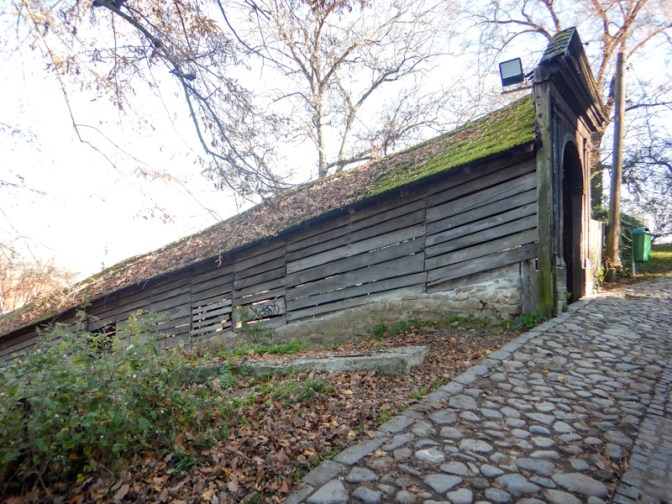
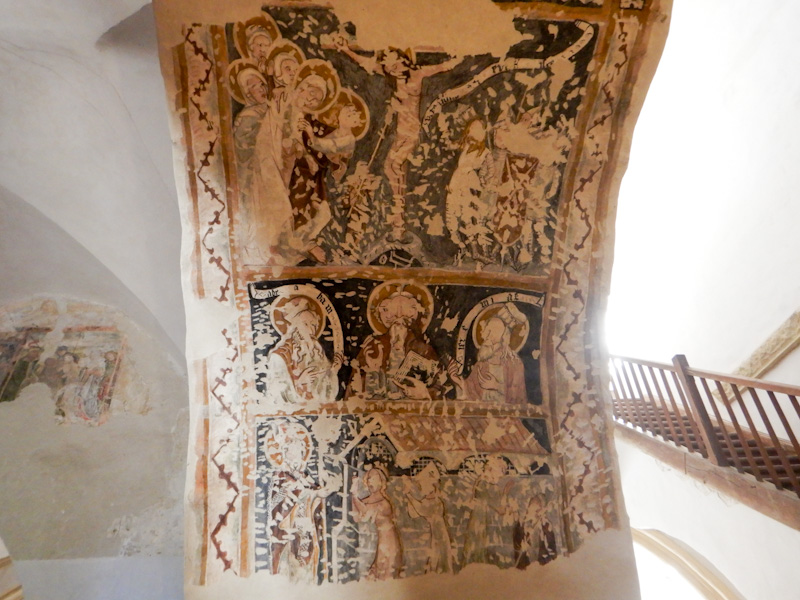
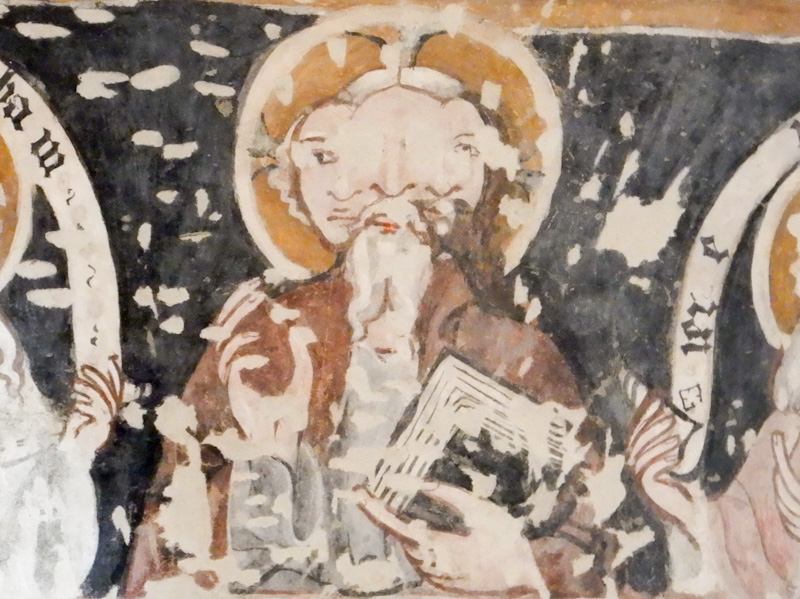
The Church on the Hill was initially a Catholic Church but became Lutheran after the 1547 reform. Recent restoration has revealed fourteenth century wall paintings including a rare depiction of The Trinity as God with three heads.
The next morning we enjoyed an amazing breakfast including Romanian specialities – sheep cheeses, spicy vegetable spread and various cakes before heading off to the railway station.
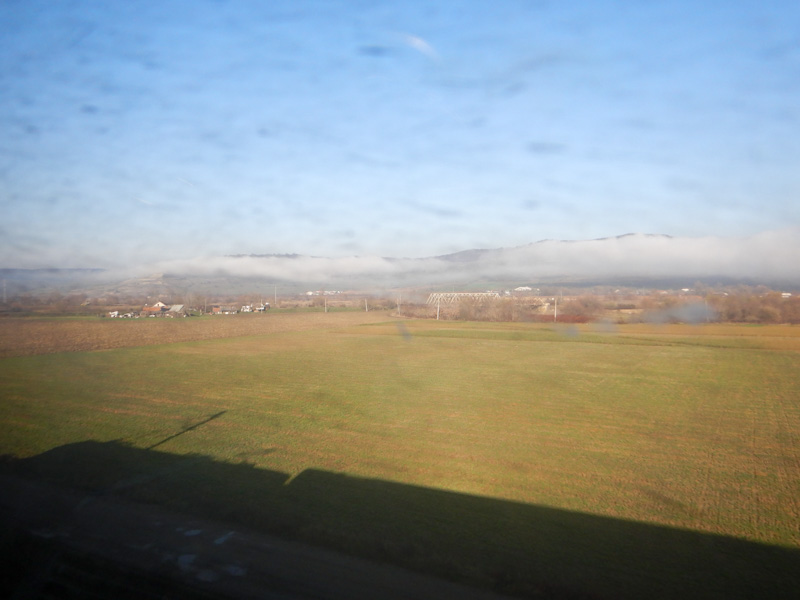
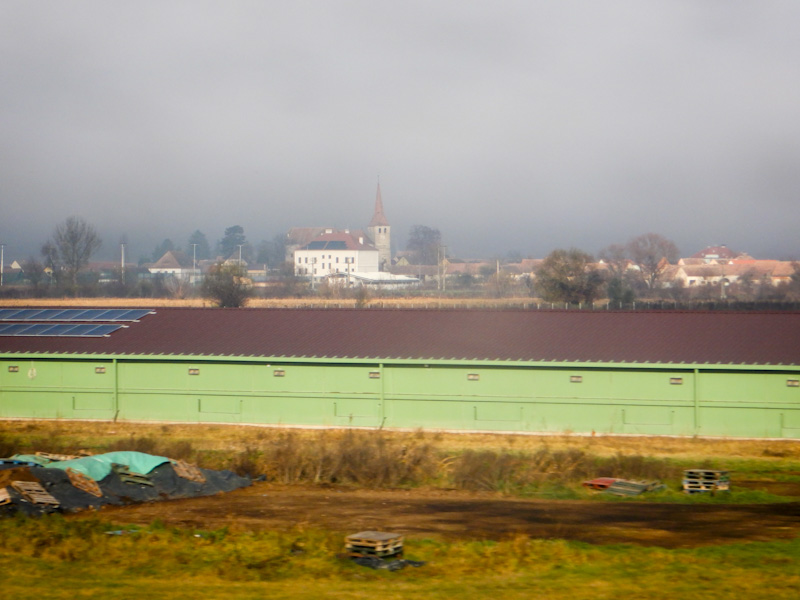
This wasn’t a day we were using our pass as we had discovered that we could buy a ticket to Sibiu for 18 leu each (just over £3). It’s a 95km journey taking over two hours travelling time in total on two different trains.
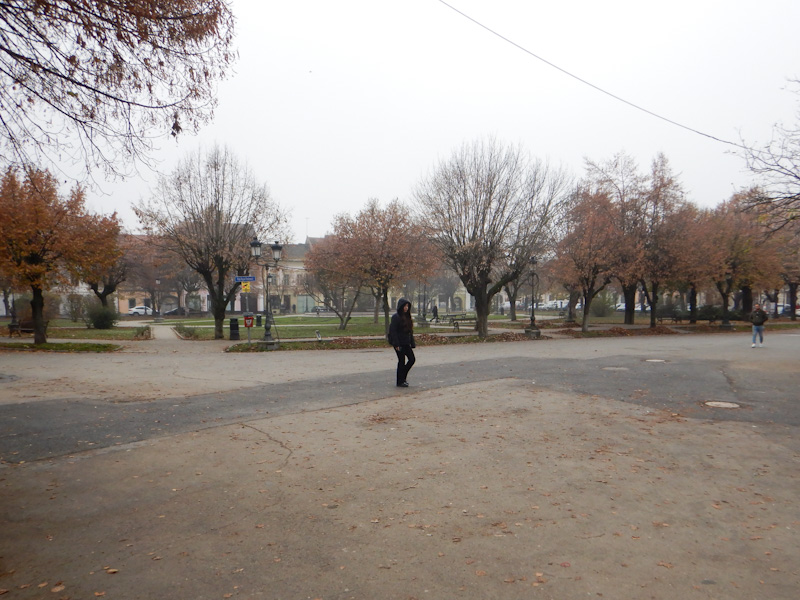

We had almost two hours at Medias, also one of the Saxon walled citadels so we visited the town. The fortified fifteenth century church of St Margaret dominates the town.
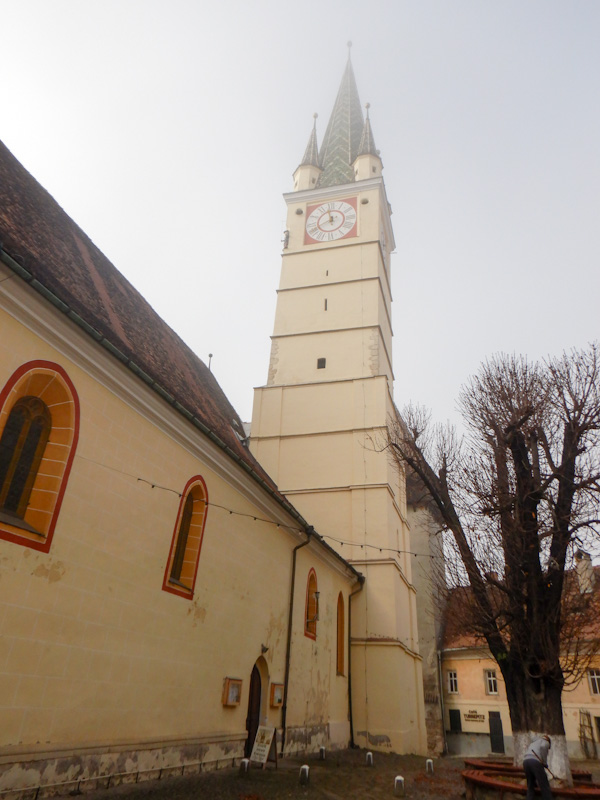
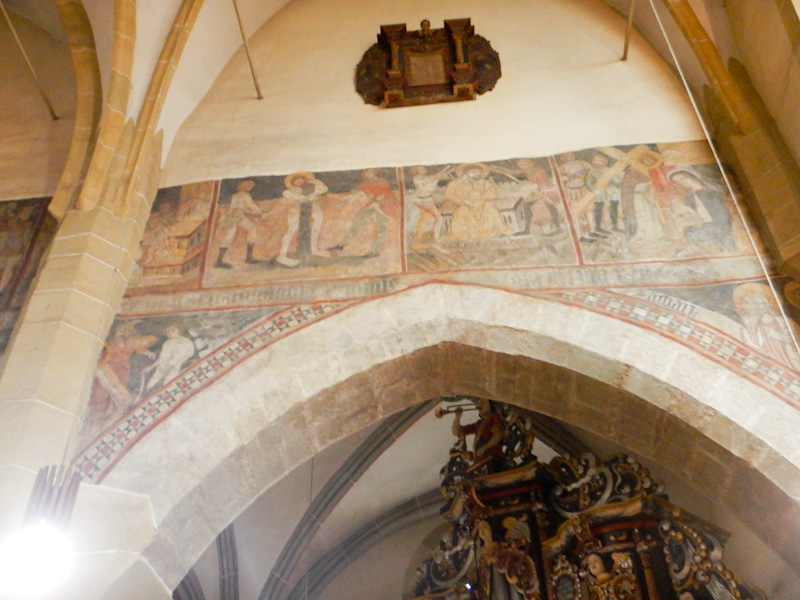
Like the church at Sighișoara, it was originally Catholic but became Lutheran at the reformation when the wall paintings were covered. Many of these paintings were uncovered and restored in the 1970s.
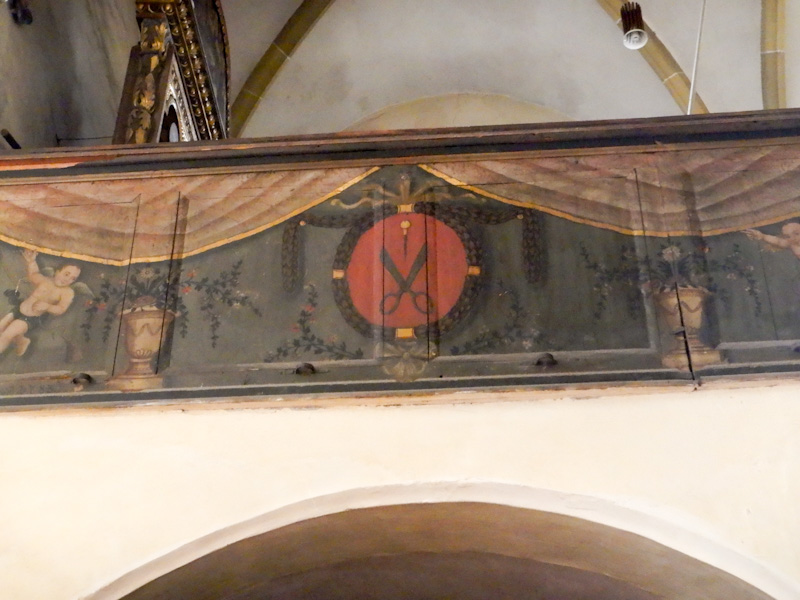
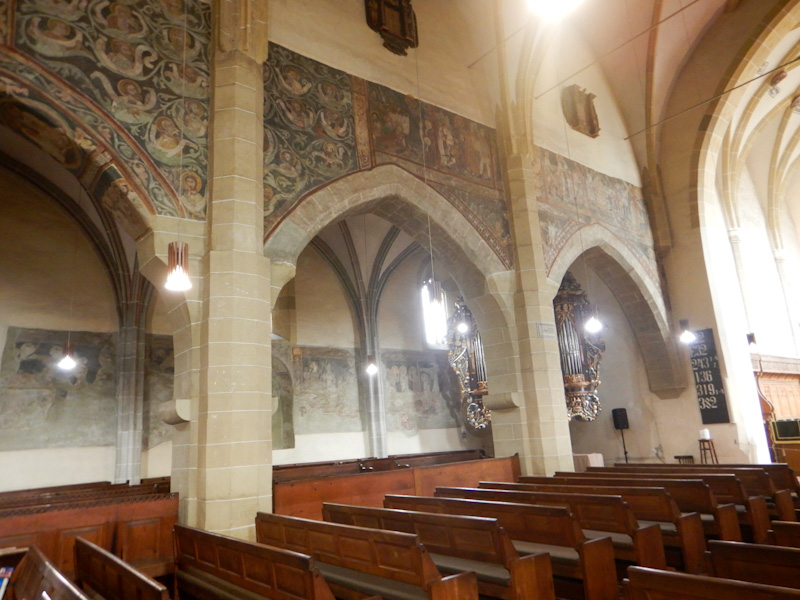
We also saw a wonderful collection of 14th and 15th century oriental rugs donated by the local tradesmen – the medieval town was dominated by the craft guilds. The church houses the oldest font in Romania.

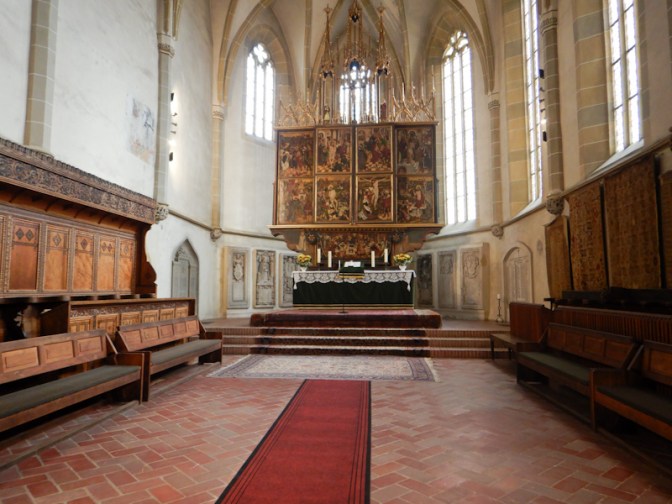
The lady who showed us round spoke excellent English and told us all about the three folding Gothic altarpieces and the various organs – including ones rescued from closed rural churches where they were at risk of vandalism.
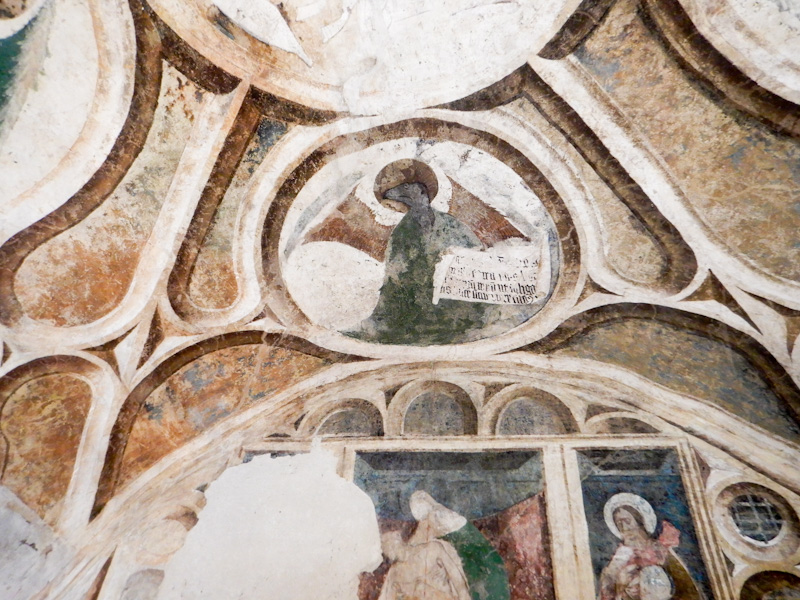
She even took us outside the church to see the small chapel within the walls where the small number of Catholics met after the reformation. This features a rare wall painting showing God the Father holding Jesus after the crucifixion. Other paintings depict the Gospel writers with their traditional heads and also paintings of all the apostles.

We just had time to buy a traditional cheese filled pancake for lunch before returning to the station to catch the second train.
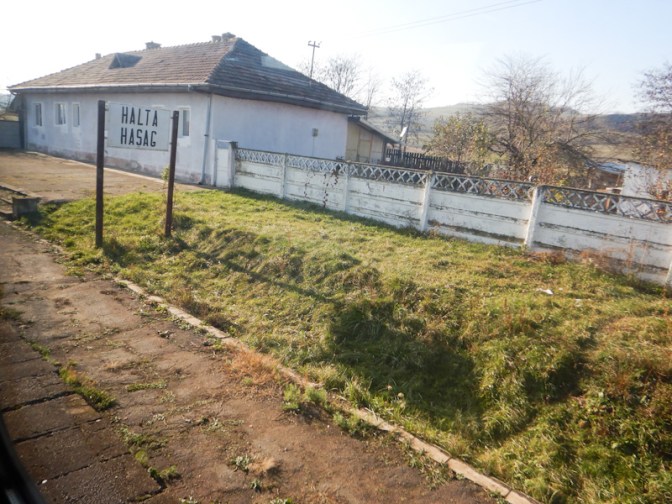
The train passed many small halts and we stopped at several. We spotted vines, maize and hops growing. In the towns we could see austere concrete-built blocks of flats.
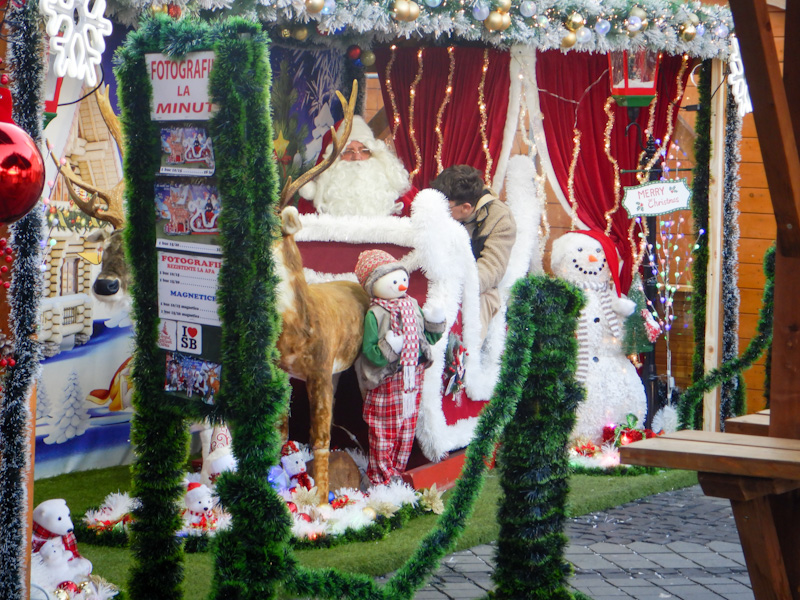
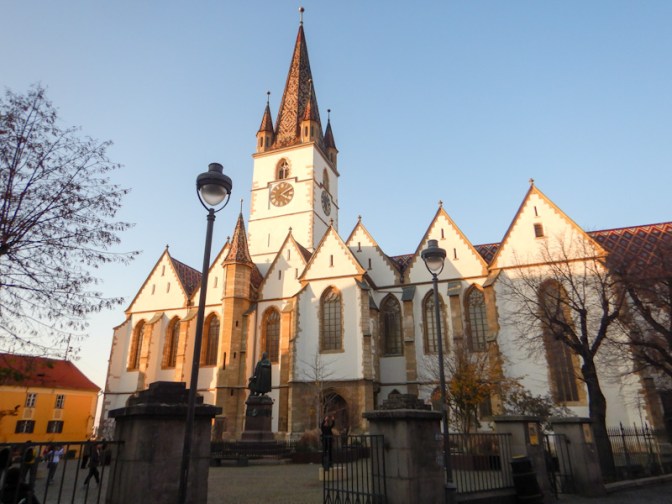
At Sibiu, our booked accommodation was outside the main part of the town. We walked back past the railway station into the town, where the Christmas market was already open (Friday 14 November), possibly for the first night of the season.
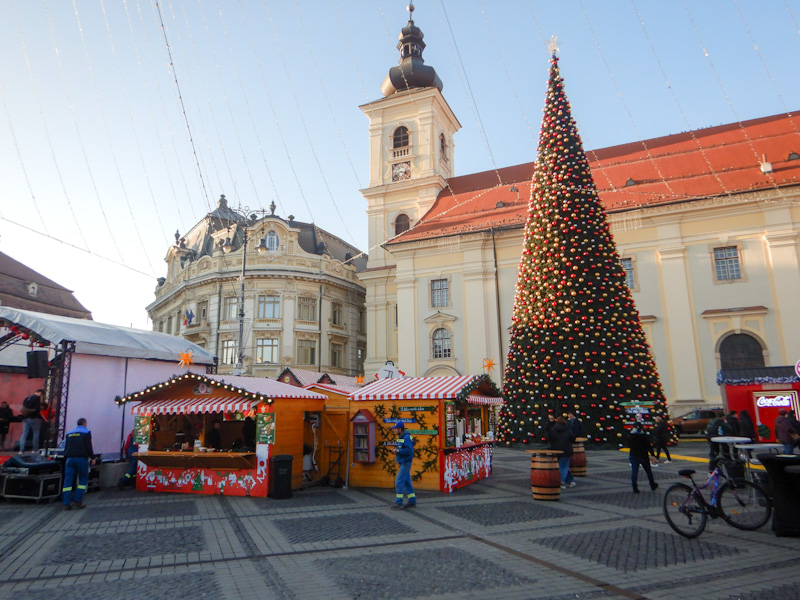
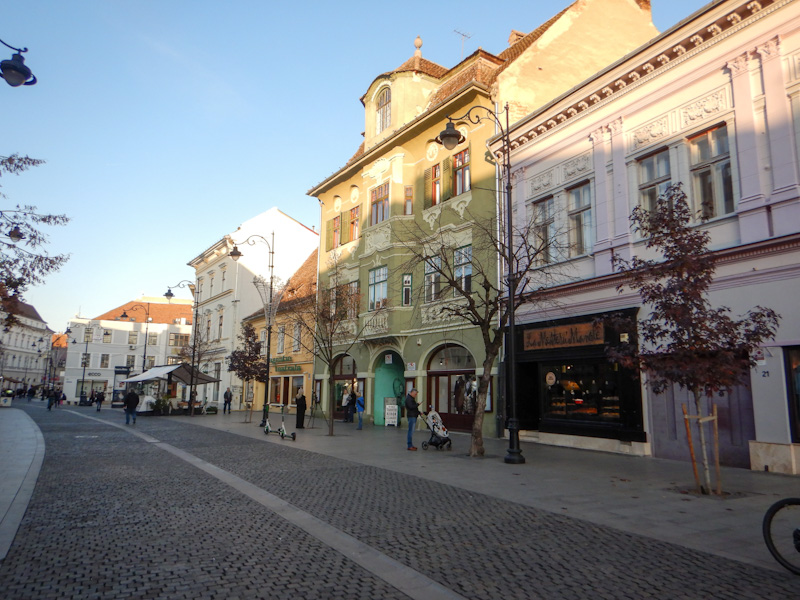
Sibiu was the largest and wealthiest of the seven walled citadels, with 39 defensive towers of which nine remain, five bulwarks, four gates and five artillery towers. The riches amassed by its guilds paid for the construction of impressive buildings and the fortifications to protect them.
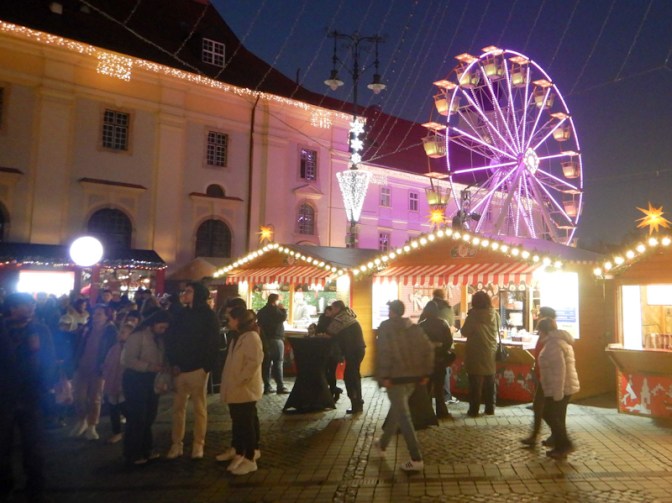
We wandered round and ate hot dogs and crepes as well as drinking the traditional vin fiert (mulled wine) before returning to our room.
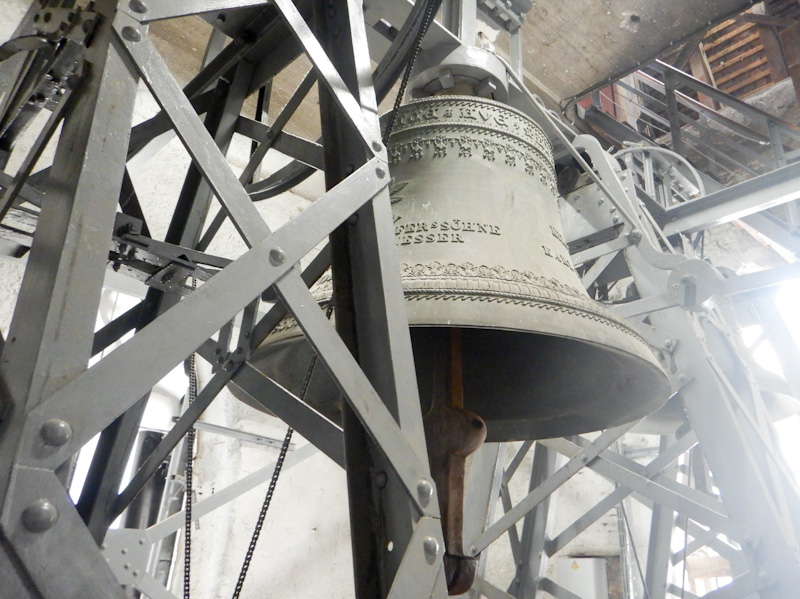
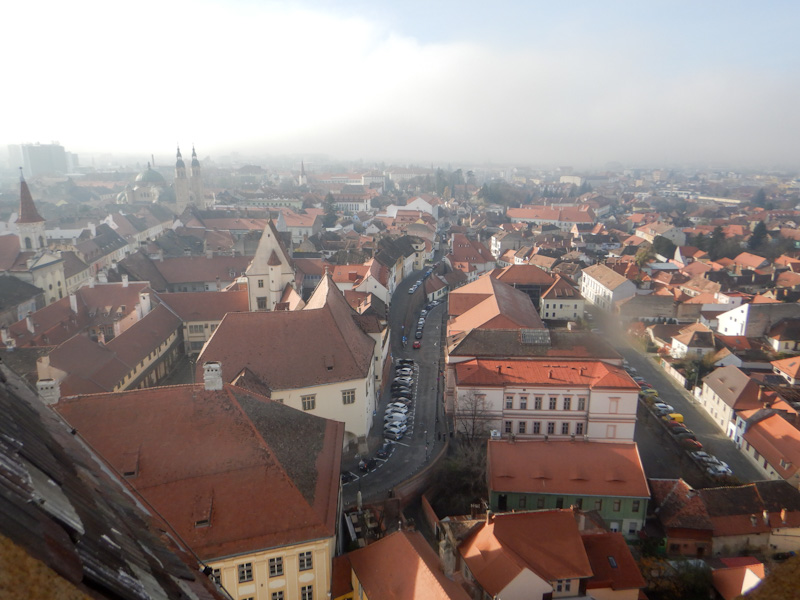
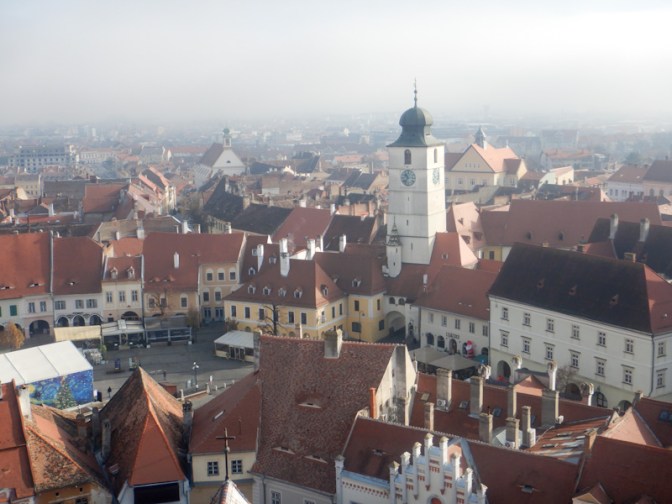
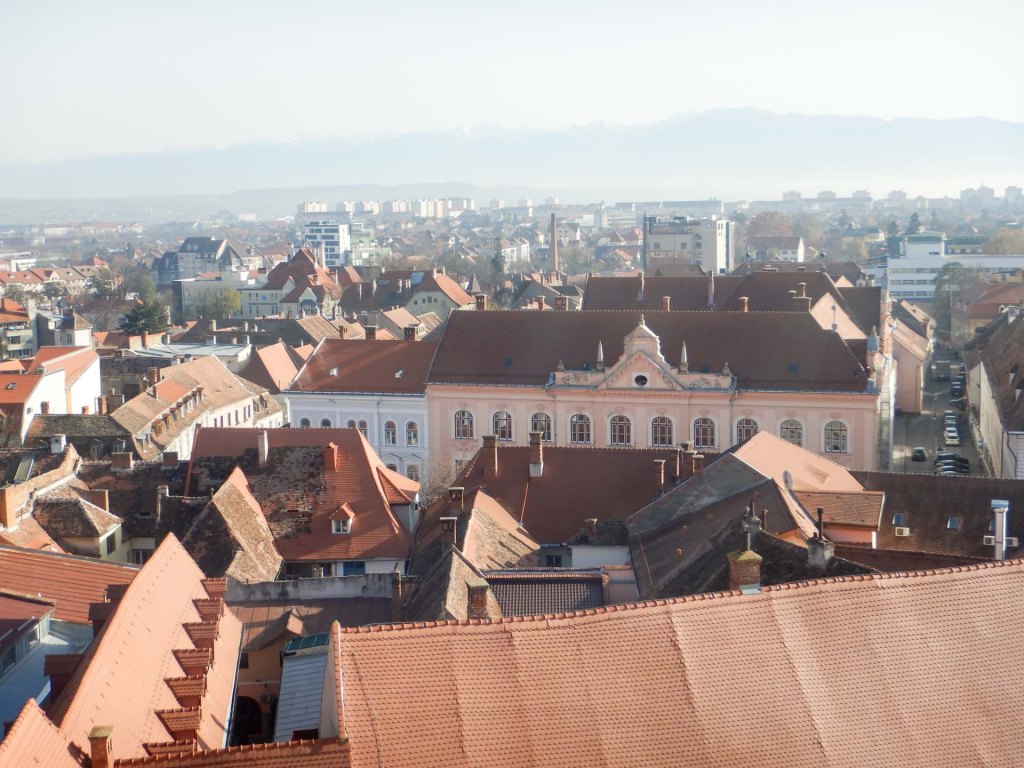
Having already oriented ourselves the previous day, after our breakfast including sheep cheese, olives and sausages, we were ready to see all the sights. The weather had become distinctly colder. We wandered round until the Lutheran Church opened for visitors. We climbed up the Bell Tower to enjoy a panoramic view of the old town.
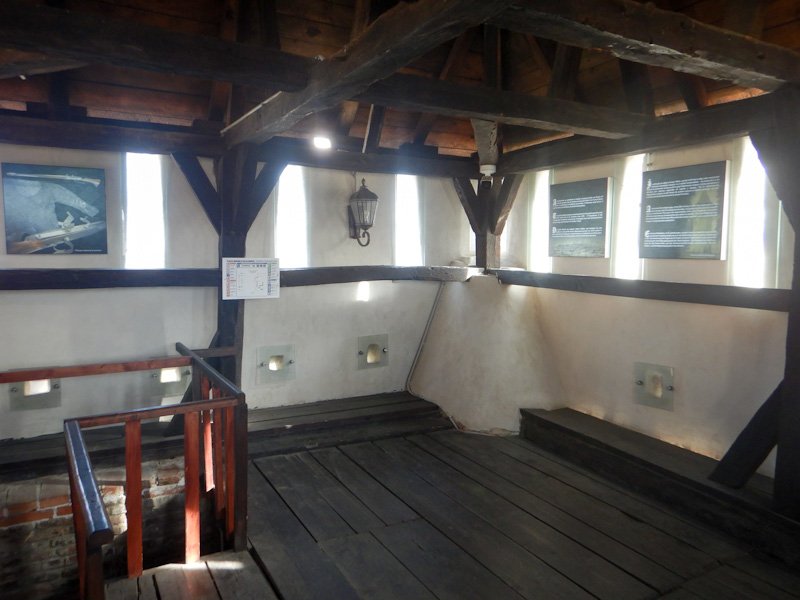
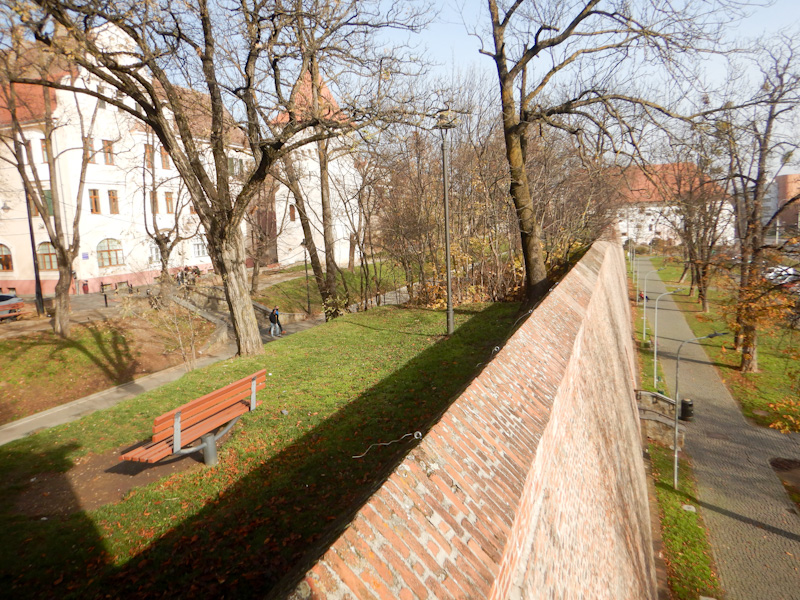
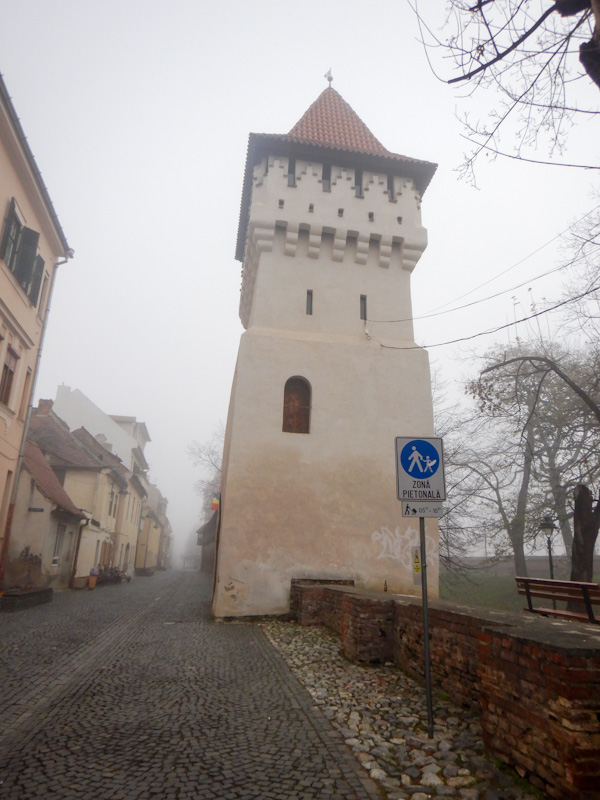
We walked to a section of the old city wall which has been restored to enable safe access to it and to the three towers within that part of the wall – the Archers’ Tower, the Potters’ Tower and the Carpenters’ Tower. The entrance fee was only 2 Leu and the man at the entrance gave us lots of information about Sibiu as well as explaining that he wanted to visit England to see the places associated with the legends of King Arthur.

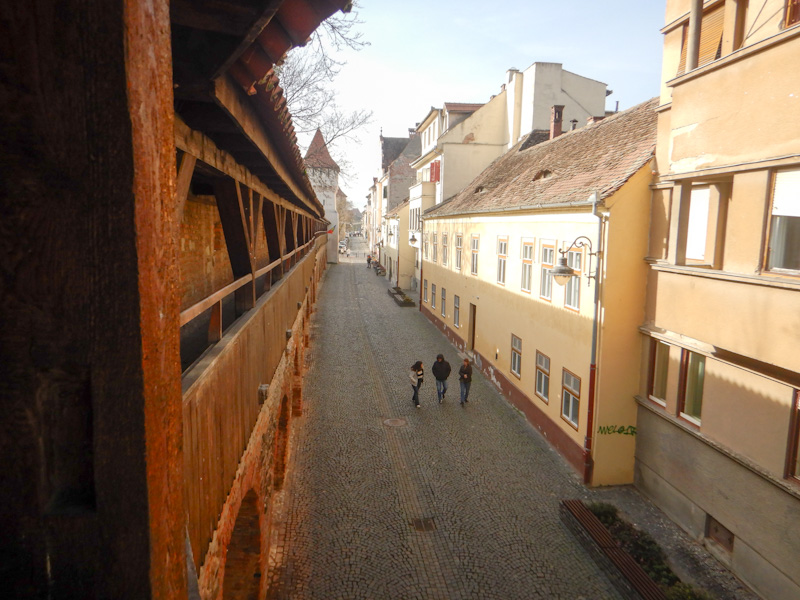
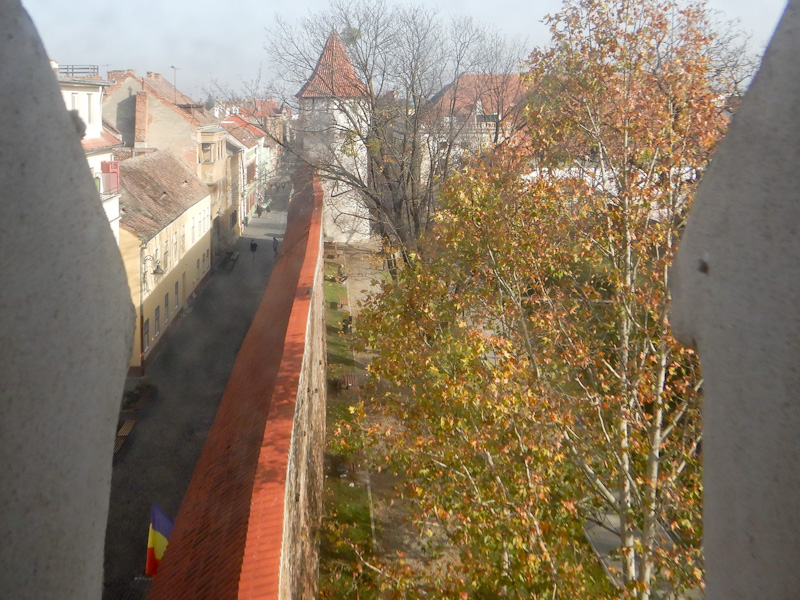

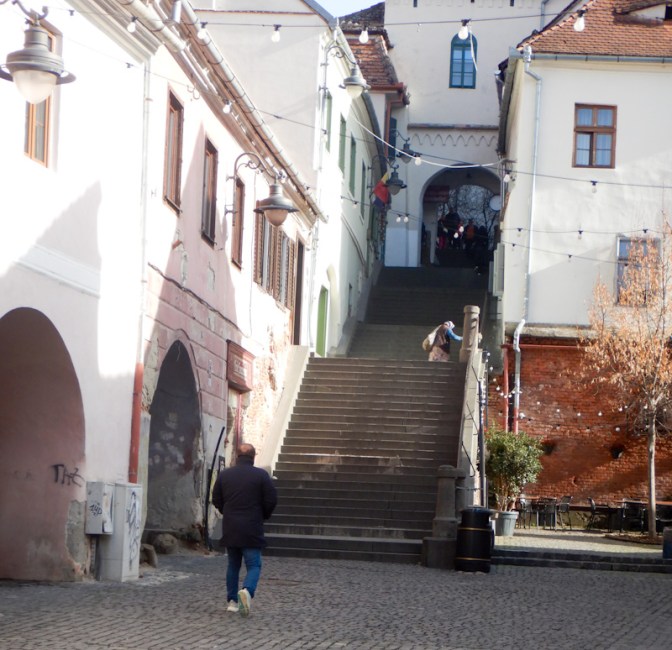
We descended the thirteenth century stairs passageway to reach the Lower Town.
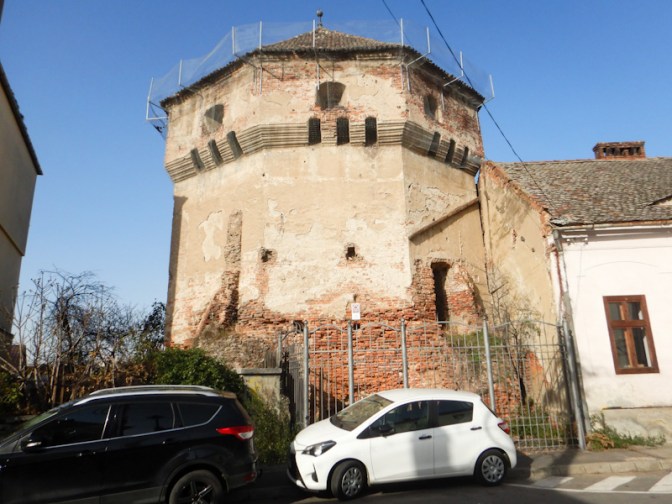
We wandered past the Tanners’ Tower.
We reached the market. There was lots of fresh produce for sale including meats, cheeses, spices and fruit and vegetables. Many of the smaller stalls appeared to be those of subsistence farmers and just had a few different items for sale.

We wandered back towards the Upper Town, seeing some women in traditional Romanian clothing. We crossed the Bridge of Lies with a wonderful view towards the Lower Town. Legend says that telling lies on the bridge will make it crumble to the ground.
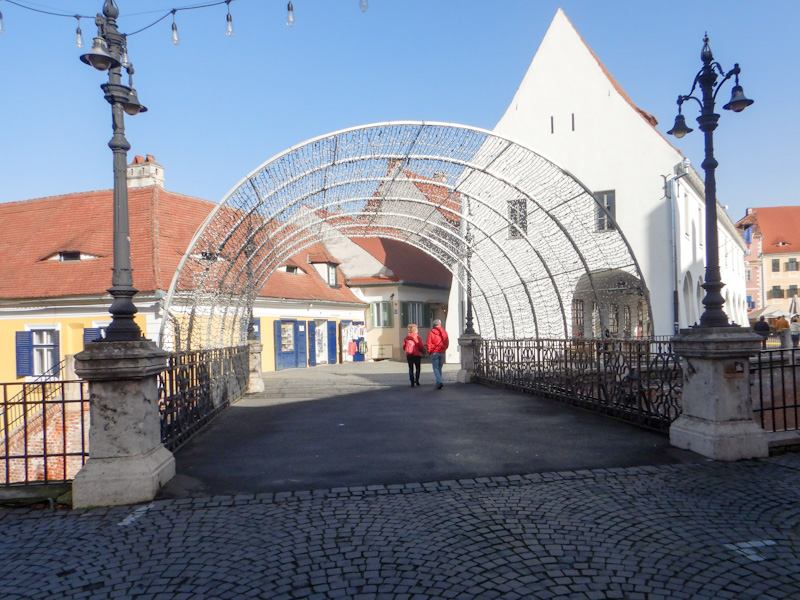

We deviated down some fifteenth century steps to Goldsmiths’ Square.
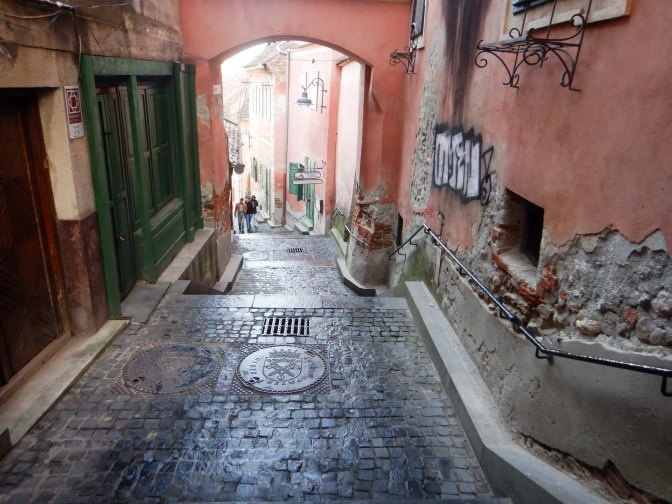
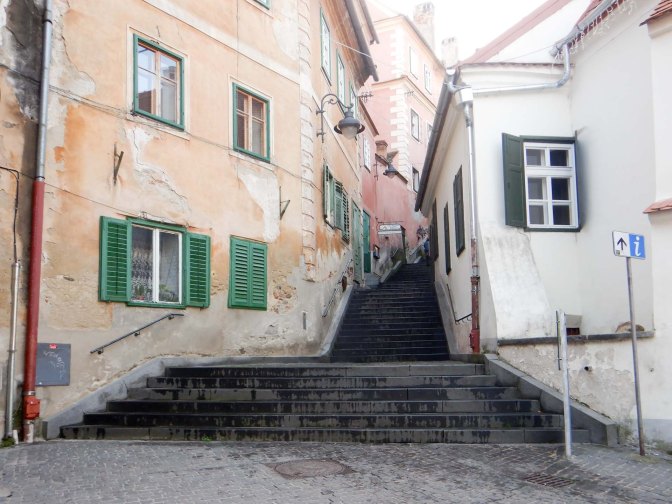
The square is a peaceful area surrounded by old houses with medieval windows, doorways and turrets and with cobbled streets spreading from it.
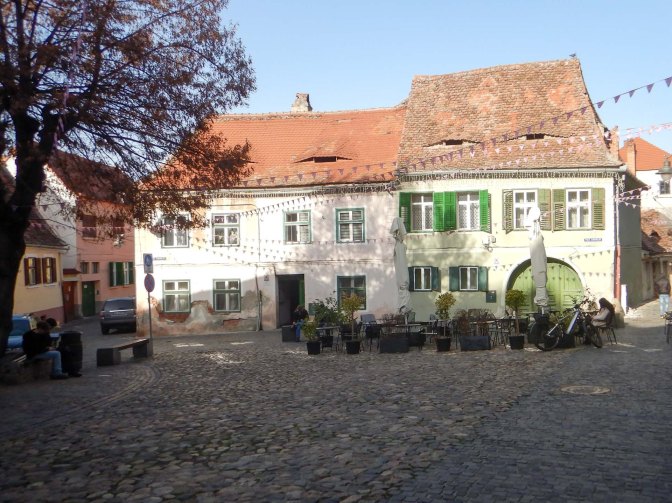
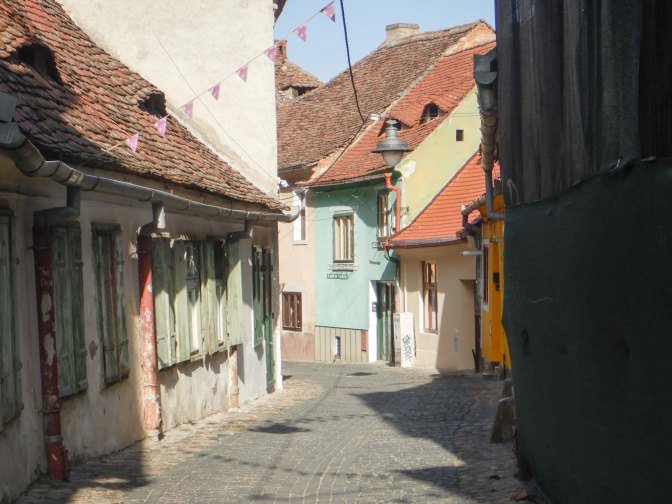
We returned again to the Upper Town to climb the 13th century Town Hall tower. This guarded the gate to the second row of fortified walls.
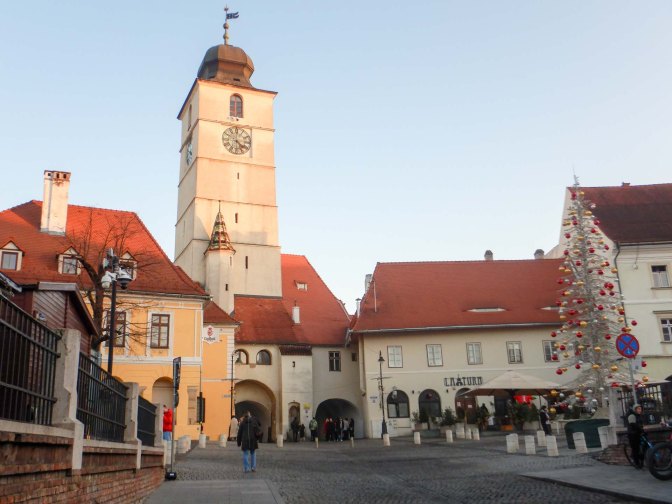
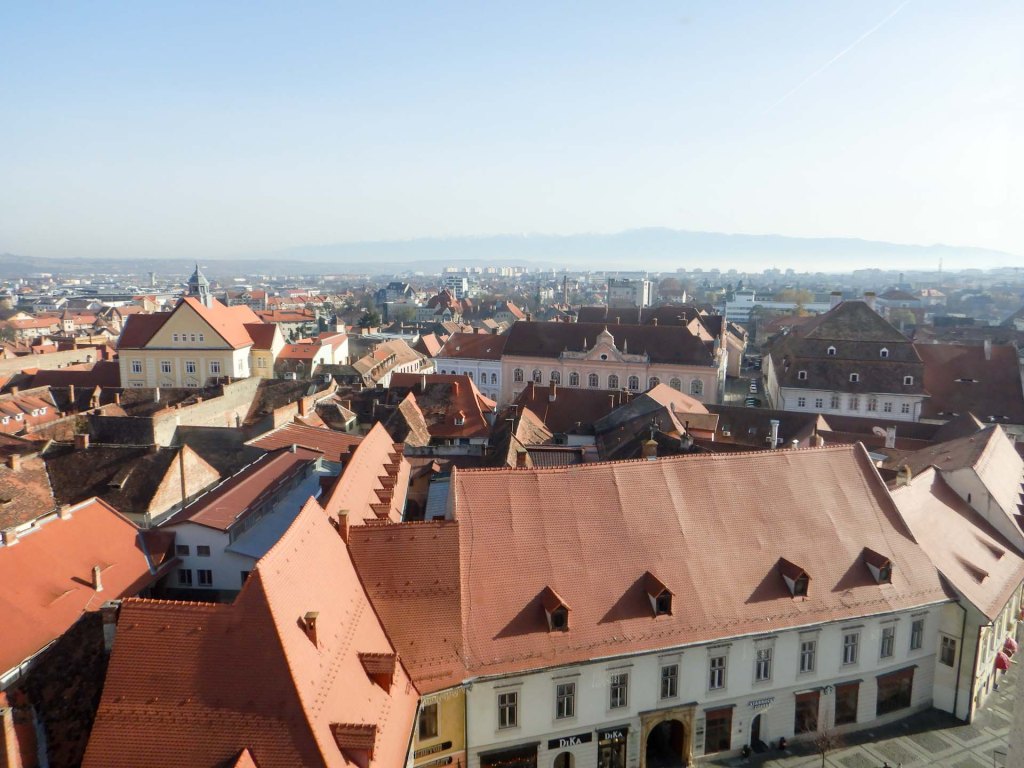
On the top floor of the tower the observation deck allowed views of the Old Town and even the snow covered Fagaras mountains beyond.
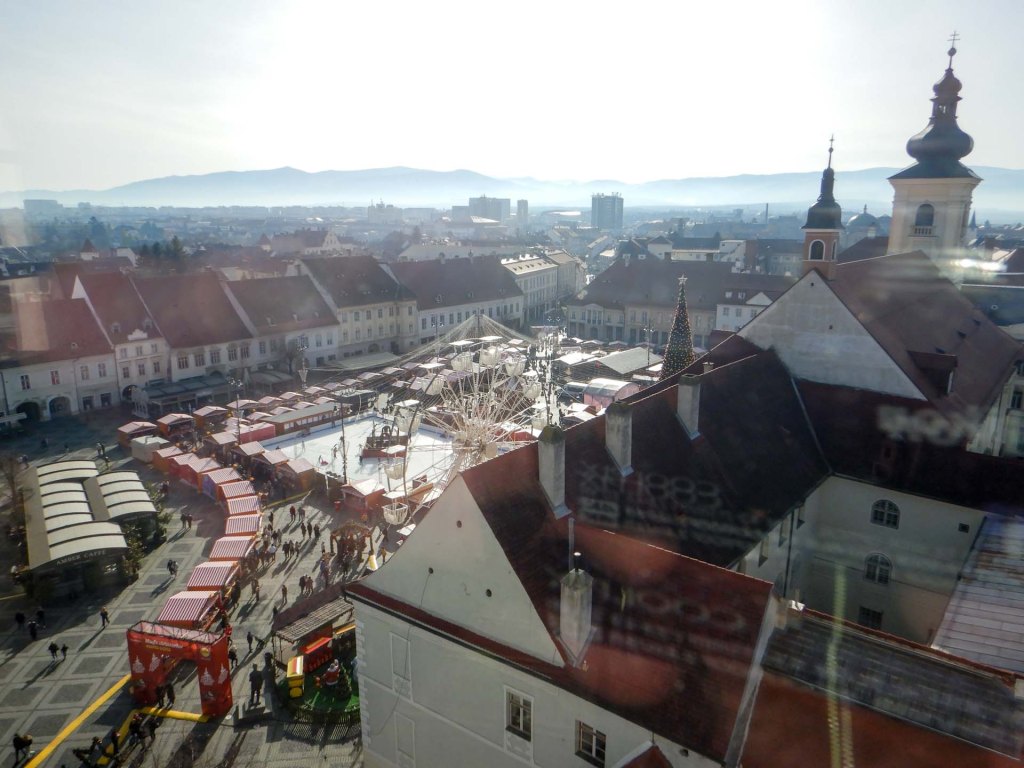
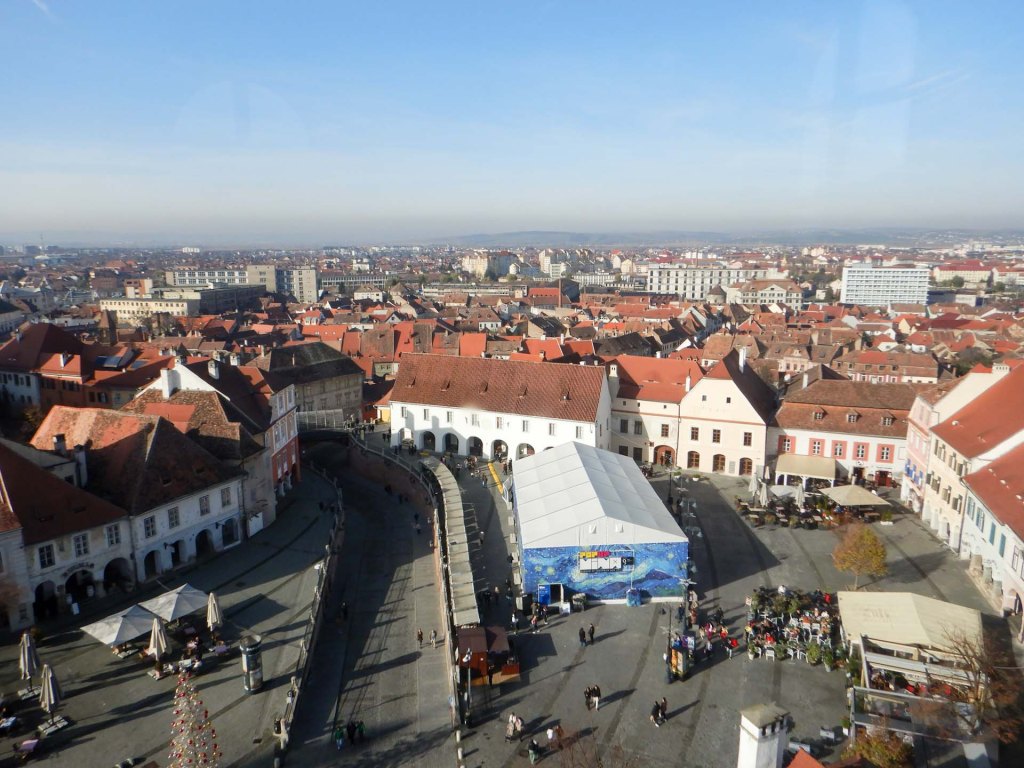
We were ready for lunch enjoyed at a restaurant in the Little Square near the Town Hall Tower. There was an area of covered semi-outdoor seating warmed by a heater so we were able to watch the crowds in the square as we ate a traditional Hungarian meal of beef goulash with polenta.

It was still cold so we decided to go inside for the afternoon and visit the art gallery containing art ranging from early masters to the twentieth century, all housed in the historic rooms of the eighteenth century Brukenthal Palace.
Emerging from the gallery at around 5pm, we had to stop at the (much busier) Christmas market for vin fiert to warm us for our walk back to our room.
It was a pity that we didn’t have another day to spend in Sibiu as we could have made the short bus journey to the second largest open-air museum in the World where there are over 300 original buildings and other structures such as fruit and seed presses, wind turbines etc. from many parts of Romania.
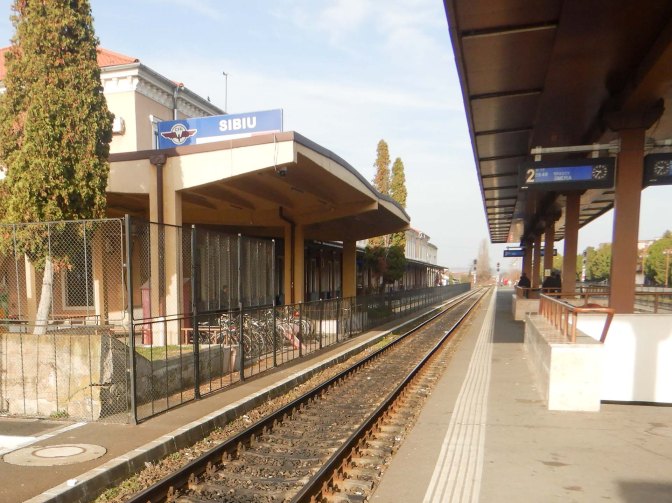
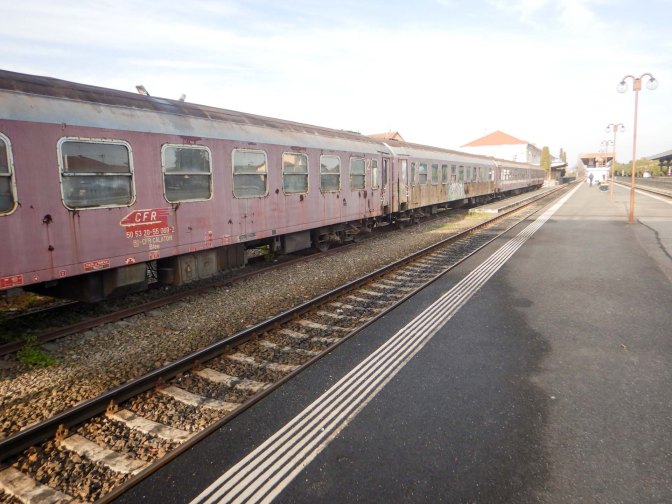
The next morning saw us at Sibiu station to catch a train to Budapest. This ticket wasn’t on our pass but was bought separately in advance as there wasn’t a mechanism to reserve seats in advance on Romanian trains if we used the inter rail app and pass. Moreover, the ticket was relatively inexpensive despite the journey lasting all day. There were only second class seats although our allocated seats appeared to be in a downgraded first class compartment so we had plenty of space. We shared the compartment with two adults and two children who were part of a group travelling to Budapest for a one week exchange visit, the other children were in adjoining compartments; for many of the children in the group it was their first time leaving Romania and so a very big adventure.
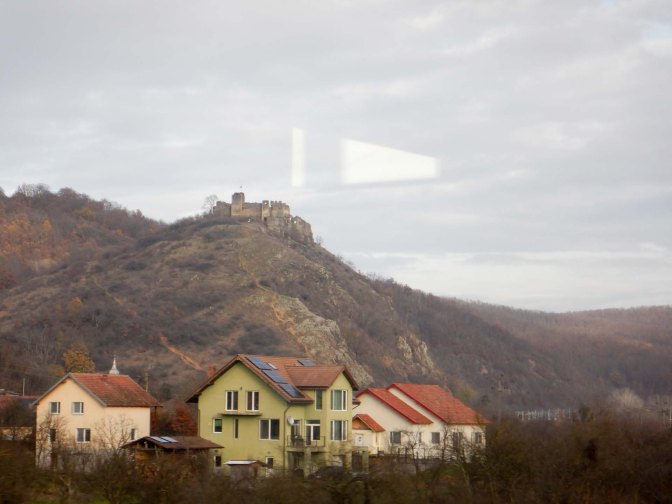
The train passed through lots of rural areas – both arable and livestock farming, much of which appeared to be on small plots of land surrounding the houses. There were also small villages and a few towns. Much of the landscape was very flat apart from one more mountainous area which appeared to be a National Park. We were checked at the border by the Romanian but not by the Hungarian border force. Once we had crossed into Hungary, the train speeded up.
Just before arriving in Budapest, we saw on our phones that Hungary had just lost a football match against the Republic of Ireland – the Irish winning goal had been in the last minute. The male teacher, who had never visited UK, explained that he supports Liverpool and that three of the Hungarian team play for Liverpool. Our train went past the stadium just before reaching the station.
We didn’t have far to go to our hotel in Budapest – it was the same hotel we had been in a few days earlier. The Hungary supporters we saw seemed resigned to the loss but nonetheless we thought it wasn’t sensible to wander too far in Budapest and we ended up eating at the nearby Macdonalds.
We were up early and took a packed breakfast from the hotel to the station for our second consecutive day with a long travel time, but this was using our pass (seventh pass day). We had time to visit the Business Class Lounge for coffee and croissants. The train was the luxurious high speed rail jet so it was quite a contrast compared to our recent journeys on Romanian trains. However, the journey did nothing to restore our faith in the timing of German trains – by Vienna we were fifteen minutes late and suddenly we saw we had become an hour late as we had to divert via Regensburg because the line we were meant to follow (already a diversion for scheduled track-work) was too busy. Unfortunately this meant that it was already dark when we reached Munich so there was no time for sightseeing that afternoon. it was even more cold. However we had a lovely room in a hotel very close to the station and there was free coffee and apples twenty four hours per day. We even found a pleasant traditional German restaurant only a stones throw from the hotel.
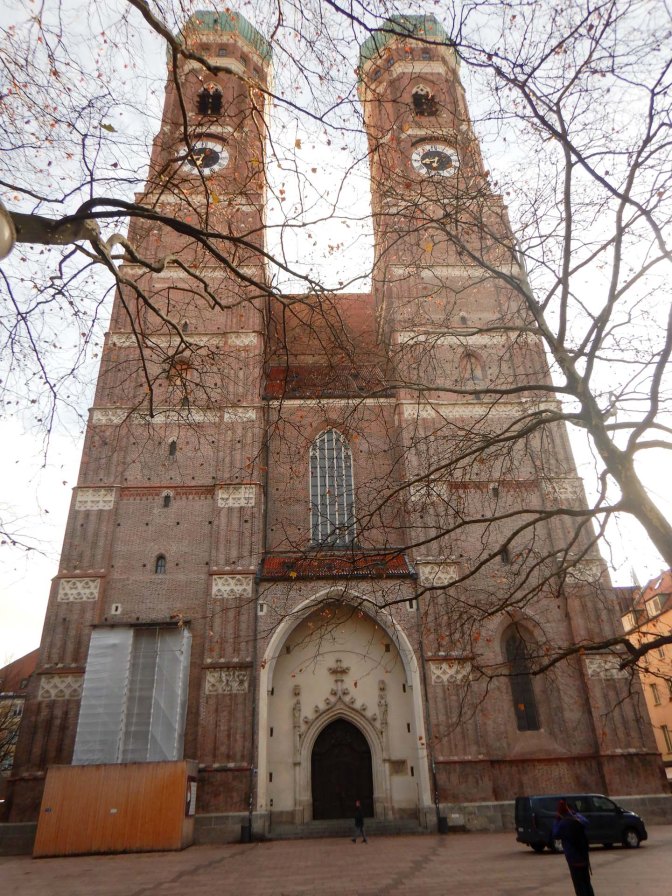
Next morning was also very cold. After breakfast, we set out on the short walk past the botanic gardens to explore the historic city centre. We took some photos as we passed the Frauenkirche, Marienplatz and Old St Peter’s as it was quite quiet but we would be returning to these places later once they opened for the day. The impressive looking Christmas Market was still being set up – doesn’t open until 24 November so we were almost a week too early.
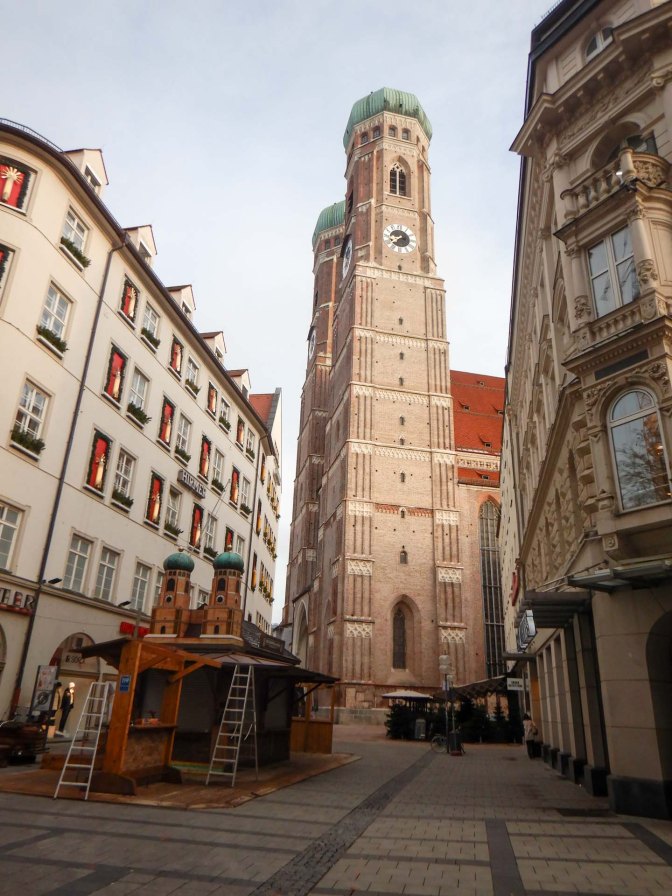
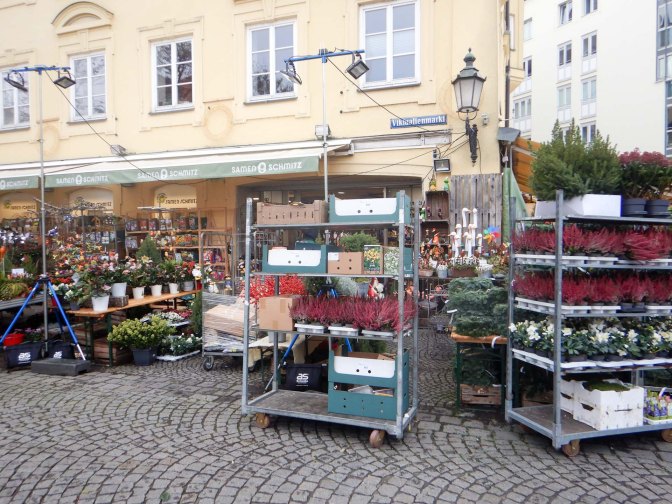
Viktualienmarkt – the farmers’ market – was already open so we wandered round some of the stalls and some of the six fountains as well as the maypole.
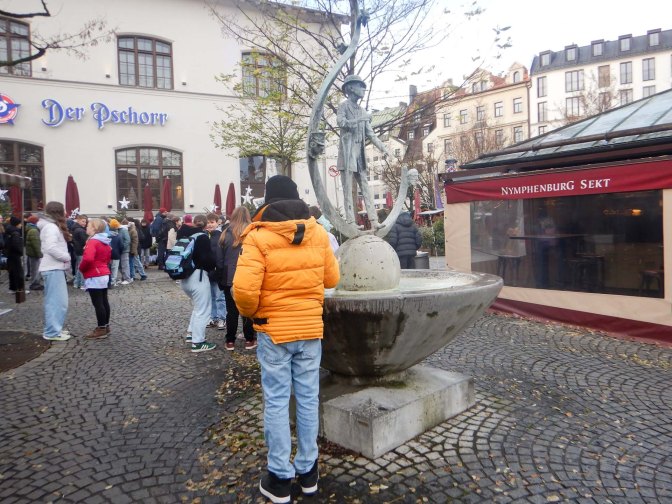
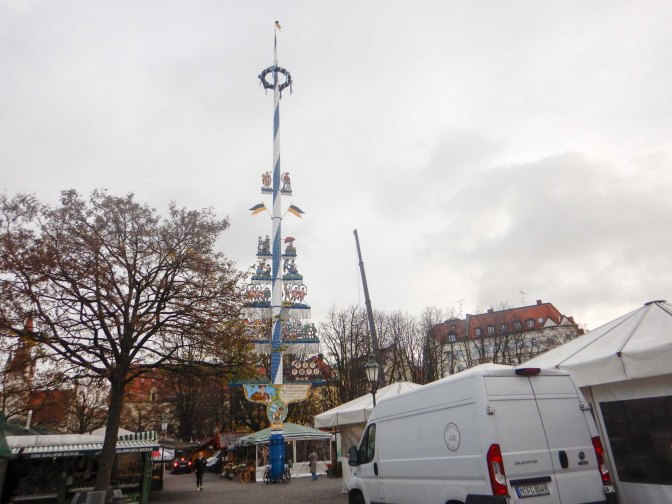
Next we returned to the Frauenkirche, where some explanatory leaflets in English kept me entertained before the tower opened.
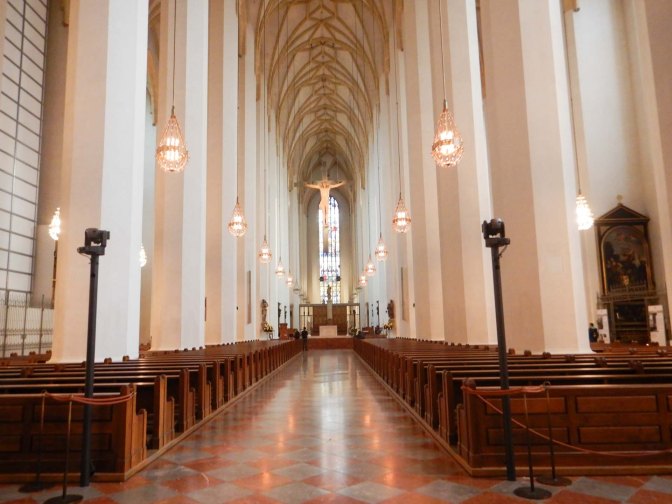
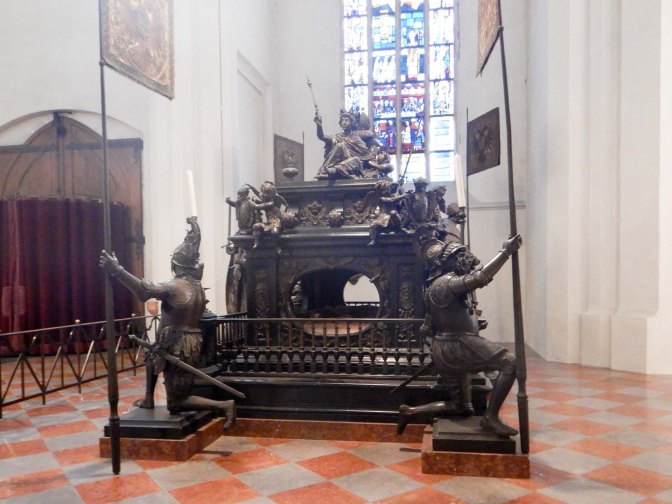
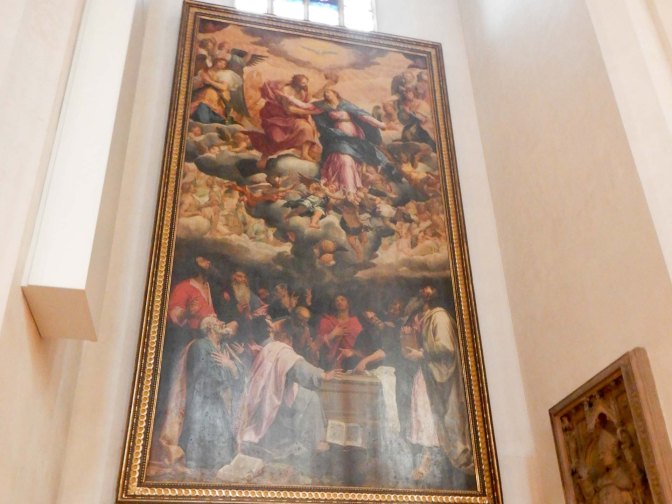
I followed the route looking at the representations of Mary, to whom the building has been dedicated ever since its construction in 1468.
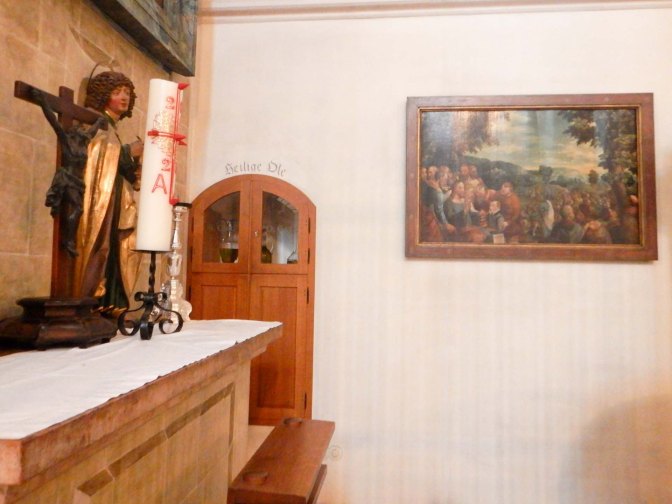
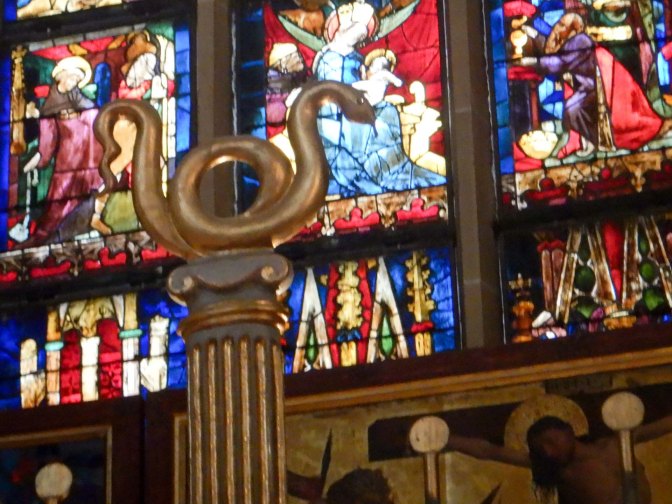
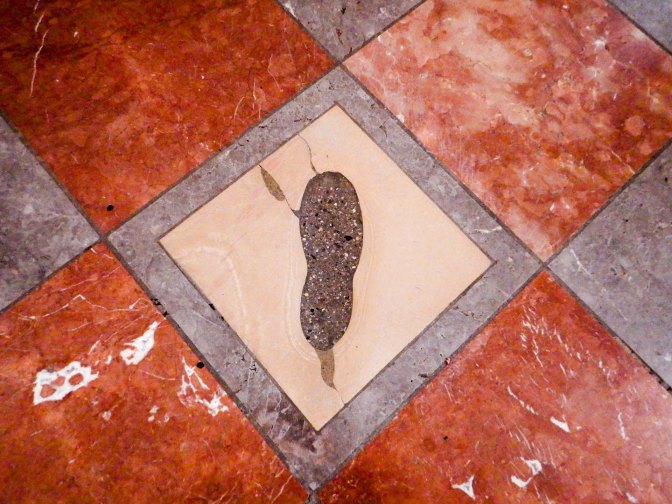
I also followed the route on the leaflet intriguingly entitled “Mysterious Places – snakes, devils and holy oils”.
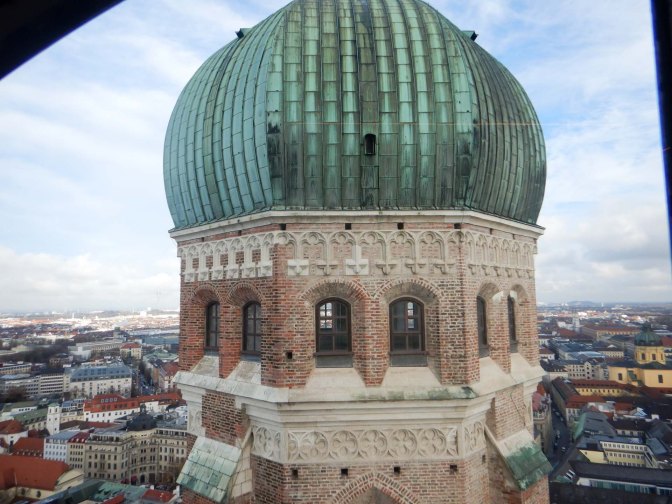
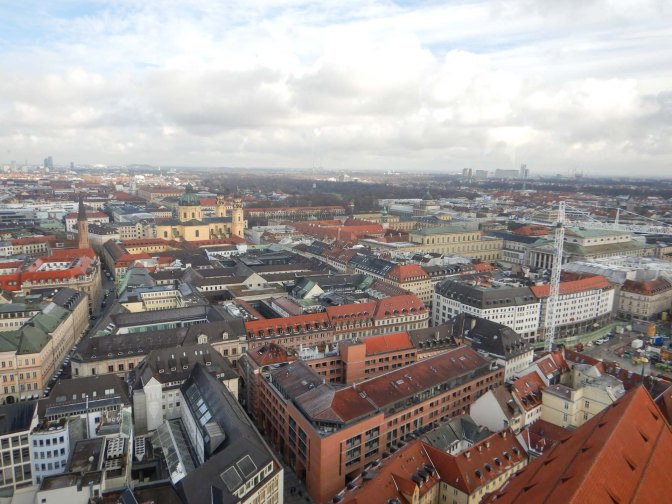
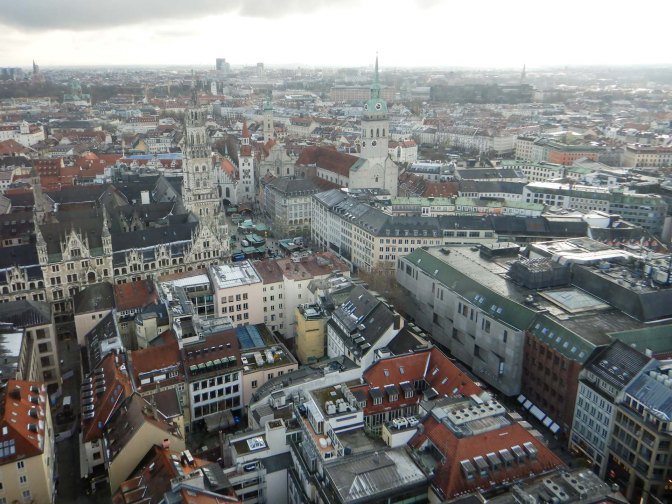
We climbed a few steps and then took the lift to the top of the 98.45m high south tower – the upper steps are only used as a fire escape. There were superb views in all directions.
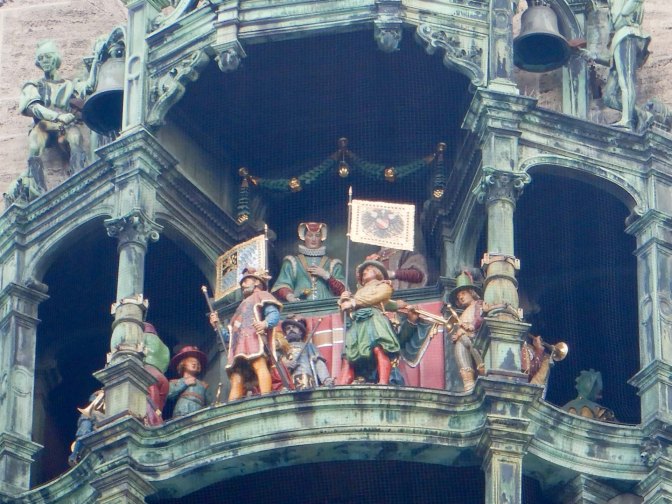
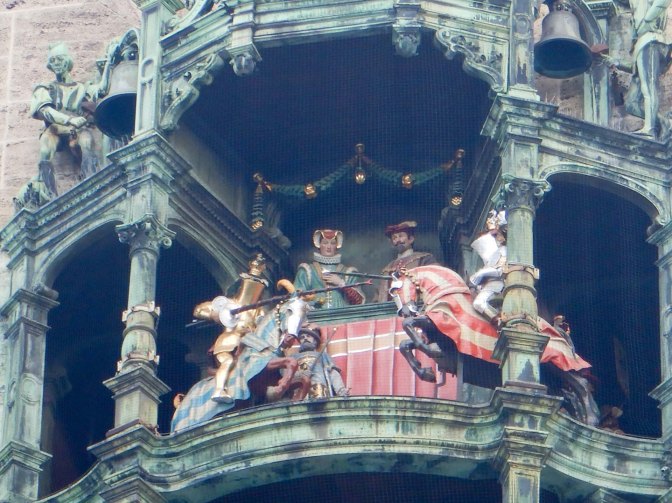
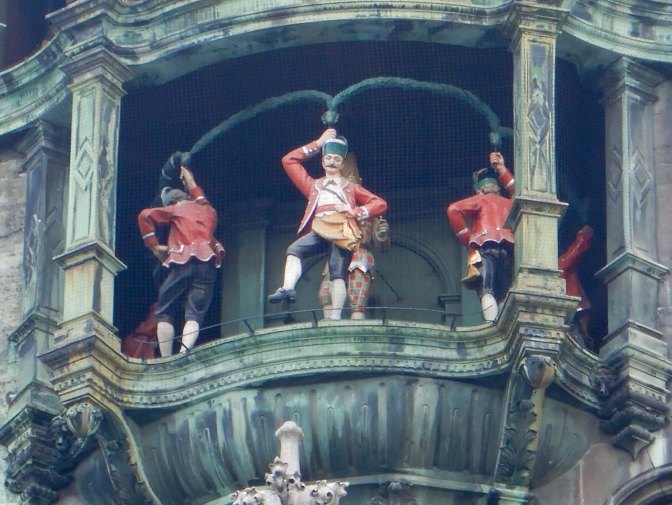
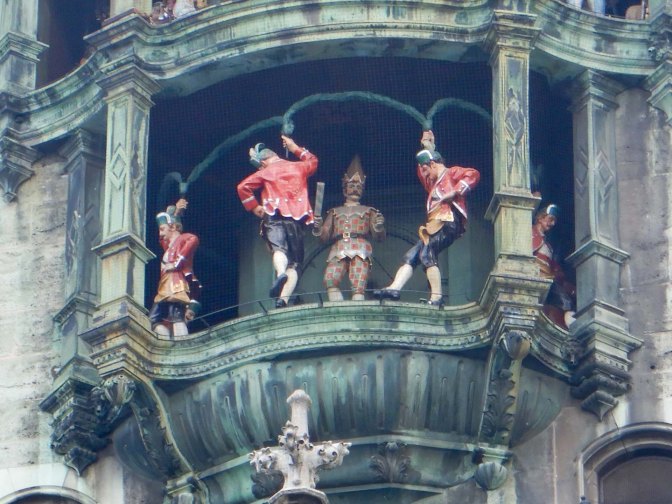
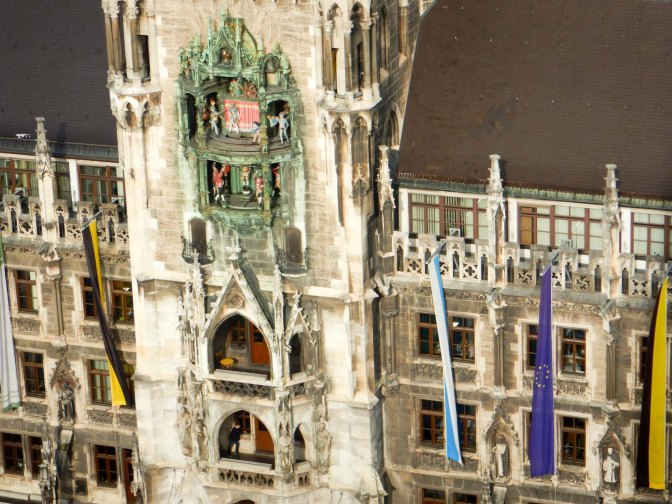
We had coffee then stood in Marienplatz waiting to hear the solar powered glockenspiel and watch moving figures at 11am.
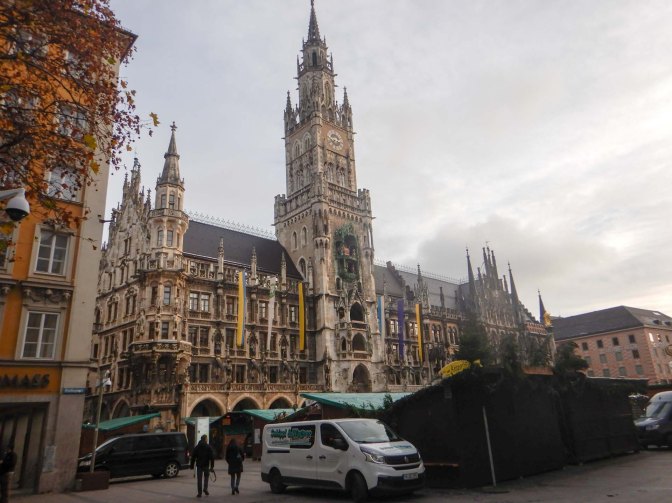
This was definitely worth seeing – first the upper floor figures moved representing the jousting tournament held in honour of the wedding of Duke Wilhelm V and Renate of Lorraine in February 1568.
Next the lower figures show the Schäfflertanz – after a severe plague epidemic, the barrelmakers were the first to venture out onto the streets and danced to amuse the plague-stricken population.
We proceeded to the Residenz and the Imperial castle, where we watched a film in English about the development of Munich and its growth in size and importance.
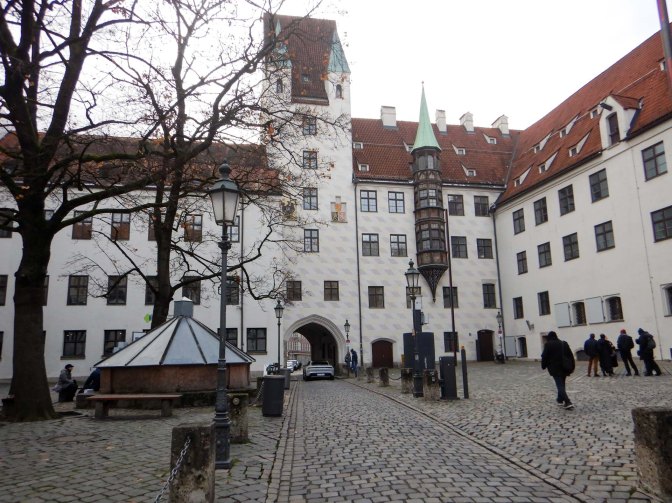
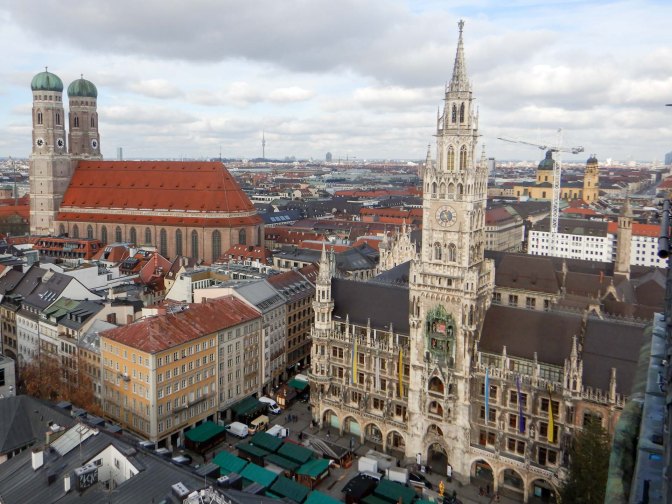
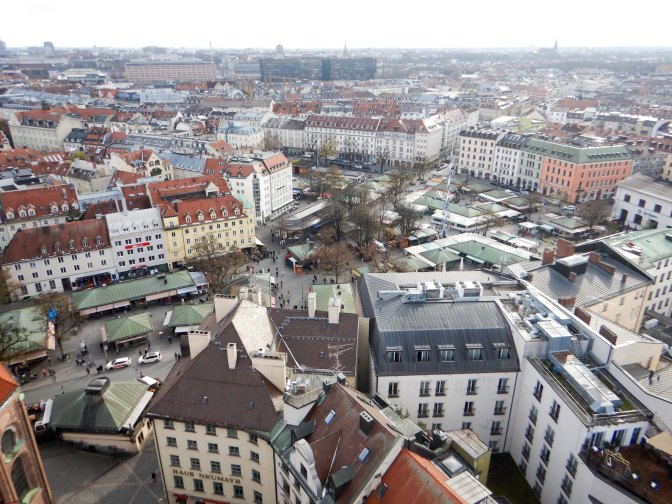
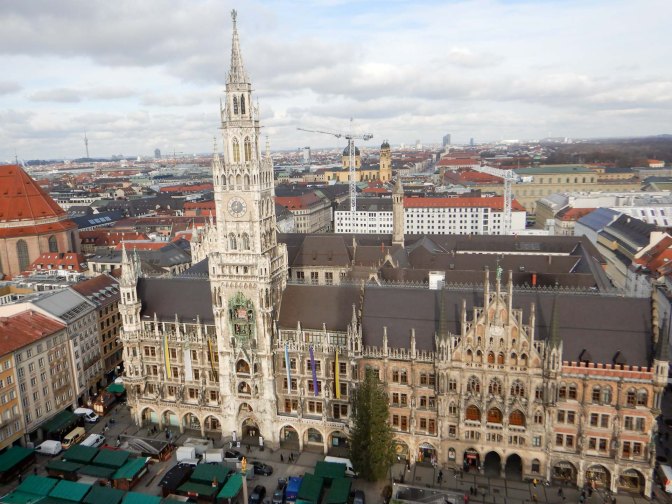
We headed to the oldest parish church in Munich. The tower of Alter Peter offers a stunning view over the city’s rooftops. We had to climb all the way up this one – there’s no lift!
After lunch, my husband persuaded me that we should visit Versicherungskammer Kulturstiftun (cultural foundation) which ended up taking some searching. He wanted to look at an exhibition of Polaroid photos by Helmut Newton whose main area of photography was fashion assignments, for example in magazines including Vogue and Paris Match. Polaroid photography was a way of seeing photos almost instantly to check lighting etc. long before the days of digital photography.
From there, we walked across much of the city centre to reach the Pinakothek der Moderne holding one of the largest collections of artworks in Europe with art, design, architecture and graphics from the 20th and 21st centuries all under one roof. We concentrated on looking at the art section which explored why modern art happened and the issues before visiting the design section where there were designer pieces of all sorts of objects spanning the last hundred years.
After our long day exploring the city and then the two galleries, we returned to the hotel before going out to eat traditional beef, onion and spaetzle at the same Bavarian restaurant as the previous night.
Having not used our Inter rail passes a couple of times, we had a spare day to go on the train so we took a day trip to Lindau to visit the old town on the island on Lake Bodensee (Constance). We travelled to the station on the mainland and walked over the bridge to the island.
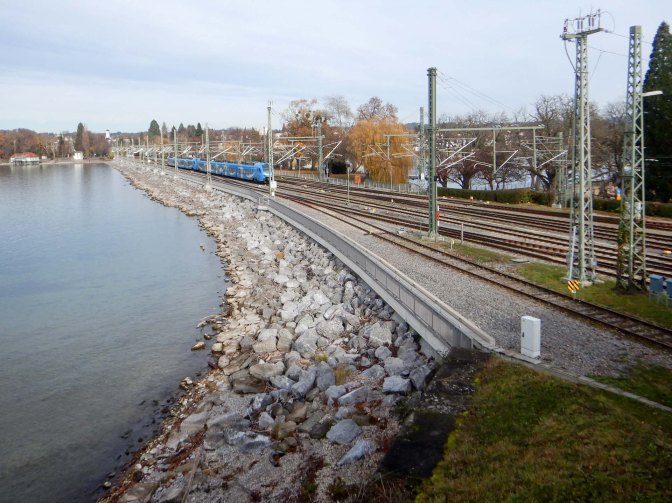
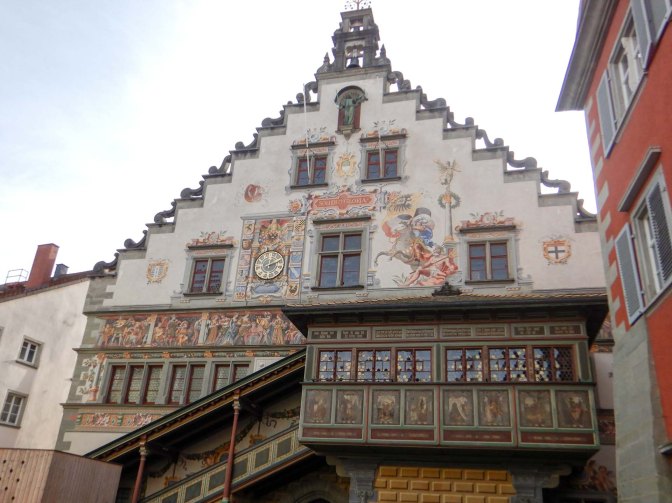
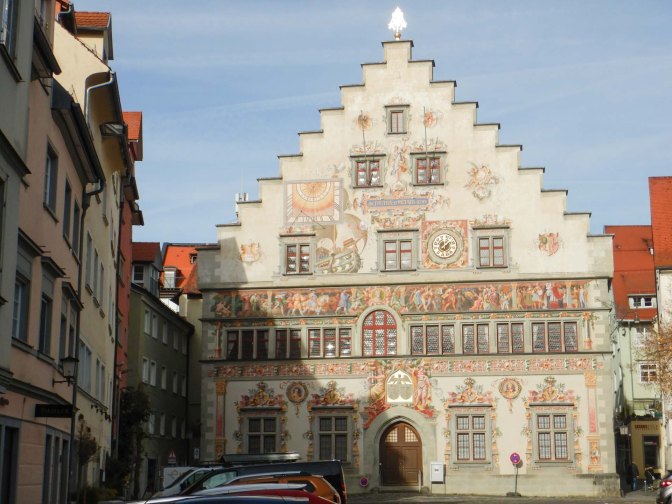
There are narrow streets, tall buildings, old churches, a town hall with wall paintings on its outside front wall and other buildings with paintings on the outside walls.
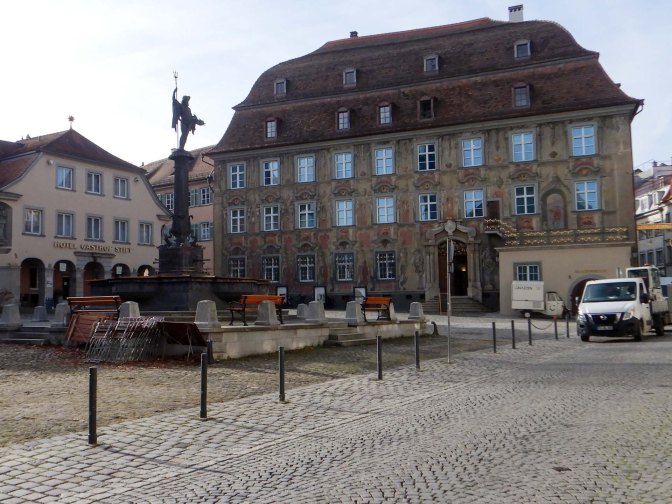
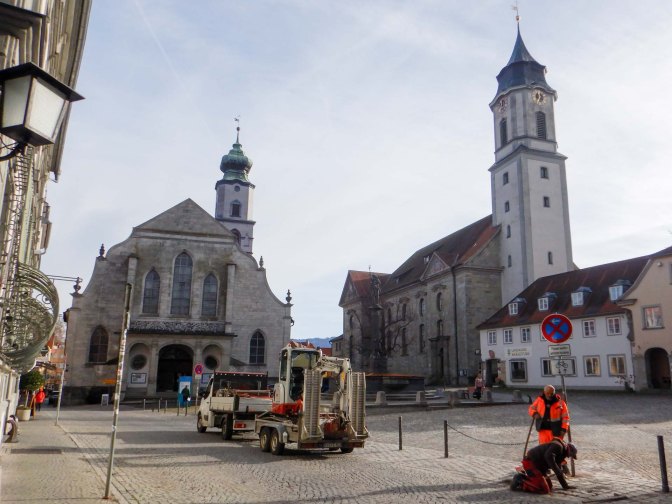
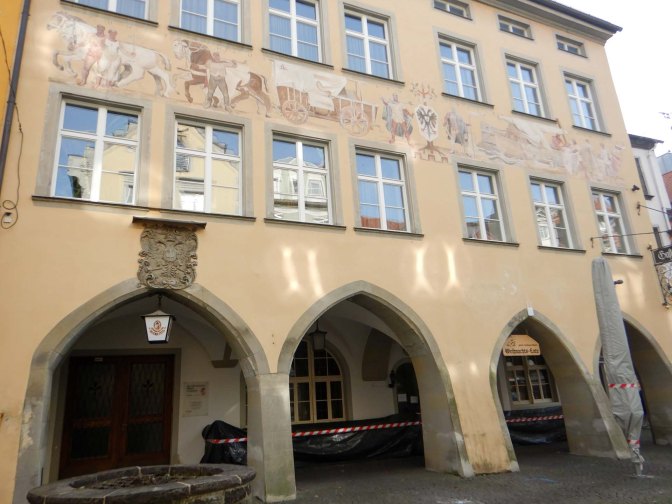
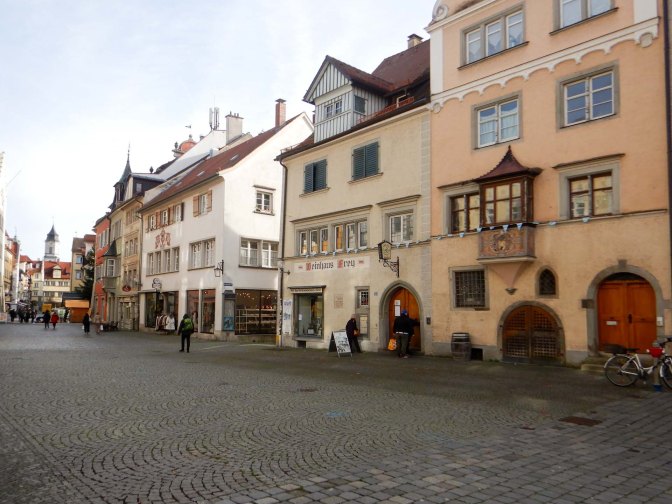
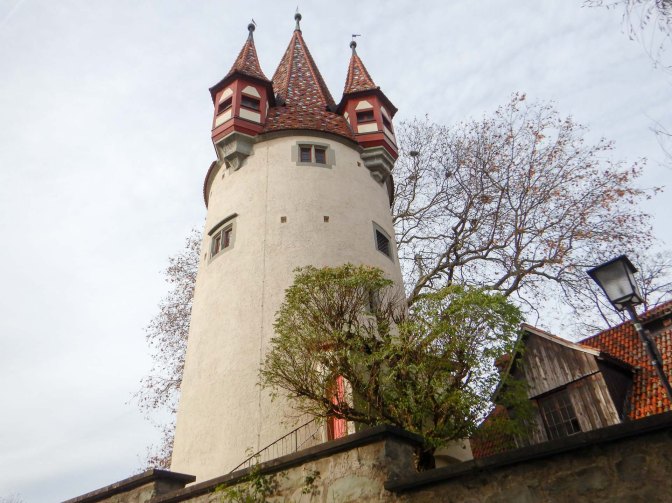
The round tower on Schrannenplatz is topped with a brightly tiled pointed roof and turrets. It’s called the Diebsturm (thieves tower) and dates from around 1400.
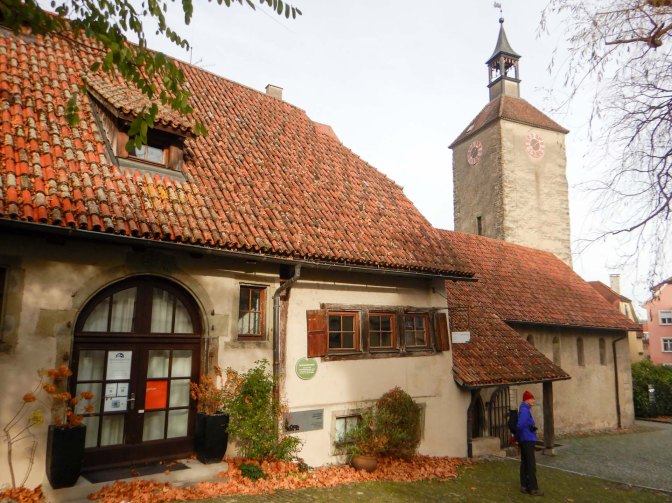
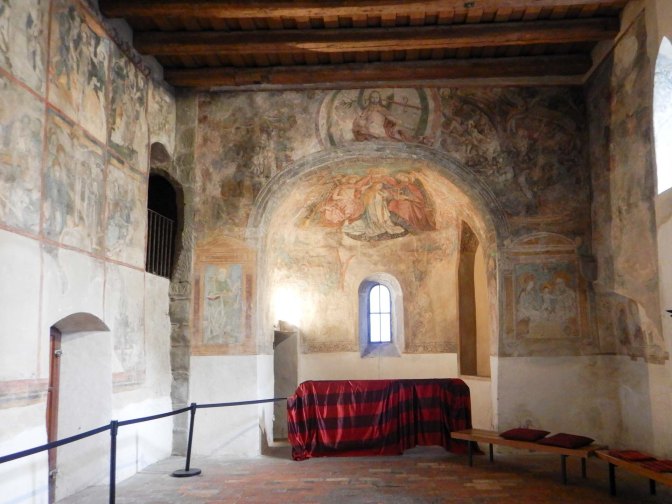
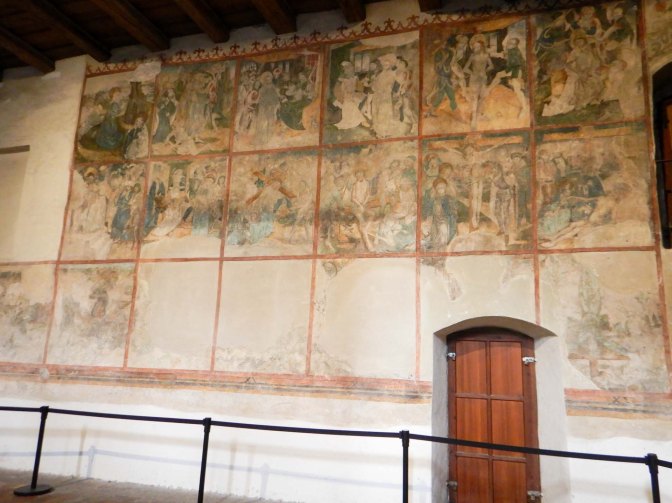
St Peter’s Church, next to the Diebsturm, is over 1,000 years old and inside there are wall paintings – the “Lindau Passion” and “Crowning of Mary”.
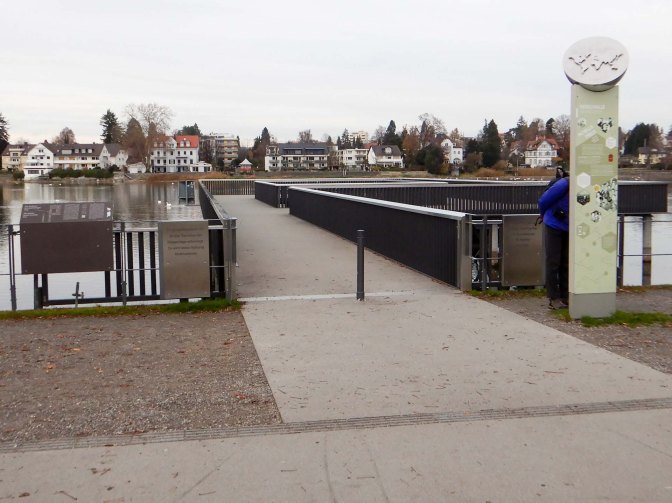
We lingered at the Nobel Laureate Pier. The island has hosted annual meetings of Nobel Laureates since 1951 and the names of all that have attended are added to the guard rail.
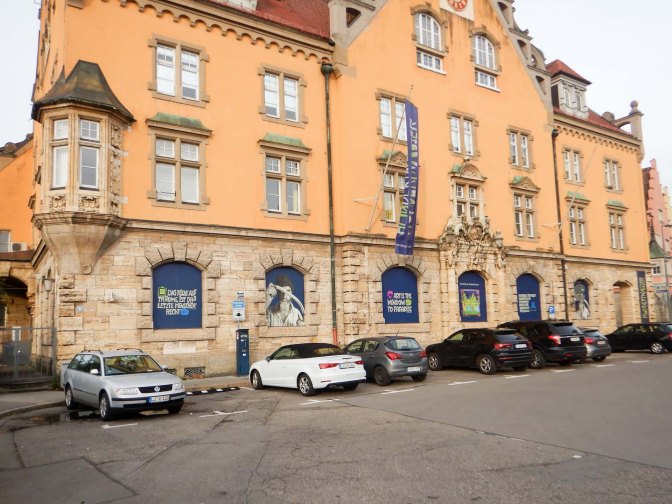
It was very cold so we decided to visit the Hundertwasser exhibition near the railway station. Hundertwasser was an artist who amongst other things worked with architects to design buildings where the eye meets curves rather than straight lines. Interestingly, the next day on the train we looked out of the window and thought that one of the buildings looked very much like his art – on further investigation we were correct! He was born in Vienna but travelled widely including to New Zealand where he designed the public toilets in a small town where he lived.
Fortunately we caught the train back to Munich relatively early as there was a problem on the line. Our train suddenly terminated at a small station and we were advised to get back to Munich via a train to Augsberg and then another train to Munich. There’s definitely an issue with the trains in Germany!
The next morning we were on the move again – our ninth pass day and a long complicated journey to Lelystad in The Netherlands requiring five different trains, some with tight connections. Our first train as far as Duisburg which was the only one where we had reserved seats booked became late (predictably). However, we were fortunate that our connection from Duisburg to Emmerich was also running late which meant we caught it. The connection to Arnhem served this feeding train – which waited. Then we only had a very short wait for the connection to Zwolle and from Zwolle the trains across Flevoland to Lelystad ran every half hour.
Having visited some of the most historic settlements in Europe, we were in one of the newest.
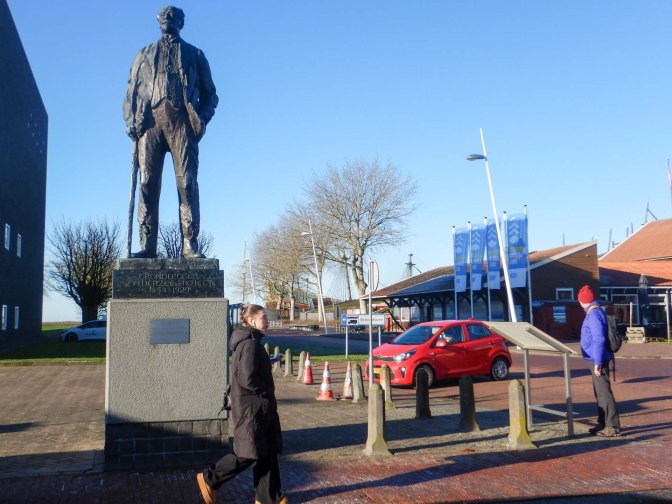
Before 1957, the land Lelystad sits on was still part of the sea; the first residents arrived in 1967. Actually these weren’t really the first inhabitants as in prehistoric times the land was above the sea and archaeological excavation has revealed Stone Age remains.
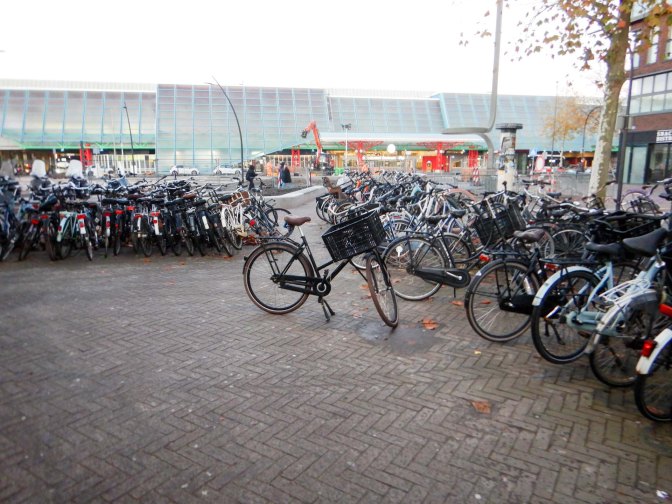
We decided to spend the next day walking around Lelystad. Our walk started just as children were cycling to school. There were bikes everywhere. However, in many places pedestrians, cycles and cars are separated and in lots of other places pedestrians / cyclists are segregated from motor vehicles. The main problem is that e – bikes go in the cycle lane and can be fast; even some motor scooters use the cycle lanes. The land is extremely flat!
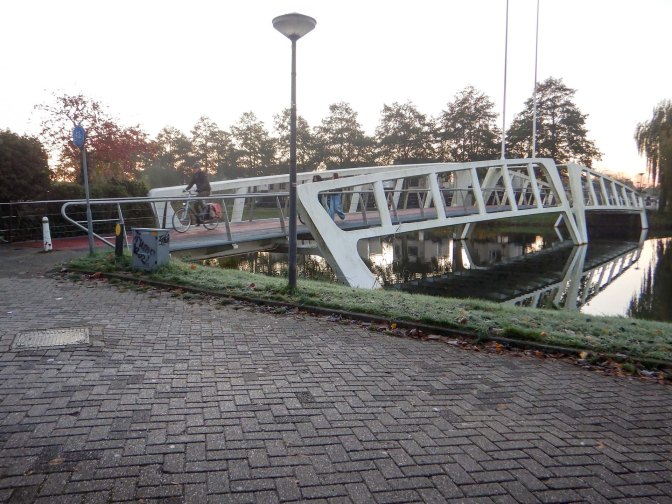
We walked through housing areas – each named housing area is divided into numbered sections and each house in a numbered section has a number. So each house is identified with four digits in two groups of two and an area name.
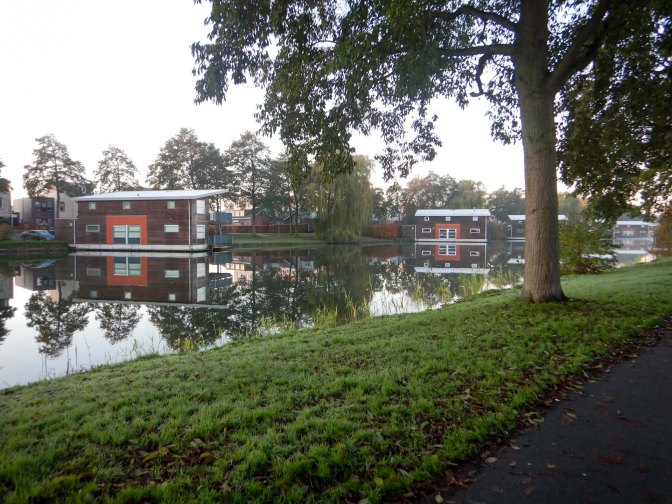
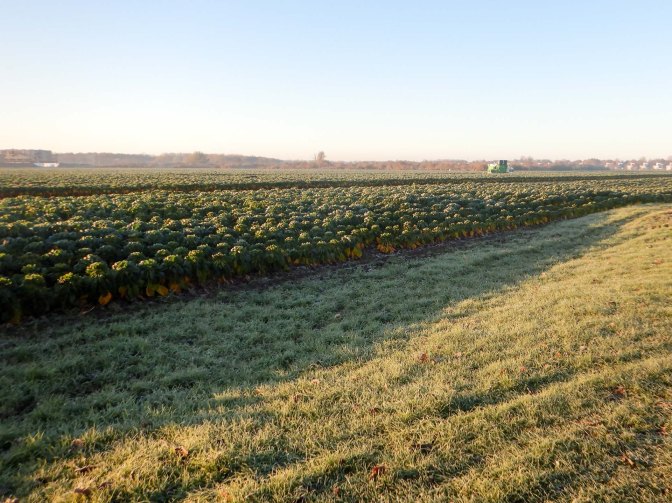
We passed waterways with birds swimming, crossed by multiple foot bridges and eventually arrived at farmland where sprouts and other brassicas appeared to be the chief crops. Eventually we reached the sea.
We strolled around the coast on a dual use cycle and footway, following the “waterwandelweg” route of information boards explaining about the continuous involvement of the Dutch people with water.
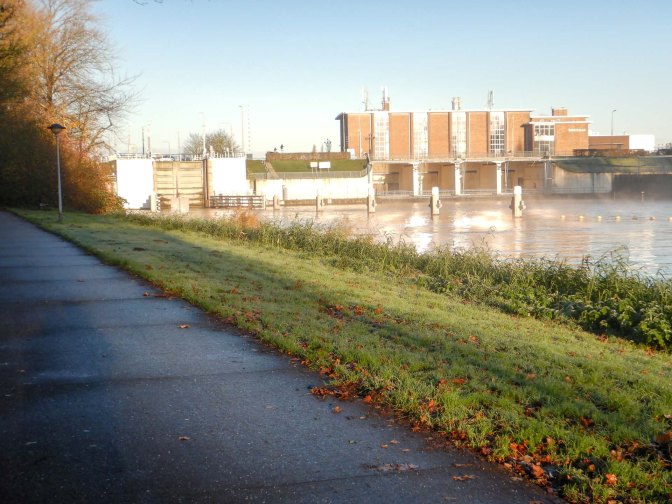
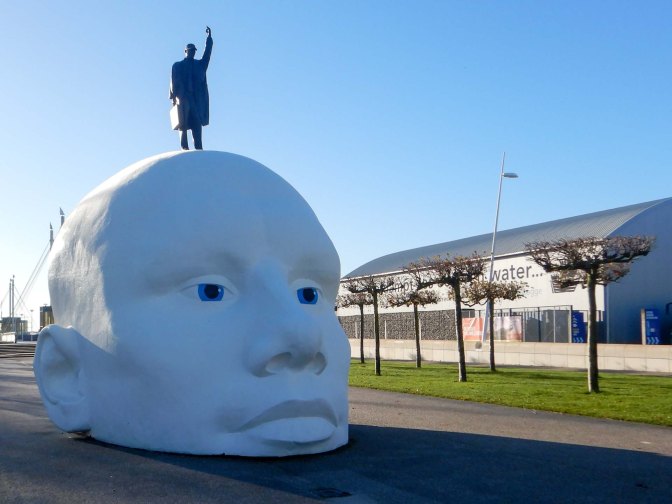
Across the water, we could see the Antony Gormley sculpture “Exposure” an eighty five foot high steel framed sculpture of a squatting man.
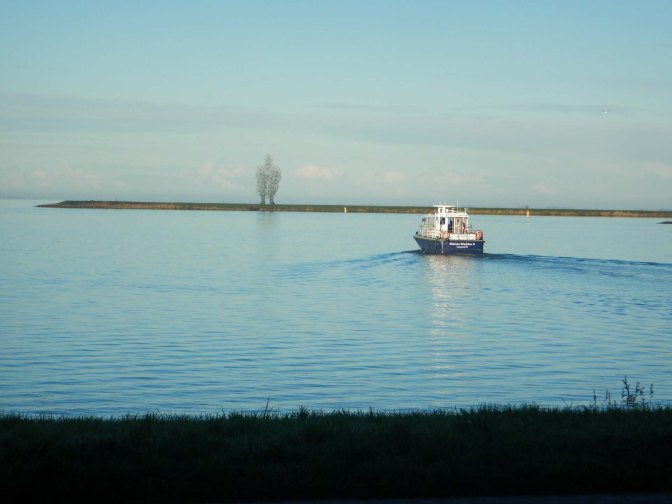
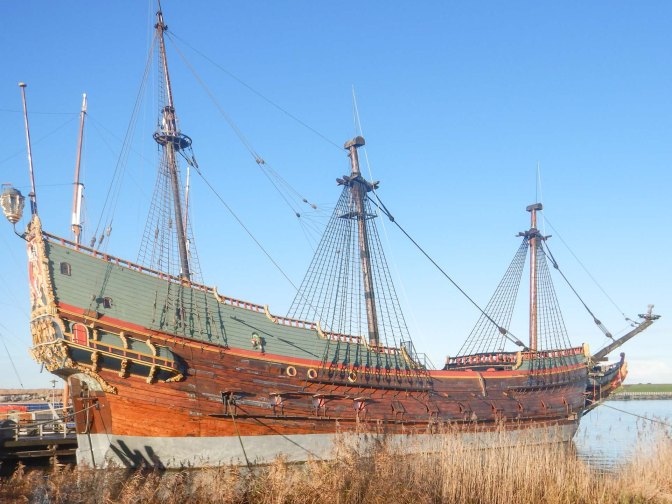
We reached the Bataviawerf, a shipyard where historical ships are built using traditinal craftsmanship. This includes Batavia – a replica of a 1628 Dutch East India Company ship. nearby is a huge outlet shopping centre.
I walked over the dam to proceed out on the peninsula, past a beach and under the sculpture, between the two feet. There were views back to the mainland.
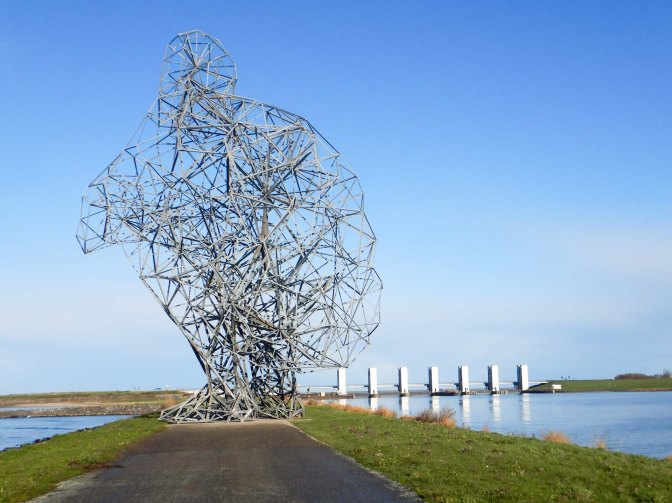
From the dam, I could also see the start of the Houtribdijk, a 27km long road on the top of the dike connecting Lelystad to Enkhuizen.
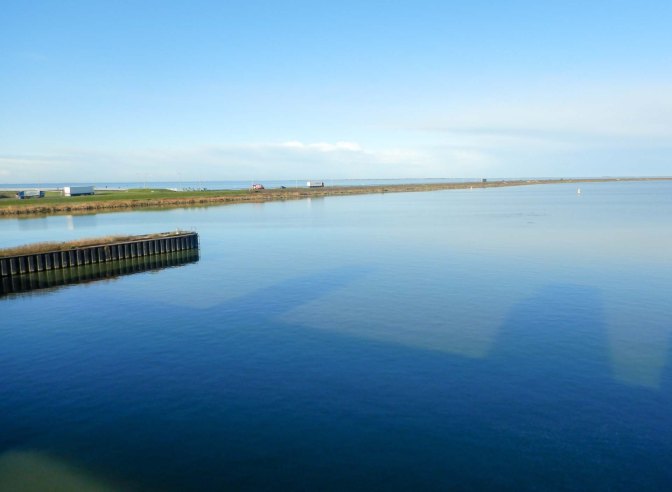
We walked in a circle, returning to the town centre via the large green wilderness of the Zuigerplas Park, where paths criss cross the overgrown forest and bridges cross waterways. We looked at the large lake. It is amazing that all this foliage has grown over such a short period since this land was reclaimed.
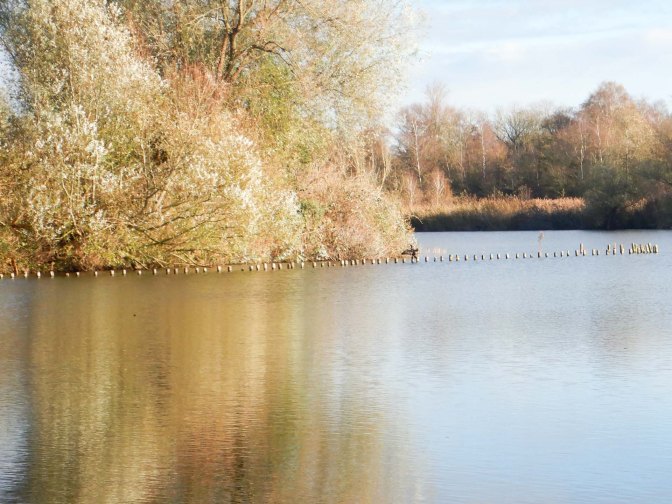
As this was our final night, we celebrated by eating at The Tasty Wok, an all you can eat buffet with enormous choice!
Sadly our adventure round Europe was coming to an end. We loaded the first train journey for the day on to our passes and were warned that no further days travel remained. That train took us across the west of Flevoland. It’s difficult to imagine that such a large area was covered by sea until the late 1950s. We passed an area of National Park, agricultural land – both arable and for grazing, huge reed beds and lakes, reaching Almere, the largest town in Flevoland. We changed trains here and could see a World Trade Centre Building close to the station. Soon after leaving Almere, on the train to Amsterdam, we left Flevoland and crossed a bridge on to the “mainland”.
Once in Amsterdam, I spotted the Booking.com headquarters from the train. We had loads of time before needing to check-in for our booked Eurostar train so we left the grandly fronted station. There were trams, bikes, cars and people everywhere! There were of course also many boats on the canal. We walked down a broad street flanked by souvenir and trinket shops to entice the unwary tourist. We reached a large plaza with a department store ahead, the building also appearing to be Madame Tussauds on its upper floors. It was very cold so we headed back to the station.
Standing in the queue to check in for Eurostar, the disorganisation of the enterprise seemed as apparent on this side of the English Channel as in London. Had these staff ever done this before? Eventually we were called forward through security and then through both border checks – out of Schengen and into UK. My incoming stamp on my passport hadn’t been made in order after all my other stamps but in a gap on a previous page so there was a temporary “panic” until I found the stamp for the border guard. We were registered on to the finger print system ready for future journeys into Schengen zone. Despite my short delay to find the stamp in my passport I had somehow overtaken people by selecting the shortest queue at each point so I proceeded into a completely empty departure lounge!
Boarding appeared to be very delayed but eventually an announcement was made that the train was late and then sometime after to say that it was even later. Hence we boarded the train about an hour late, again in a disorganised fashion as passengers with huge wheeled suitcases who should have taken the lift attempted to use the escalators. On the platform, we had a long walk all the way to the end of the train. It wouldn’t have been a problem with our luggage which we could carry easily but we had to weave past many people ambling slowly along and struggling with multiple and large pieces of baggage.
We were informed that our lunch wouldn’t be served until after Brussels. Eventually the time arrived – but quite a long way after Brussels as from overheard conversations it appeared that there was a problem. Apparently there was no hot water available but we could get our post meal coffee by walking about eight carriages forward to the standard class buffet carriage and showing our ticket. I did this and was tempted to ask for a coffee flask so I could pour out a beverage for others. However, this would probably break Health and Safety Rules so I just requested a coffee for me and one for my husband. I didn’t notice any of the other passengers making the “expedition”.
At St Pancras we were, of course, late. However we made excellent progress across London on the direct Hammersmith and City tube to catch the 17.03 train from Paddington. All was going well until Newbury when the important announcement was made that we were running on only two of the five engines so we would become late. The train would also terminate at Exeter and other arrangements made for those travelling further – as far as Penzance for some! I remembered that we travelled on our first journey of our trip with two engines not working. Clearly these trains have a big problem – or it was a coincidence. Anyway in the end all it meant for us was that we missed our connecting train to Pinhoe by some margin and instead caught the next train to Polsloe Bridge, walking the rest of the way home.
Overall we had a brilliant time on our whirlwind trip to some historic European towns and cities as well as very new Flevoland. We may even repeat the experience, travelling through a different part of Europe. In addition we would like to revisit some of those places for longer, particularly parts of Romania, and have more time to explore in depth.

 Where's Kathryn?