26 August 2022
We decided to break our return journey from Anglesey by spending a couple of nights in the South Wales valleys and chose to stay in Blaenavon.
My grandmother on my mother’s side of the family was born at Abersychan, just up the valley from Pontypool and down the valley from Blaenavon. My mother spent her childhood in the area before moving away to teacher training in Cheltenham, never to live in the area again. However, during my childhood, I stayed with a Great Aunt in Abersychan for a few days on several occasions (my grandmother died before I was born) and I have a lot of memories of the area – but as far as I remember we always had expeditions down rather than up the valley. My grandfather lived in lodgings in Blaenavon for a time before he moved to residential care near us in England. I actually only remember visiting him in Blaenavon once as he normally came to our house to see us. However my memory from the 1960s is of Blaenavon being a rather grimy town with rows of terraced cottages, very different from our semi detached house in a leafy market town between Bristol and Bath.
The reality in 2022 is of a town nestling in the valley and surrounded by stunningly scenic moorland. In fact the area is a lot more green than Exeter at the moment as they must have had a bit more rain than us over the dry summer. The surrounding hills are also covered with patches of purple heather. However, scratch below the surface and it is clear that my impression in the 1960s, even though it was really only seen from the back seat of the car, is likely to have been reasonably accurate. The remains of heavy industry and mining are still part of the landscape although the old slag heaps are now covered with a layer of vegetation. Nowadays there is even a nature reserve covering forty hectares of lake and grassland, providing a diverse wildlife habitat.
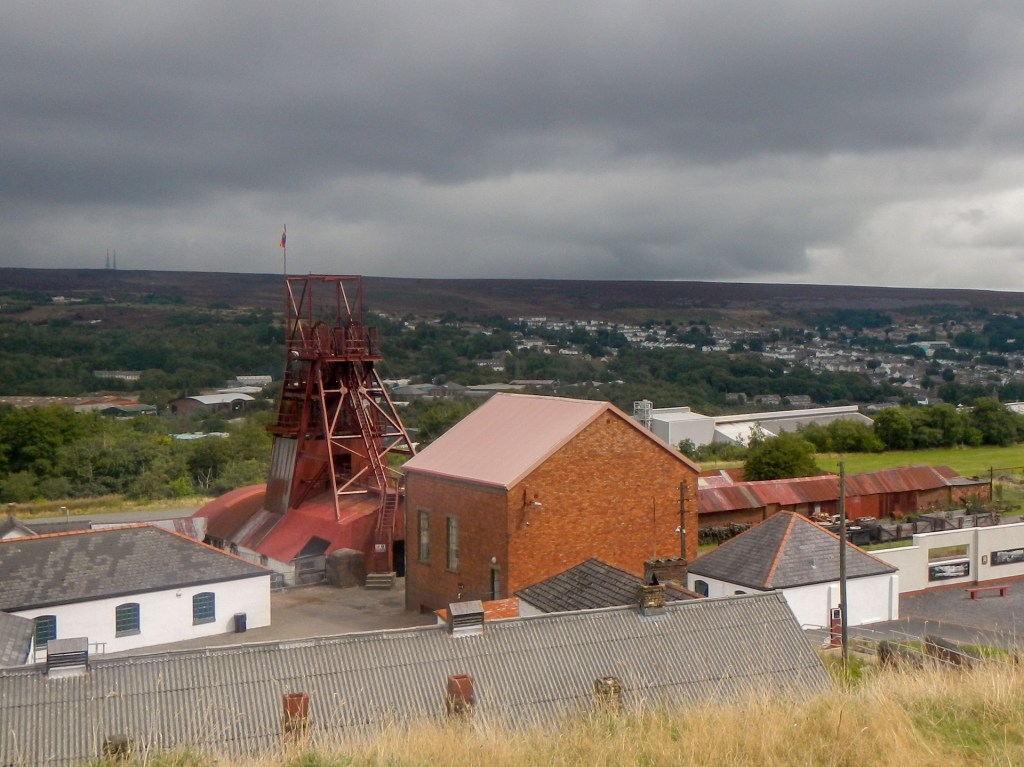
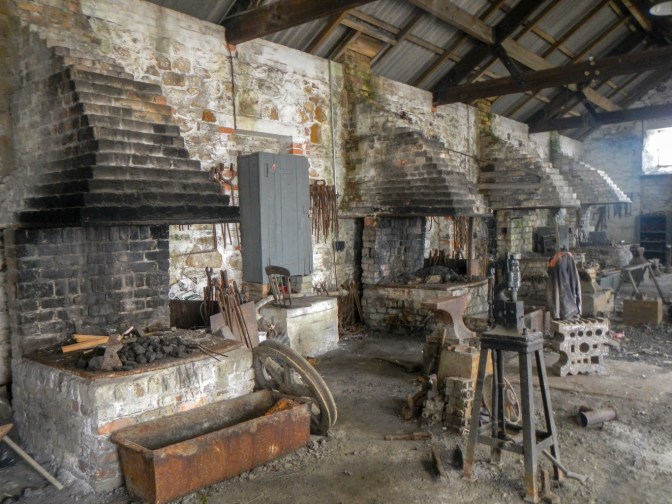
The Big Pit mine was the main attraction, drawing us to visit. This was a working coal mine from the nineteenth century, employing well over a thousand people at its peak in the early twentieth century and then declining and eventually closing in February 1980. The position of Blaenavon near a fault line means that not only coal was available but there was also iron and limestone in the area – all that was needed for smelting iron. There is an old iron works that is open to visitors but our timing and the limitations of my walking ability imposed by my recently fractured ankle meant we didn’t have time to go there as well.
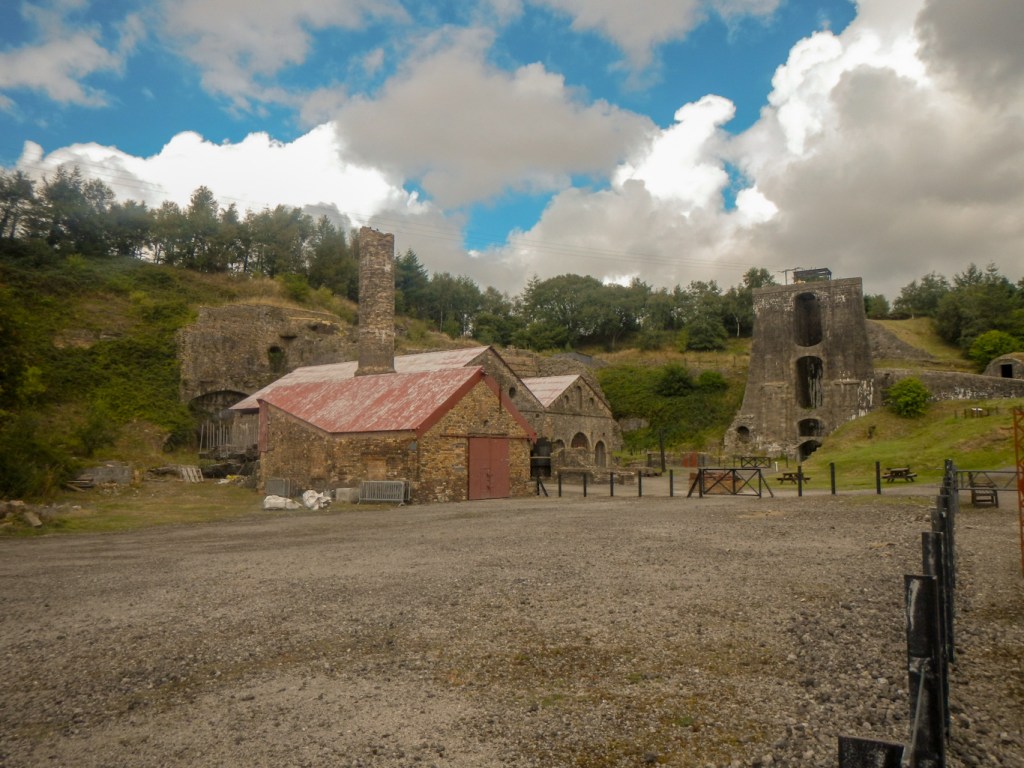
In 2000, UNESCO accepted the Blaenavon Industrial Landscape as a World Heritage Site, in recognition of the important part the area played as the world’s major producer of iron and coal during the Industrial Revolution.
Big Pit is the Welsh National Coal Museum and, as part of the National Museum of Wales, amazingly admission is free. The highlights include the galleries house containing simulated underground workings and a multi-media presentation telling the story of how the Welsh mining industry evolved as well as an enormous display of mining artefacts located within the old Pithead Baths, where the locker rooms and showers remain intact. There was also an interesting temporary exhibition when we visited detailing the work done in the mine by women and young children. Conditions were barbaric and it seems unbelievable that these ways of working were accepted only a few generations ago.
However the major highlight is without doubt the tour underground to look at the mine workings. This is a real adventure! It’s also free of charge, although actually better to book in advance to avoid a potential long wait and there is a small booking donation charged. The tours are in small groups of about 16-17 people.
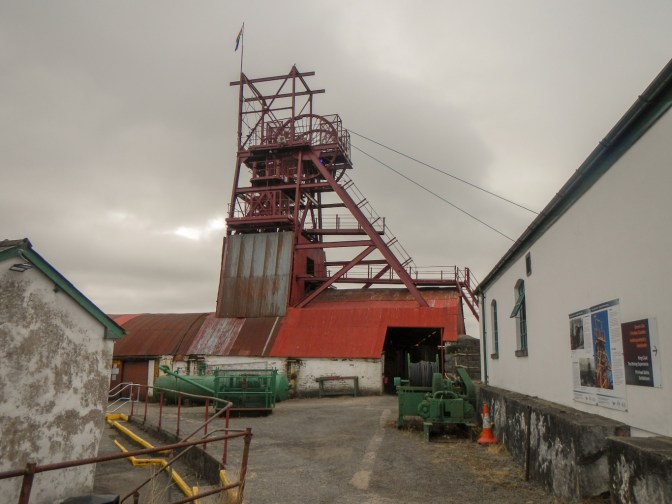
Initially we were shown into a room where we were all kitted out by cheerful ex-miners with the required equipment – a helmet, cap lamp, belt, battery and ‘self rescuer’. The ‘self rescuer’ is a small box (costing about £850) and containing a catalyst which oxidises carbon monoxide and so protects against carbon monoxide poisoning. It gives a survival time of about an hour if it is needed for use – but fortunately isn’t often needed as the miners complete all safety checks on a regular basis and the mine would be closed to visitors if conditions were adverse. We were introduced to our guide, Iain, who explained that we were not permitted to take any batteries underground (apart from the ones sealed and provided by the mine for the cap lamp). This includes car keys and watches; of course cameras are also banned so no photos can be taken. The reason for this is the risk of sparks leading to fire. The mine is still subject to the regulations of a working mine as far as what can be taken underground. Having filled Iain’s “booty bag” which was stowed safely in a locker above ground, we proceeded underground.
All the guides have previously worked as miners either at The Big Pit or at mines in adjacent valleys. Iain had worked in the Six Bells Colliery in nearby Abertillery, as had his father and grandfather. The fact of being guided in the mine by real miners with in-depth lived experience gives the underground tour a special significance; I wonder how this will be once all the ex-miners have retired and indeed whether there will be people with sufficient skills and knowledge to enable this sort of tour to continue.
The experience begins with the group members squeezing into the iron cage to be lowered 90m deep into the mine. Iain explained that we were lowered at a sedate two metres per second rather than the more rapid twenty five metres per second rate used for lowering miners.
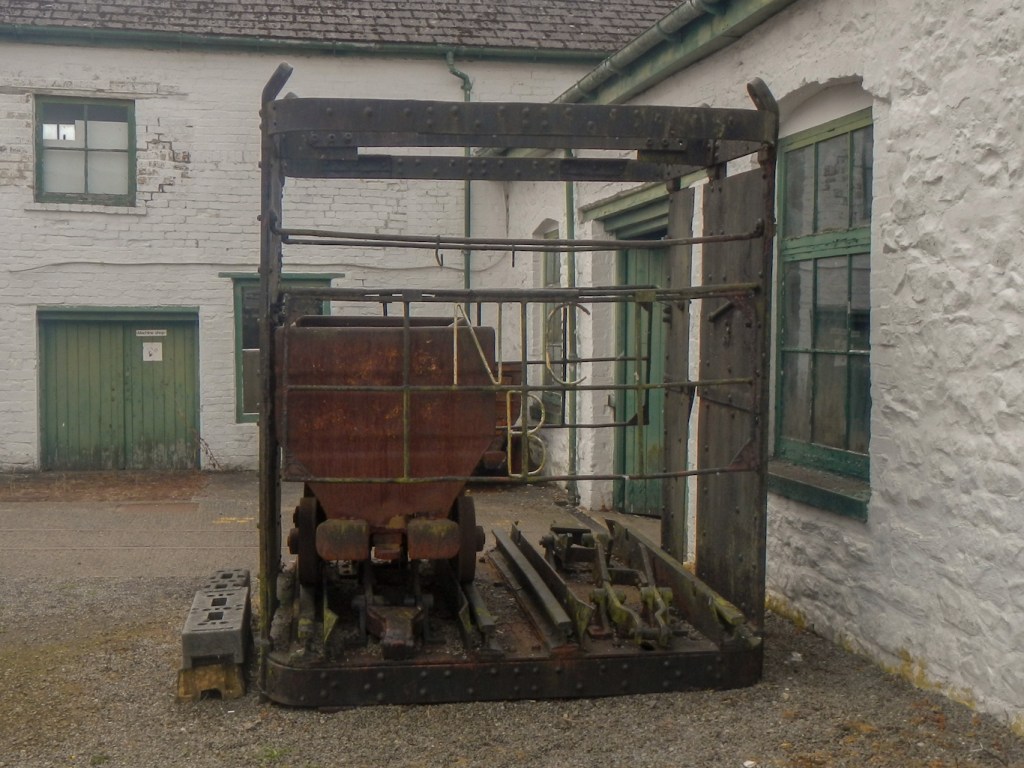
Once below, Iain explained to us that we should walk bending sideways through the tunnels and not bending forward as we needed to be able to see where we were going as well as seeing the roof of the tunnel. He explained that if there was an emergency and the winder for the cage couldn’t be used then there was another way to get out of the mine by walking through tunnels to an opening further down the hillside. He added that for him this would be an hour long walk but for the rest of us unused to walking along low passages by torch light with uneven ground it would probably take two or more hours.

During the tour we visited some coal faces, engine houses and stables where the pit ponies were housed. Each time we stopped, Iain talked to us about an aspect of the mine. At one point we were all asked to turn off our cap lamps to realise how dark it is – totally dark. Iain explained that young children worked in the mine opening and shutting doorways for twelve hour shifts. If they were fortunate they would have the light of a candle but if it blew out or their family could not afford a candle, they would be alone in total blackness for most of their shift. The pit ponies did not see the light of day after they were first lowered into the mine, until 1947, once coal mining had undergone nationalisation, when the pit was closed down for two weeks each year and the ponies would be raised to live in a field for those two weeks. Naturally at the end of the two weeks they tried to resist capture! He explained to us about risks from build up of different gases in the mine, including death from carbon monoxide poisoning even at very small concentrations and risks of explosion due to methane. Nowadays scientific instruments can be used to detect gases but, like most miners, he preferred the old manual ways of detecting gases using a flame safety lamp, and using the instruments more as a confirmation. He explained that the coal was formed from trees over 300 million years ago – indeed once we were back on the surface he showed us a picture of a fossilised tree found in his old workplace at Six Bells colliery.
Iain was clearly incredibly enthusiastic to share his experiences and our tour lasted well over the standard fifty minute time slot. However it was all incredibly fascinating and I had not realised how much time had passed until I was back on the surface and reunited with my watch.
I can certainly recommend this adventure to look at the conditions in which miners work and to hear the stories from true experts who have lived and worked as miners in the area. I think it’s best to do this sooner than later as these miners must be approaching retirement!
We finished our day by strolling back to Blaenavon town centre past the historic iron works and popping into the Blaenavon World Heritage Centre housed in former early 19th century school buildings and featuring a Victorian schoolroom, film and multi-media displays.

 Where's Kathryn?